Why You’re Not Losing Fat in a Calorie Deficit (7 Common Mistakes)
Why You Are Not Losing Fat in a Calorie Deficit

⚡ TL;DR
If you're wondering why you are not losing fat in a calorie deficit, you're not alone—and it's not a failure of willpower. The LION study found that after significant weight loss, metabolic adaptation can reduce resting metabolic rate by an average of 70 kcal/day . Research suggests people underreport calorie intake by hundreds of calories, and fitness trackers often overestimate burn . A 2025 Japanese study confirms that NEAT (non-exercise activity) can drop unconsciously during dieting, costing up to 200-300 calories daily . This guide reveals the 8 hidden reasons fat loss stalls and provides actionable solutions—from protein targets to smart tracking—to finally break through the plateau.
1. The Calorie Deficit Paradox
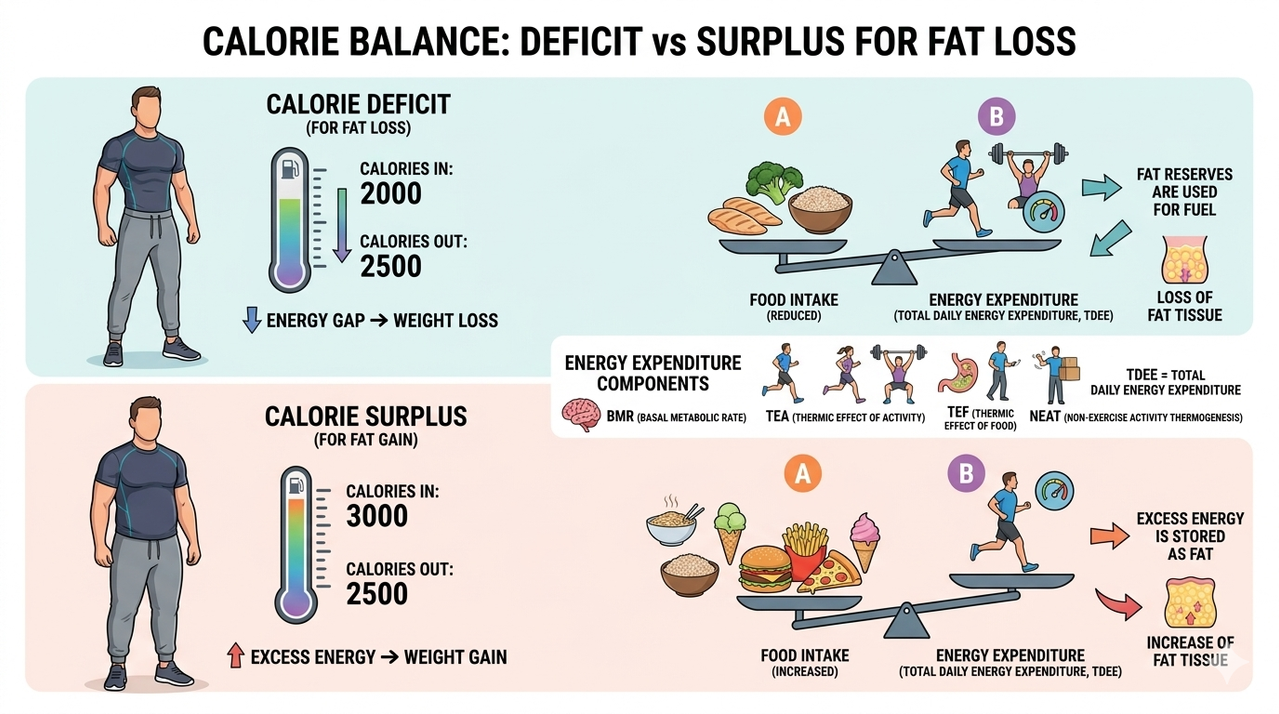
You've done the math. You calculated your maintenance calories, subtracted 500, and you've been meticulously tracking every bite. Yet the scale refuses to move. Your reflection hasn't changed. The frustration is real, and it's enough to make anyone question whether "calories in, calories out" is a lie.
The truth is, the equation isn't wrong—but your body isn't a simple calculator. When you cut calories, your body fights back. A 2025 German study confirmed that caloric restriction induces metabolic adaptation that's directly associated with the amount of weight lost . Understanding why you are not losing fat in a calorie deficit is the first step to outsmarting your biology. This guide uncovers the 8 hidden reasons behind the stall and provides science-backed solutions to restart your progress.
2. The Science: Your Body Fights the Deficit
2.1. Metabolic Adaptation: The LION Study
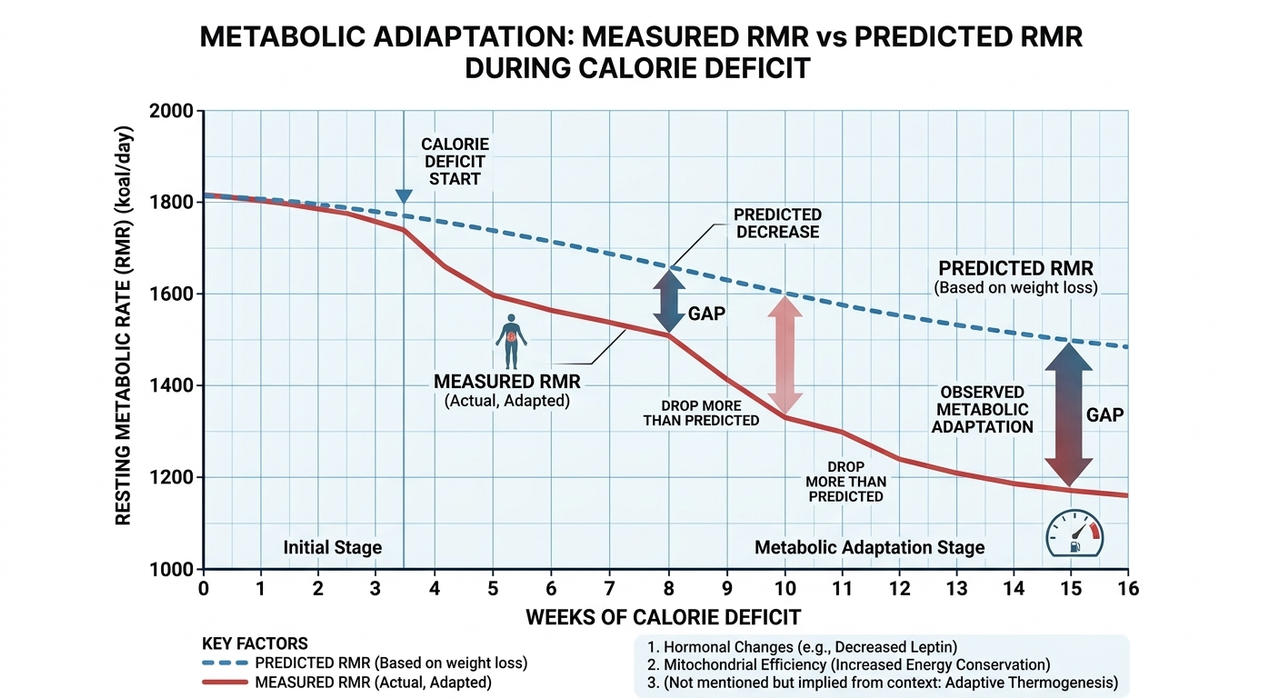
The LION study, published in 2025, tracked 234 participants through weight loss and maintenance. After an 8-week intervention, participants lost an average of 11.7 kg—but their resting metabolic rate dropped by 70.9 kcal/day more than predicted based on their new body composition . This metabolic adaptation persisted, and the change in adaptation was directly associated with the amount of weight lost . Your body literally becomes more efficient at using fewer calories.
2.2. The 2026 Cell Metabolism Breakthrough
New research from the University of Southern Denmark has identified a gene (Plvap) that controls whether the liver burns sugar or fat during fasting. When this gene is turned off in mice, the liver "does not recognize" that the body is fasting and continues burning sugar . While human applications are years away, this confirms that metabolic regulation is far more complex than simple math.
2.3. Why the Scale Lies
One large study found that weight naturally fluctuates by about 0.35% within a single week due to water retention, glycogen stores, and food volume . Carbs bind to water—eating more carbs means more water weight. This can easily mask a pound of fat loss.
3. Hidden Culprit #1: Inaccurate Tracking
3.1. The Underreporting Problem
Research suggests people tend to underreport calorie intake without realizing it . A splash of cream in coffee, cooking oil left unmeasured, or portion sizes estimated instead of weighed can all add up to hundreds of "invisible" calories a day .
3.2. Overestimated Exercise Burn
On the flip side, fitness trackers and gym machines often overestimate how many calories you burn during exercise. They base numbers on broad averages rather than your individual specs, making your deficit look bigger than it really is .
3.3. The "Calibration Week" Solution
Nutritionist Lena Beal recommends using a food scale for a "calibration week" to reset your eye for portion sizes, then putting it away . This helps you spot hidden calories without permanent tracking .
4. Hidden Culprit #2: The NEAT Crash
4.1. What is NEAT?
NEAT (Non-Exercise Activity Thermogenesis) is the energy you burn doing everything that isn't sleeping, eating, or formal exercise . It includes walking, fidgeting, standing, and even typing. NEAT can account for 15-50% of your daily energy expenditure .
4.2. The 2025 Japanese Research
Your body unconsciously moves less when you're in a calorie deficit. Japanese research confirms that this "micro-movement" reduction can significantly impact daily burn . A 2026 Women's Health report notes that increasing NEAT through simple habits like standing, stairs, and walking can add 200-400 calories to your daily burn without structured exercise .
4.3. The "Lazy" Adaptation
When you cut calories, you may sit longer, fidget less, and take the elevator instead of stairs—often without realizing it. This NEAT crash can undo your calorie deficit .
5. Hidden Culprit #3: Inadequate Protein & Muscle Loss
5.1. Protein Preserves Metabolism
During a deficit, protein is crucial for preserving muscle mass. A recent study shared by strength researcher Menno Henselmans found that even intakes as low as 0.6g per pound of body weight can maintain muscle when combined with resistance training, but higher intakes (0.8-1.0g/lb) provide a safety margin .
5.2. The Muscle-Metabolism Connection
Muscle is metabolically active, burning more calories at rest than fat. Losing muscle accelerates metabolic adaptation .
5.3. How Much Do You Need?
For fat loss, aim for at least 1.6g per kg of body weight (0.7g/lb). For a 180 lb person, that's about 126g daily .
6. Hidden Culprit #4: Sleep, Stress, and Cortisol
6.1. The Sleep-Hunger Connection
Research shows that even one night of poor sleep can increase hunger hormones (ghrelin) and decrease satiety hormones (leptin) . Sleep-deprived individuals eat an average of 300 more calories per day .
6.2. Cortisol and Fat Storage
Chronic stress elevates cortisol, which increases appetite, cravings for high-fat and high-sugar foods, and promotes fat storage around the midsection . Stress can also disrupt sleep and reduce motivation for exercise .
6.3. Sleep Requirements
Aim for 7-9 hours of quality sleep nightly to support fat loss and muscle recovery .
7. Hidden Culprit #5: Your Deficit Is Too Aggressive
7.1. The Backfire Effect
Severe restriction can backfire. It triggers intense hunger, low energy, cravings, and increased loss of lean muscle mass—which lowers your resting metabolic rate and slows weight loss .
7.2. The Sustainable Range
Aim for a moderate deficit of 300-500 calories below maintenance. This allows steady fat loss of 0.5-1 lb per week without triggering excessive adaptation .
8. Sample 2000-Calorie Fat-Breaking Meal Plan
This sample plan prioritizes protein and nutrient density to combat metabolic adaptation while keeping you full .
Breakfast (7 AM) – 450 kcal | 35g protein
- 3 eggs scrambled with spinach (18g protein)
- 1 slice whole-grain toast (3g protein)
- 1 cup Greek yogurt (20g protein)
- ½ cup berries
Lunch (12 PM) – 500 kcal | 40g protein
- 5 oz grilled chicken breast (35g protein)
- 2 cups mixed greens with lemon juice
- ½ cup quinoa (4g protein)
- 1 tbsp olive oil
Snack (4 PM) – 200 kcal | 15g protein
- 1 cup cottage cheese (25g protein) or 1 scoop protein shake
Dinner (7 PM) – 600 kcal | 40g protein
- 5 oz salmon or lean beef (35g protein)
- 1 cup roasted broccoli
- 1 medium sweet potato (4g protein)
Total: ~1,750 kcal, ~130g protein
8.1. Vegan/Vegetarian Adaptation
- Replace eggs with tofu scramble (6 oz firm tofu = 15g protein)
- Replace chicken with 6 oz tempeh (30g) or seitan
- Replace salmon with 6 oz extra-firm tofu + 1 cup lentils
- Use pea protein shakes to hit protein targets
- Add nutritional yeast for B12 and protein boost
9. Frequently Asked Questions
Can I really be in a calorie deficit and not lose weight?
Yes. Factors like metabolic adaptation, water retention, tracking errors, and reduced NEAT can mask fat loss for weeks .
How much does metabolic adaptation slow metabolism?
The LION study found an average adaptation of 70 kcal/day after 11.7 kg weight loss, but individual responses vary .
Do I need to count calories forever?
No. A "calibration week" with a food scale can reset your portion awareness. After that, many people maintain without strict tracking .
How many steps should I aim for?
Aim for 8,000-10,000 steps daily to maintain NEAT and support fat loss without formal cardio .
What if I've tried everything and still not losing?
Consult a healthcare provider to check for underlying conditions like hypothyroidism, PCOS, or medication side effects .
10. Related Resources
- Low-Intensity Walking for Fat Loss: Simple Strategy to Burn More Fat
- How to Handle Hunger Pangs During a Strict Cutting Phase (Athlete’s Guide)
- Intermittent Fasting for Bodybuilders: Pros, Cons, and Muscle-Building Truth
- How to Lose Belly Fat Without Losing Muscle (Science-Based Guide)
- Why You’re Not Losing Fat Despite Eating Clean (7 Science-Backed Reasons)
11. Scientific References
- Blanken, C., et al. (2025). Caloric restriction-induced metabolic adaptation associated with amount of body weight lost – results from the LION study. Adipositas, 19(03), 186. View Source
- Ro. (2025). Why Am I Not Losing Weight in a Calorie Deficit? 10 Possible Reasons. ro.co. View Source
- 五藤良將 (Goto, Y.). (2025). 減少內臟脂肪不靠運動也可以!醫推「NEAT減重技巧」. 元氣網. View Source
- 沈宜萱醫師. (2025). 減重不要變成「減肌肉」!醫提4關鍵策略. TVBS健康2.0. View Source
- Pape, P. (2025). Your Macro Tracking App is Too "Dumb" for Real Fat Loss. Wits & Weights Podcast. View Source
- Healthgrades. (2024). Why Am I Not Losing Weight in a Calorie Deficit? healthgrades.com. View Source
- Hansen, D., et al. (2025). Hepatic stellate cells regulate liver fatty acid utilization via plasmalemma vesicle-associated protein. Cell Metabolism. View Source
- Women's Health Taiwan. (2026). 日本研究證實!這「1 個習慣」比跑步更燃脂. womenshealthmag.com. View Source
- Men's Fitness. (2025). Strength Researcher: This is How Much Protein You Really Need to Maintain Muscle During a Cut. mensfitness.com. View Source
- Clisset, C. C. (2026). I Tested a Smart Kitchen Scale, Then Resumed Using a Regular One. The New York Times Wirecutter. View Source
Join the conversation