Best Rest Time Between Sets for Muscle Growth (Science-Based Guide)
Best Rest Time Between Sets for Muscle Growth: Science-Based Guide (2026)
⚡ TL;DR
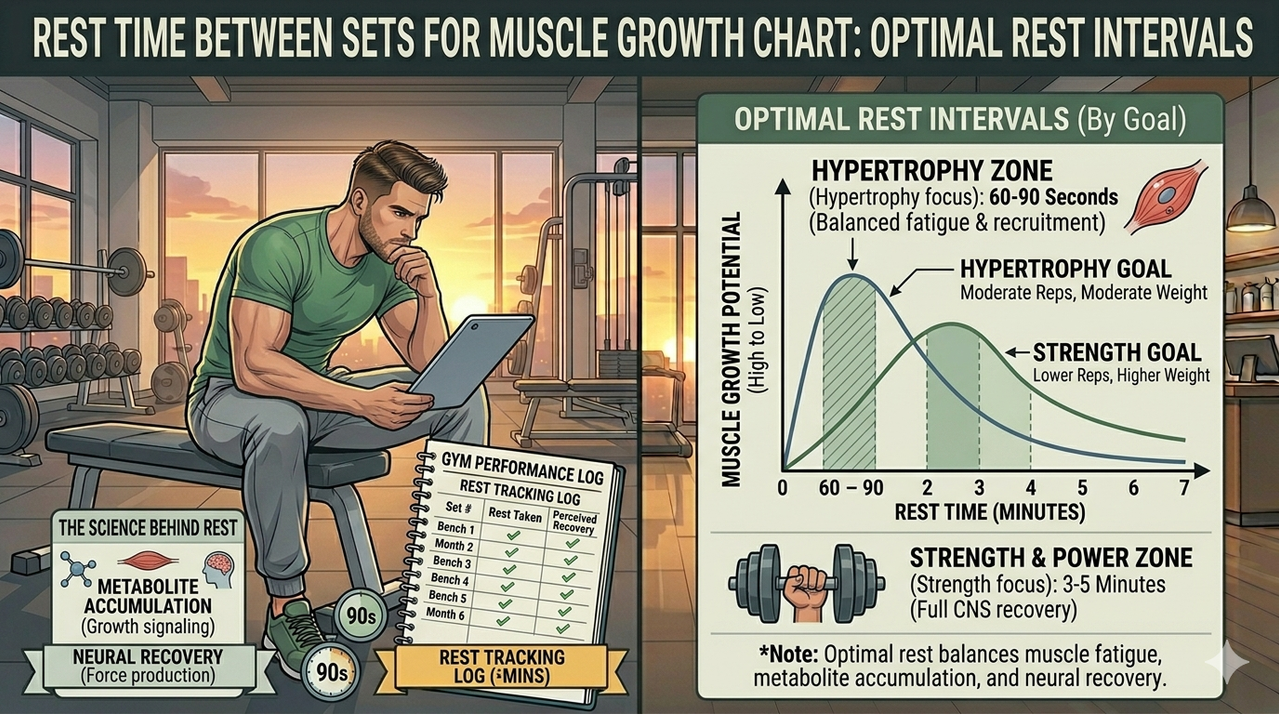
The best rest time between sets for muscle growth is 30-90 seconds for hypertrophy, 2-5 minutes for strength, and 30 seconds or less for endurance. Research shows 60-90 seconds optimizes muscle growth by balancing mechanical tension and metabolic stress . For compound lifts (squat, bench, deadlift), rest 90-120 seconds. For isolation exercises (curls, lateral raises), rest 45-60 seconds. Adjust based on your goal, exercise, and how you feel. If you can't complete target reps, rest longer. Consistency in rest periods is key to progressive overload .
1. The Rest Period Question: How Long Should You Wait?
You finish a set. You look at your phone. How long until the next set? The answer—rest time between sets for muscle growth—isn't one-size-fits-all. It depends on your goal: hypertrophy (muscle growth), strength, or endurance. Understanding how long to rest between sets can dramatically impact your results. This hypertrophy rest time guide provides evidence-based recommendations for rest periods bodybuilding and general fitness.
How long should you rest between sets for muscle growth?
How long should you rest between sets for muscle growth? For muscle growth (hypertrophy), rest 30-90 seconds between sets. For strength focus, rest 2-3 minutes. For endurance, rest 30 seconds or less. The optimal rest period depends on your goal, exercise type (compound vs isolation), and intensity. Shorter rest increases metabolic stress; longer rest allows greater force production.
2. The Science: What Happens During Rest
Rest periods allow your body to recover between sets. Key processes:
- ATP replenishment: Adenosine triphosphate (energy) replenishes 70% in 30 seconds, 100% in 3-5 minutes
- Metabolite clearance: Lactic acid and hydrogen ions are cleared, reducing fatigue
- Neural recovery: Central nervous system resets, allowing maximum muscle recruitment
- Muscle oxygenation: Blood flow delivers oxygen and removes waste products
📊 ATP Replenishment by Rest Time
3. Rest Periods by Training Goal
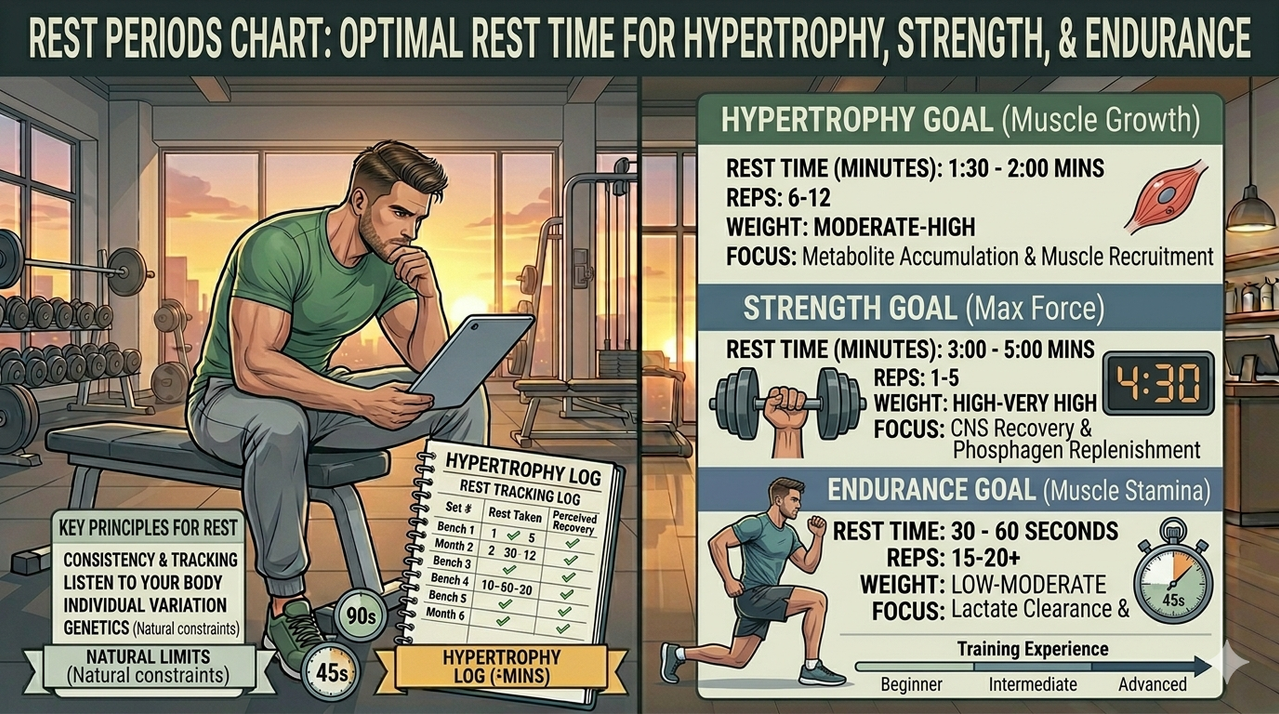
Hypertrophy (Muscle Growth) – 30-90 Seconds
Research shows 60-90 seconds rest optimizes muscle growth . Shorter rest (30-60 seconds) increases metabolic stress (muscle pump), which promotes hypertrophy. However, too short rest (<30 seconds) reduces performance, limiting total volume.
Strength – 2-5 Minutes
For heavy lifting (1-5 reps), rest 2-5 minutes. This allows ATP replenishment and neural recovery, enabling maximum force production .
Endurance – 30 Seconds or Less
For muscular endurance (15+ reps), rest 30 seconds or less. This maintains metabolic stress and improves fatigue resistance .
4. Compound vs Isolation Exercises
- Compound exercises (squat, deadlift, bench press): Rest 90-120 seconds. These involve more muscle mass and are more fatiguing.
- Isolation exercises (curls, lateral raises, leg extensions): Rest 45-60 seconds. Less muscle mass, faster recovery.
5. How Rest Affects Volume and Intensity
Research shows total volume (sets × reps × weight) is the primary driver of hypertrophy. Rest periods affect your ability to maintain volume:
- Shorter rest (<60 seconds): May reduce weight/reps in later sets, decreasing total volume
- Optimal rest (60-90 seconds): Maintains performance while providing metabolic stress
- Longer rest (>2 minutes): Allows higher intensity but may reduce metabolic stress
6. Sample Rest Period Protocols
Full Body Hypertrophy (3 days/week)
- Compound lifts (squat, bench, row): 90-120 seconds rest
- Isolation lifts (curls, lateral raises): 45-60 seconds rest
- Total workout time: 50-70 minutes
Upper/Lower Strength (4 days/week)
- Main lifts (squat, deadlift, bench): 3-5 minutes rest
- Accessory lifts: 60-90 seconds rest
- Total workout time: 60-90 minutes
High Volume Bodybuilding (5 days/week)
- Compound lifts: 60-90 seconds rest
- Isolation lifts: 30-45 seconds rest
- Total workout time: 45-60 minutes
7. Nutrition to Support Rest Periods
Proper nutrition helps you recover between sets and sessions:
- Pre-workout: Carbs 30-60 minutes before (energy for training)
- Intra-workout: Water (2-3 liters throughout training)
- Post-workout: Protein + carbs within 30-60 minutes
Sample Pre-Workout Meal (1 hour before)
- 1 banana + 1 tbsp peanut butter (200 kcal, 5g protein)
- OR 1 cup oats + 1 scoop protein (400 kcal, 25g protein)
Vegan/Vegetarian Pre-Workout Options
- 1 banana + 1 tbsp almond butter (200 kcal)
- 1 cup oats + 1 scoop plant protein + 1 cup oat milk (450 kcal, 25g protein)
Gluten-Free Options
- Use certified gluten-free oats
- Choose rice cakes or bananas for quick carbs
- Verify protein powders are gluten-free certified
8. Common Rest Period Mistakes
- Resting too short: Reduces performance, limiting total volume and intensity
- Resting too long: Reduces metabolic stress, extends workout duration unnecessarily
- Inconsistent rest: Makes progressive overload tracking difficult
- Distracted resting: Scrolling phone for 3+ minutes without purpose
- Not adjusting for fatigue: Using same rest time for heavy deadlifts and bicep curls
9. Quick Reference: Rest Times by Exercise
- Squat (heavy, 3-5 reps): 3-5 minutes rest
- Deadlift (heavy, 3-5 reps): 3-5 minutes rest
- Bench press (8-12 reps): 60-90 seconds rest
- Overhead press (8-12 reps): 60-90 seconds rest
- Rows/Pull-ups (8-12 reps): 60-90 seconds rest
- Bicep curls (10-15 reps): 30-45 seconds rest
- Triceps extensions (10-15 reps): 30-45 seconds rest
- Lateral raises (12-15 reps): 30-45 seconds rest
10. Frequently Asked Questions
How long should you rest between sets for muscle growth?
For muscle growth (hypertrophy), rest 30-90 seconds between sets. For strength focus, rest 2-3 minutes. For endurance, rest 30 seconds or less. The optimal rest period depends on your goal, exercise type (compound vs isolation), and intensity. Shorter rest increases metabolic stress; longer rest allows greater force production.
What is the best rest time for hypertrophy?
Research shows 60-90 seconds rest between sets optimizes muscle growth for most exercises. Shorter rest (30-60 seconds) increases metabolic stress, which promotes hypertrophy. Longer rest (2-3 minutes) allows greater volume but may reduce metabolic stress. For compound lifts, rest 90-120 seconds; for isolation, rest 45-60 seconds.
Does longer rest build more muscle?
Research suggests moderate rest (60-90 seconds) is optimal for hypertrophy. Very short rest (<30 seconds) reduces performance, limiting total volume. Very long rest (3-5 minutes) may reduce metabolic stress, though some studies show comparable growth with longer rest when volume is matched. For most lifters, 60-90 seconds is the sweet spot.
How long to rest between sets for strength?
For strength training (1-5 reps, heavy weight), rest 2-5 minutes between sets. Longer rest allows ATP replenishment (70% in 30 seconds, 100% in 3-5 minutes) and neural recovery, enabling maximum force production in subsequent sets. Resting less than 2 minutes reduces strength performance by 10-20%.
Does rest time affect muscle growth?
Yes, rest time significantly affects muscle growth through two mechanisms: mechanical tension (force production) and metabolic stress (muscle pump). Shorter rest increases metabolic stress and growth hormone response. Longer rest allows greater volume and intensity. Optimal rest balances both: 60-90 seconds for most exercises.
Should I rest longer for compound exercises?
Yes, compound exercises (squat, deadlift, bench press) require longer rest than isolation exercises because they involve more muscle mass and are more fatiguing. Rest 90-120 seconds for compound lifts. For isolation exercises (curls, lateral raises), rest 45-60 seconds. Adjust based on how you feel—if you can't complete target reps, rest longer.
11. Related Resources
- How to Train for Size Instead of Strength (Hypertrophy Training Guide)
- Best Bulking Routine for Skinny Guys (Fast Muscle Gain Plan)
- Why Beginners Gain Muscle Faster (Newbie Gains Explained)
- How to Stay Lean While Gaining Muscle (Lean Bulking Guide)
- Best Snacks for Bulking and Muscle Growth (High-Protein & High-Calorie)
- How to Increase Appetite for Bulking (Proven Natural Tips)
12. Scientific References
- Schoenfeld, B. J., et al. (2016). Effects of different rest intervals on muscle hypertrophy: a systematic review and meta-analysis. Sports Medicine, 46(4), 533–543. PubMed
- Grgic, J., et al. (2018). Effects of rest interval duration on resistance training performance: a systematic review and meta-analysis. Journal of Strength and Conditioning Research, 32(12), 3581–3590. PubMed
- Willardson, J. M., & Burkett, L. N. (2006). The effect of rest interval length on the sustainability of squat and bench press repetitions. Journal of Strength and Conditioning Research, 20(2), 400–403. PubMed
- Morton, R. W., et al. (2018). A systematic review, meta-analysis and meta-regression of the effect of protein supplementation on resistance training-induced gains in muscle mass and strength. British Journal of Sports Medicine, 52(6), 376–384. PubMed
- ACSM. (2021). Nutrition and Athletic Performance. Medicine & Science in Sports & Exercise, 53(3), 600–618. PubMed
Join the conversation