Why Beginners Gain Muscle Faster (Newbie Gains Explained)
Why Beginners Gain Muscle Faster: Newbie Gains Explained (2026)
⚡ TL;DR
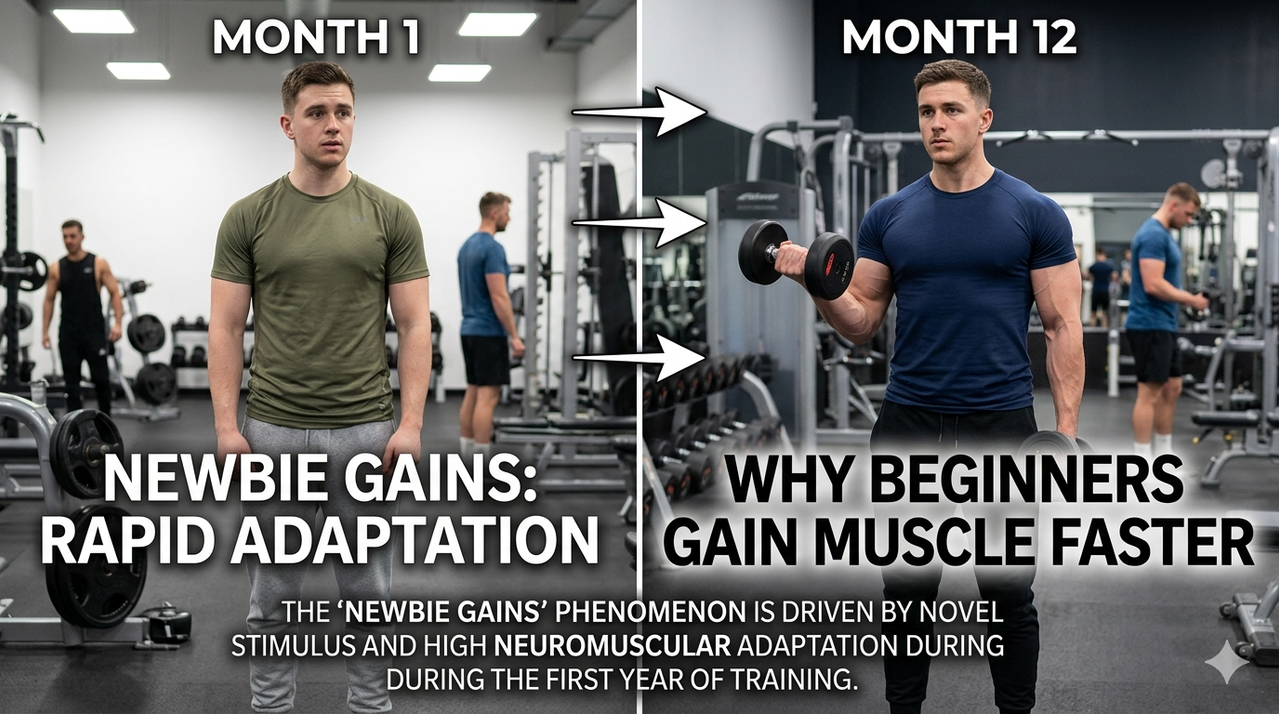
Why beginners gain muscle faster is due to the "newbie gains" phenomenon. Newbie gains explained: the body responds explosively to a new training stimulus, neural adaptations occur rapidly, recovery capacity is high, and the starting baseline is low. Muscle growth beginners can achieve 0.5–1 kg (1–2 lbs) of muscle per month in the first year—far exceeding advanced lifters. This window typically lasts 6–12 months. To maximize how fast beginners build muscle, focus on compound lifts, progressive overload, adequate protein (1.6–2.2 g/kg), and a moderate calorie surplus .
1. The Beginner's Advantage: Why Everything Grows Fast
You've probably seen it: a friend starts lifting and within months looks completely transformed. Meanwhile, experienced lifters grind for years to add a few pounds of muscle. This phenomenon—why beginners gain muscle faster—is one of the most fascinating aspects of human physiology. Newbie gains explained involves multiple biological mechanisms that create a perfect storm for rapid muscle growth. Understanding muscle growth beginners rate helps both new lifters maximize this window and experienced athletes appreciate why progress slows.
Why do beginners gain muscle so fast?
Why do beginners gain muscle so fast? Because: body responds quickly to new stimulus (training shock activates dormant systems), rapid neural adaptations improve strength within weeks, better recovery capacity with less accumulated fatigue, and low starting baseline means significant relative gains. This combination creates the 'newbie gains' phenomenon.
2. The Science of Newbie Gains: What's Happening Inside
Newbie gains explained requires understanding multiple physiological adaptations that occur simultaneously in untrained individuals.
2.1. Neural Adaptations
In the first 4–8 weeks, most strength gains come from improved neural efficiency. The brain learns to recruit more motor units, fire them synchronously, and reduce antagonist co-contraction. This explains why beginners often double their strength in months without significant muscle size increase initially .
2.2. Muscle Protein Synthesis (MPS) Sensitivity
Untrained muscles are exquisitely sensitive to training stimuli. A single workout can elevate MPS for 48–72 hours (versus 24–36 hours in trained individuals). This prolonged anabolic response accelerates growth .
2.3. Satellite Cell Activation
Beginners have a larger pool of dormant satellite cells that rapidly activate and donate nuclei to growing muscle fibers. This increases the fiber's capacity to synthesize protein .
📊 Muscle Growth Rate by Training Experience
| Experience Level | Monthly Muscle Gain (Men) | Monthly Muscle Gain (Women) | Duration |
|---|---|---|---|
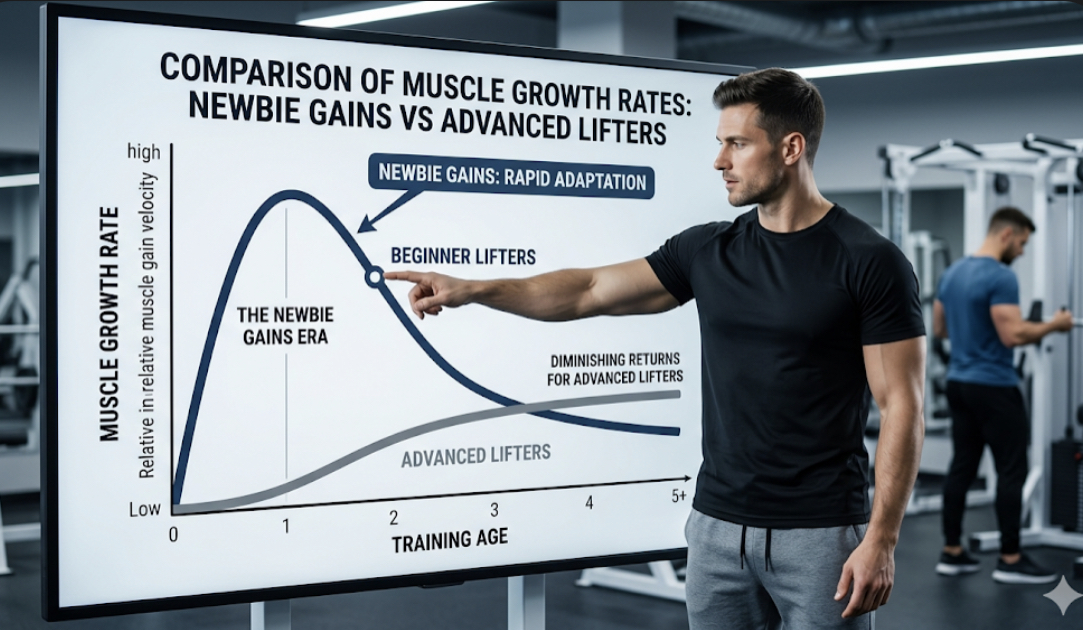
| Beginner (0-12 months) | 0.5–1.0 kg (1–2 lbs) | 0.25–0.5 kg (0.5–1 lb) | First year |
| Intermediate (1-3 years) | 0.25–0.5 kg (0.5–1 lb) | 0.1–0.25 kg (0.2–0.5 lb) | Ongoing |
| Advanced (3+ years) | 0.1–0.25 kg (0.2–0.5 lb) | 0.05–0.1 kg (0.1–0.2 lb) | Years |

3. How Long Do Newbie Gains Last?
The rapid growth phase typically lasts 6–12 months of consistent training. By 12–18 months, the rate of muscle gain decreases by 50% or more. This doesn't mean progress stops—it simply requires more sophisticated programming and patience .
3.1. Factors That Influence Duration
- Consistency: Those who train consistently for 12 months maximize the window
- Nutrition: Adequate protein and calorie surplus extend the rapid phase
- Sleep: 7–9 hours nightly supports optimal recovery
- Training intensity: Progressive overload keeps stimulus high
- Starting point: Very sedentary individuals may have longer newbie gain period
4. Maximizing Beginner Muscle Growth: Nutrition
4.1. Caloric Intake
To maximize how fast beginners build muscle, maintain a moderate surplus of 250–500 kcal above maintenance. This supports muscle synthesis without excessive fat gain. Track weekly weight: aim for 0.25–0.5% body weight gain .
4.2. Protein: The Foundation
Consume 1.6–2.2 g protein per kg body weight daily. For an 80 kg beginner: 128–176 g protein. Spread across 3–5 meals with 20–40 g per meal to maximize MPS .
4.3. Sample Beginner Meal Plan (2,800–3,000 kcal)
- Breakfast: 3 eggs, 1 cup oats, 1 banana, 1 tbsp peanut butter (650 kcal, 35g protein)
- Lunch: 150g chicken breast, 1.5 cups rice, 1 cup vegetables (550 kcal, 40g protein)
- Pre-Workout: 1 cup Greek yogurt, 1 apple (250 kcal, 22g protein)
- Post-Workout: 1 scoop whey, 1 banana (250 kcal, 25g protein)
- Dinner: 150g lean beef, 1.5 cups sweet potato, 1 tbsp olive oil, vegetables (650 kcal, 38g protein)
- Evening: 1 cup cottage cheese (200 kcal, 25g protein)
Vegan/Vegetarian Beginner Plan
- Replace chicken with tempeh or seitan (150g)
- Replace whey with pea/rice protein blend
- Replace eggs with tofu scramble (200g)
- Include edamame, lentils, and quinoa for protein
Gluten-Free Options
- Use certified gluten-free oats
- Choose rice, quinoa, buckwheat
- Verify protein powders are gluten-free certified
5. Training to Maximize Newbie Gains
5.1. The Full-Body Approach
For beginners, full-body workouts 3 times per week are optimal. This frequency allows training each muscle group 2–3 times weekly, maximizing MPS while allowing adequate recovery .
5.2. Compound Exercises First
Focus on multi-joint movements: squat, deadlift, bench press, overhead press, rows, pull-ups. These recruit the most muscle mass and stimulate the greatest hormonal response .
5.3. Progressive Overload
Each week, aim to add weight, reps, or sets. Beginners can typically add 2.5–5 kg to compound lifts weekly. This progressive overload is the primary driver of continued growth .
5.4. Sample Beginner Full-Body Routine (3x/week)
- Workout A: Squat 3×8–10, Bench Press 3×8–10, Bent-over Row 3×8–10, Plank 3×45s
- Workout B: Deadlift 3×5, Overhead Press 3×8–10, Pull-ups or Lat Pulldown 3×8–10, Leg Raises 3×12
- Alternate A/B every other training day. Add weight when you hit top rep range.
6. Recovery: The Secret to Consistent Gains
While beginners recover faster than advanced lifters, recovery still must be prioritized:
- Sleep: 7–9 hours nightly. Sleep is when MPS peaks and growth hormone is released
- Rest days: Take at least 1 rest day between full-body workouts
- Deload weeks: Every 8–10 weeks, reduce volume by 40–50% to prevent overtraining
- Hydration: 2.5–3.5 liters water daily supports protein synthesis
7. Common Beginner Mistakes That Slow Gains
- Not eating enough: Undereating is the #1 reason beginners plateau
- Overtraining: Training 6 days/week as a beginner can exceed recovery capacity
- Poor form: Ego lifting with bad form reduces muscle activation and increases injury risk
- Inconsistent training: Missing weeks resets neural adaptations
- Ignoring compound lifts: Isolation exercises alone don't maximize newbie gains
- No progressive overload: Doing the same weight/reps weekly leads to plateaus
- Inadequate sleep: Sleep deprivation impairs MPS and recovery
8. Quick Beginner-Friendly Recipes
- Beginner Mass Shake (600 kcal, 40g protein): 1 cup milk, 1 scoop whey, 1 banana, 1 tbsp peanut butter, ½ cup oats
- Simple Chicken & Rice (550 kcal, 45g protein): 150g chicken, 1.5 cups rice, 1 tbsp olive oil
- Protein Oatmeal (500 kcal, 30g protein): 1 cup oats, 1 cup milk, 1 scoop protein powder, 1 banana
9. Frequently Asked Questions
Why do beginners gain muscle so fast?
Beginners gain muscle so fast because: the body responds quickly to a new stimulus (training shock), rapid neural adaptations improve strength and coordination, better recovery capacity with less accumulated fatigue, and a low starting baseline means significant relative gains. This combination creates the 'newbie gains' phenomenon.
How much muscle can a beginner gain?
A beginner can gain 0.5-1 kg (1-2 lbs) of muscle per month in the first year of training. This is significantly faster than intermediate lifters (0.25-0.5 kg/month) and advanced lifters (0.1-0.25 kg/month). Total first-year muscle gain potential is 10-12 kg (22-26 lbs) under optimal conditions.
How long do newbie gains last?
Newbie gains typically last 6-12 months of consistent training. The rapid growth phase begins to slow after 6-8 months, with the rate of muscle gain decreasing by 50% or more after the first year. By 18-24 months of consistent training, you're considered intermediate.
What is the best workout for beginners to maximize newbie gains?
The best workout for beginners is a full-body routine performed 3 times per week, focusing on compound exercises (squat, deadlift, bench press, overhead press, rows). Aim for 3-4 sets of 8-12 reps per exercise. This frequency allows optimal recovery while providing sufficient stimulus for muscle growth.
Can beginners build muscle without weights?
Yes, beginners can build significant muscle with bodyweight exercises. The initial neural adaptations and muscle growth don't require heavy weights. Push-ups, squats, lunges, and rows can produce excellent results in the first 3-6 months when performed with progressive overload (increasing reps, sets, or difficulty).
Do newbie gains require a calorie surplus?
Yes, to maximize newbie gains, a moderate calorie surplus (250-500 kcal above maintenance) is recommended. While beginners can build muscle in a slight deficit if they have excess body fat, a surplus accelerates growth. Protein intake should be 1.6-2.2 g per kg body weight.
10. Related Resources
- How to Fix a Failed Bulking Phase (Step-by-Step Recovery Guide)
- Signs Your Bulk Is Working (Or Failing): How to Track Progress Correctly
- How Many Calories Do You Need to Build Muscle? (Complete Guide)
- Why Your Muscles Are Not Growing (Even If You Train Hard)
- Best Meal Timing for Muscle Growth Beginners (When to Eat for Results)
- Can You Build Muscle Without Supplements? (Natural Muscle Growth Guide)
- How to Know If You’re Gaining Muscle or Fat (Simple Tracking Guide)
11. Scientific References
- Morton, R. W., et al. (2018). A systematic review, meta-analysis and meta-regression of the effect of protein supplementation on resistance training-induced gains in muscle mass and strength. British Journal of Sports Medicine, 52(6), 376–384. PubMed
- Schoenfeld, B. J., et al. (2017). Effects of different weekly sets-equated resistance training frequencies on muscular strength, muscle hypertrophy, and body composition. Journal of Strength and Conditioning Research, 31(12), 3271–3278. PubMed
- Helms, E. R., et al. (2014). Evidence-based recommendations for natural bodybuilding contest preparation. Journal of the International Society of Sports Nutrition, 11(1), 20. PubMed
- Damas, F., et al. (2016). A review of resistance training-induced changes in skeletal muscle protein synthesis and their contribution to muscle hypertrophy. Sports Medicine, 46(3), 319–330. PubMed
- Krieger, J. W. (2010). Single vs. multiple sets of resistance exercise for muscle hypertrophy: a meta-analysis. Journal of Strength and Conditioning Research, 24(4), 1150–1159. PubMed
- Kerksick, C. M., et al. (2018). ISSN exercise & sports nutrition review update. Journal of the International Society of Sports Nutrition, 15(1), 38. PubMed
- ACSM. (2021). Nutrition and Athletic Performance. Medicine & Science in Sports & Exercise, 53(3), 600–618. PubMed
Join the conversation