Best Time to Work Out for Muscle Growth (Morning vs Evening Guide)

Discover the best time to work out for muscle growth and whether morning or evening training is better.
Best Time to Work Out for Muscle Growth: Morning vs Evening Guide (2026)
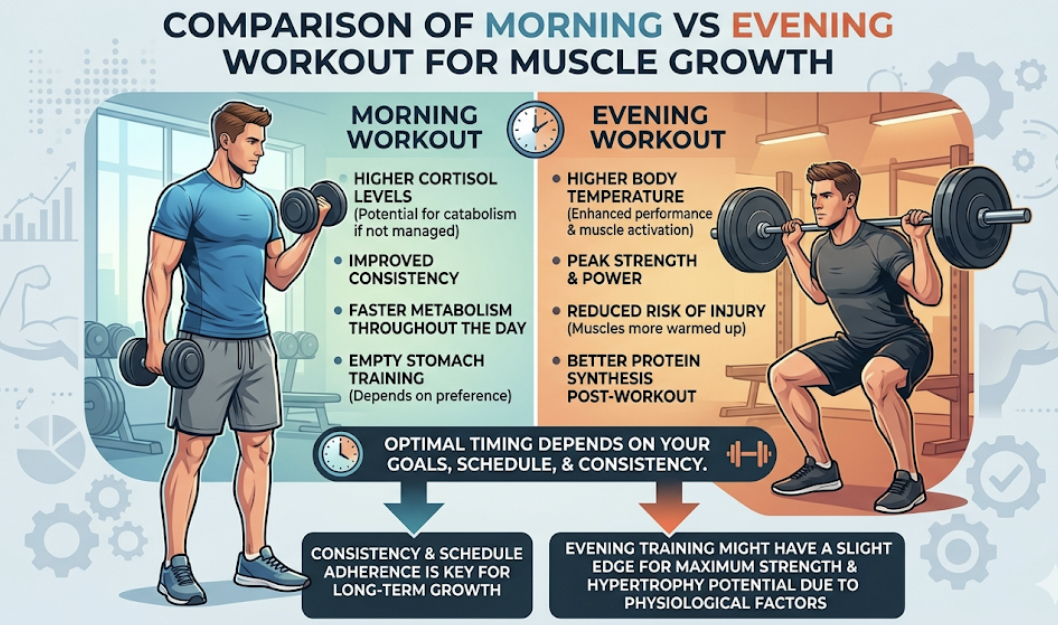
Best Time to Work Out for Muscle Growth: Morning vs Evening Guide (2026)

Infographic comparing morning vs evening workout for muscle growth showing optimal workout time
Image 1: The best time to work out is the time you can stick to consistently.

⚡ TL;DR

The best time to workout for muscle growth depends on your schedule and preference. Morning vs evening workout research shows: evening workouts (4-8 PM) offer slight performance advantages (higher strength, power, lower injury risk) due to peak body temperature and hormones. Morning workouts (6-10 AM) improve consistency and habit formation. However, muscle growth is similar when training volume and intensity are matched. The optimal workout time is whatever allows you to train consistently. Consistency beats perfect timing every time .

1. The Timing Debate: Does It Really Matter When You Train?

You've heard morning people swear by 5 AM workouts. Evening exercisers claim better performance at 6 PM. Who's right? The answer to best time to workout for muscle growth is more nuanced than you might think. This morning vs evening workout guide examines the science behind workout timing for muscle growth and helps you choose the optimal workout time for your lifestyle. Spoiler: consistency trumps perfect timing.

What is the best time to work out for muscle growth?

What is the best time to work out for muscle growth? There's no single best time for everyone. Evening workouts (4-8 PM) offer slight performance advantages (higher strength, power, lower injury risk). Morning workouts (6-10 AM) improve consistency and habit formation. The best time is whatever you can stick to consistently. Research shows muscle growth is similar when volume and intensity are matched.
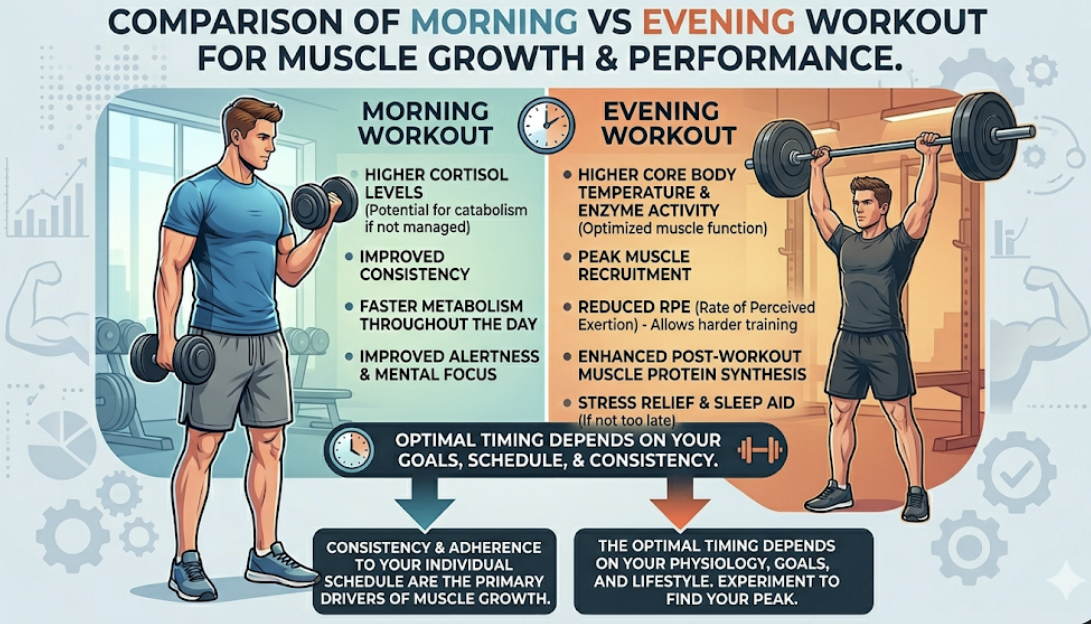
Circadian rhythm and performance chart showing morning vs evening workout effects on strength and hormones
Image 2: Both morning and evening workouts can build muscle effectively when done consistently.

2. The Science: Circadian Rhythms and Performance

Your body's internal clock (circadian rhythm) affects physical performance. Key factors:

  • Body temperature: Peaks in late afternoon (4-6 PM), improving muscle contractility
  • Testosterone: Baseline peaks in morning (8-10 AM), acute response higher in evening
  • Cortisol: Highest in morning, may impair performance slightly
  • Reaction time: Faster in afternoon/evening
  • Perceived effort: Lower in evening (workouts feel easier)

📊 Physiological Factors by Time of Day

.= "Body temperature" ? 'Body temperature' : '' ?>Body temperature .= "Testosterone (baseline)" ? 'Testosterone (baseline)' : '' ?>Testosterone (baseline) .= "Cortisol" ? 'Cortisol' : '' ?>Cortisol .= "Reaction time" ? 'Reaction time' : '' ?>Reaction time .= "Strength output" ? 'Strength output' : '' ?>Strength output .= "Injury risk" ? 'Injury risk' : '' ?>Injury risk

3. Morning Workouts: Pros and Cons

Pros

  • Consistency: Fewer schedule conflicts, higher adherence rates
  • Habit formation: Morning routines stick better for many people
  • Metabolism boost: May increase calorie burn throughout the day
  • Mental clarity: Exercise improves focus for the workday
  • Less crowded: Gyms quieter in early morning

Cons

  • Lower body temperature: Requires longer warm-up (10-15 minutes)
  • Higher injury risk: Cold muscles more susceptible to strains
  • Lower strength: 5-10% lower performance compared to evening
  • Fasted training issues: May feel weaker without pre-workout fuel

4. Evening Workouts: Pros and Cons

Pros

  • Peak performance: Higher strength, power, endurance (5-10% better)
  • Lower injury risk: Warmer muscles, better joint mobility
  • Stress relief: Great way to decompress after work
  • Social opportunities: Easier to train with friends
  • Fully fueled: Multiple meals before training

Cons

  • Schedule conflicts: Work, family, social events interfere
  • Fatigue: Long workday may reduce motivation
  • Crowded gyms: Peak hours (5-7 PM) busiest
  • Sleep disruption: Intense evening workouts may affect sleep for some

5. What Does the Research Say About Muscle Growth?

Several studies have compared muscle growth between morning and evening training:

  • 2019 study: No significant difference in muscle growth between morning and evening training over 10 weeks
  • 2021 meta-analysis: Evening training showed slight strength advantages, but muscle growth was similar
  • Key finding: Consistency and total volume matter more than timing
💡 Key Insight: If you train consistently with progressive overload, your muscles will grow regardless of whether you train at 6 AM or 6 PM.

6. Nutrition Timing for Morning vs Evening Workouts

Morning Workout Nutrition

  • Option 1 (fasted): Train on empty stomach (fine for some, but performance may suffer)
  • Option 2 (light snack): Banana + coffee 30 min before (150-200 kcal)
  • Option 3 (full meal): Wake earlier, eat 2 hours before (400-600 kcal)
  • Post-workout: Protein + carbs within 2 hours

Evening Workout Nutrition

  • Pre-workout meal (2-3 hours before): Carbs + protein (400-600 kcal)
  • Pre-workout snack (30-60 min before): Banana or small carb source
  • Post-workout: Protein + carbs for recovery
  • Avoid heavy meals right before bed (if training late)

Sample Pre-Workout Meals by Time

  • Morning (5 AM): 1 banana + black coffee (150 kcal, 2g protein)
  • Morning (7 AM - full meal): 2 eggs + 1 cup oats (450 kcal, 20g protein)
  • Evening (5 PM): 150g chicken + 1 cup rice + vegetables (500 kcal, 35g protein)
  • Evening (6 PM - snack): 1 apple + 1 tbsp peanut butter (200 kcal, 5g protein)

Vegan/Vegetarian Options

  • Morning: 1 banana + 1 tbsp almond butter + plant protein shake (300 kcal, 25g protein)
  • Evening: 150g tempeh + 1 cup quinoa + vegetables (550 kcal, 30g protein)

Gluten-Free Options

  • Use certified gluten-free oats
  • Choose rice, quinoa, buckwheat
  • Verify protein sources are gluten-free certified

7. How to Make Morning Workouts More Effective

  • Extended warm-up: 10-15 minutes dynamic stretching (body temperature lower in morning)
  • Pre-workout nutrition: Light snack (banana, coffee) if needed
  • Consistent sleep schedule: 7-9 hours for recovery
  • Prepare night before: Lay out clothes, pack gym bag
  • Gradual progression: Expect 5-10% lower strength initially—this improves with adaptation

8. How to Make Evening Workouts More Effective

  • Avoid late-night intense training: Can disrupt sleep for some individuals
  • Manage schedule: Block time in calendar like a meeting
  • Pre-workout meal timing: Eat 2-3 hours before to avoid digestive issues
  • Deal with fatigue: Caffeine or light movement can boost energy
  • Post-workout wind-down: Light stretching, cool shower to promote sleep

9. Sample Weekly Schedule by Preference

Morning Training Schedule (5-7 AM)

  • Wake at 5:00 AM, light snack, warm-up
  • 5:30-6:30 AM: Workout
  • 6:30-7:00 AM: Cool-down, breakfast
  • Benefits: Done before work, consistent

Evening Training Schedule (5-7 PM)

  • Work day, snack at 4:00 PM
  • 5:00-6:00 PM: Workout (peak performance time)
  • 6:00-7:00 PM: Post-workout meal, dinner
  • Benefits: Higher strength, stress relief

10. Frequently Asked Questions

What is the best time to work out for muscle growth?

There's no single best time for everyone. Evening workouts (4-8 PM) offer slight performance advantages (higher strength, power, lower injury risk). Morning workouts (6-10 AM) improve consistency and habit formation. The best time is whatever you can stick to consistently. Research shows muscle growth is similar when volume and intensity are matched.

Is it better to workout in the morning or evening?

Evening workouts (4-8 PM) show slightly better performance: body temperature peaks, testosterone higher, reaction time faster. Morning workouts (6-10 AM) improve consistency and may boost metabolism. For muscle growth, both work equally well when training is consistent. Choose based on your schedule and energy levels.

Does working out in the morning increase testosterone?

Testosterone naturally peaks in the morning (8-10 AM), but this is your baseline, not exercise-induced. Research shows evening workouts may produce slightly higher acute testosterone response. However, long-term muscle growth doesn't differ between morning and evening training when total volume is matched.

How long before a workout should I eat?

Eat a meal 2-3 hours before training (400-600 kcal with carbs + protein). For a pre-workout snack, eat 30-60 minutes before (100-200 kcal, mostly carbs). Morning fasted training is fine for some, but pre-workout nutrition improves performance for most people.

Can I build muscle working out at 5 AM?

Yes, you can build muscle working out at 5 AM. Morning training is effective when you warm up properly (5-10 minutes dynamic stretching) and fuel adequately (pre-workout snack if needed). The key is consistency—morning workouts have higher adherence rates for many people.

What time of day is testosterone highest?

Testosterone naturally peaks between 8-10 AM and is lowest in the evening (8-10 PM). However, this is baseline, not exercise-induced. Evening workouts may produce a higher acute testosterone response. But for muscle growth, total training volume matters more than timing.

11. Related Resources

12. Scientific References

  1. Chtourou, H., & Souissi, N. (2012). The effect of training at a specific time of day: a review. Journal of Strength and Conditioning Research, 26(7), 1984–2005. PubMed
  2. Sedliak, M., et al. (2009). Effect of time of day on strength and hypertrophy responses to resistance training. Chronobiology International, 26(5), 1003–1021. PubMed
  3. Grgic, J., et al. (2019). Time-of-day effects on resistance exercise performance: a review. Chronobiology International, 36(3), 315–328. PubMed
  4. Morton, R. W., et al. (2018). A systematic review, meta-analysis and meta-regression of the effect of protein supplementation on resistance training-induced gains in muscle mass and strength. British Journal of Sports Medicine, 52(6), 376–384. PubMed
  5. ACSM. (2021). Nutrition and Athletic Performance. Medicine & Science in Sports & Exercise, 53(3), 600–618. PubMed
FitForge Lab. Created by Techly420
FitForge Lab Welcome to WhatsApp chat
Hi! Need help with fitness or diet? 💪
Type here...
FactorMorning (6-10 AM)Afternoon/Evening (4-8 PM)Winner
LowerPeak (higher)Evening
PeakLowerMorning
HighLowerEvening
SlowerFasterEvening
5-10% lowerPeakEvening
Slightly higherLowerEvening