Can You Build Muscle in a Calorie Deficit? (Fat Loss & Muscle Gain Explained)

Learn if you can build muscle in a calorie deficit and how to lose fat while maintaining or gaining muscle.
Can You Build Muscle in a Calorie Deficit? Fat Loss & Muscle Gain Explained (2026)
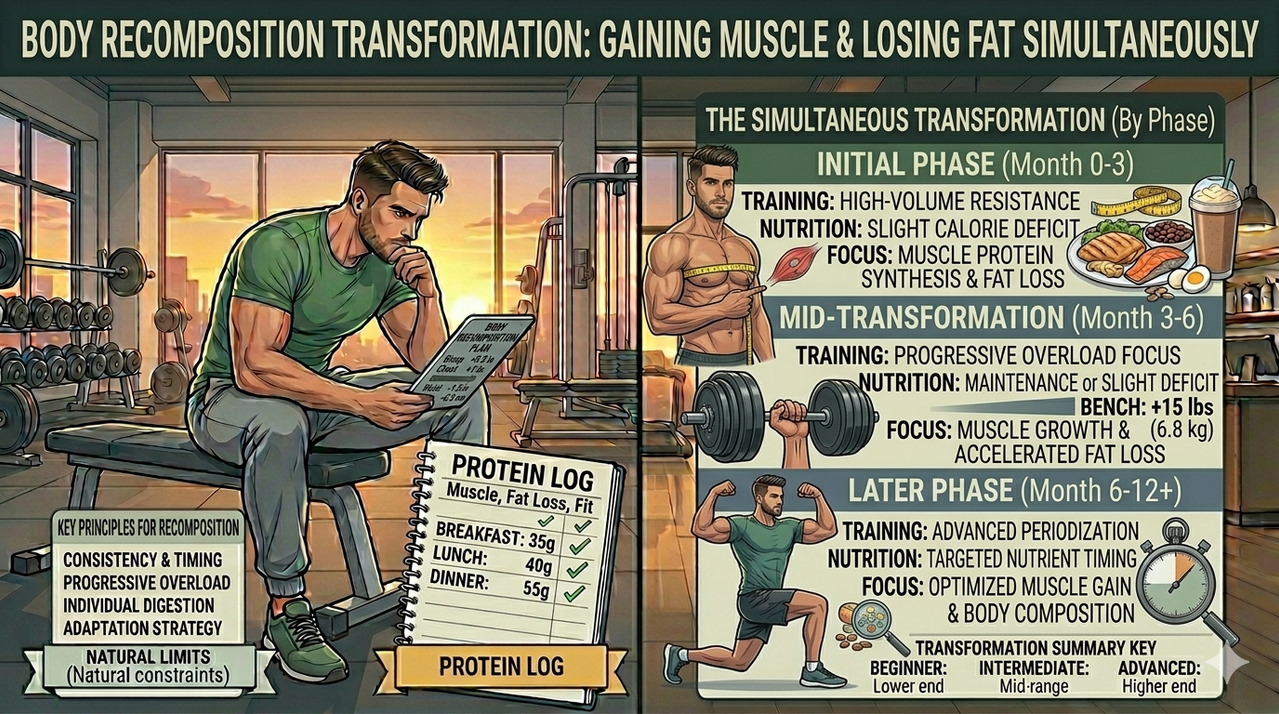
Can You Build Muscle in a Calorie Deficit? Fat Loss & Muscle Gain Explained (2026)

Infographic showing how to build muscle in a calorie deficit through body recomposition for fat loss and muscle gain
Image 1: Body recomposition—building muscle while losing fat—is possible with the right approach.

⚡ TL;DR

Yes, you can build muscle in a calorie deficit—this is called body recomposition. It's most effective for beginners, overweight individuals, and those returning after a break. Keys to success: high protein intake (1.8–2.4 g/kg body weight), strength training with progressive overload (3–5x/week), and a slight deficit (200–300 calories below maintenance, not 500+). Muscle gain in deficit requires prioritizing protein (30-40g per meal) and recovery (7–9 hours sleep). Intermediates and advanced lifters struggle to build muscle in a deficit and typically need separate bulk/cut phases .

1. The Holy Grail: Losing Fat While Gaining Muscle

For decades, fitness dogma said you must choose: bulk (gain muscle, gain some fat) or cut (lose fat, lose some muscle). But research now shows gain muscle lose fat simultaneously is possible—a process called body recomposition. Understanding can you gain muscle while cutting depends on your training status, body fat percentage, and nutrition strategy. This guide explains exactly how to build muscle in a calorie deficit and who can achieve it.

Can you gain muscle while in a calorie deficit?

Can you gain muscle while in a calorie deficit? Yes, especially for: beginners, overweight individuals, and people returning after a training break. Conditions needed: high protein intake (1.8-2.4 g/kg), strength training with progressive overload, and proper recovery (7-9 hours sleep). This is called body recomposition.
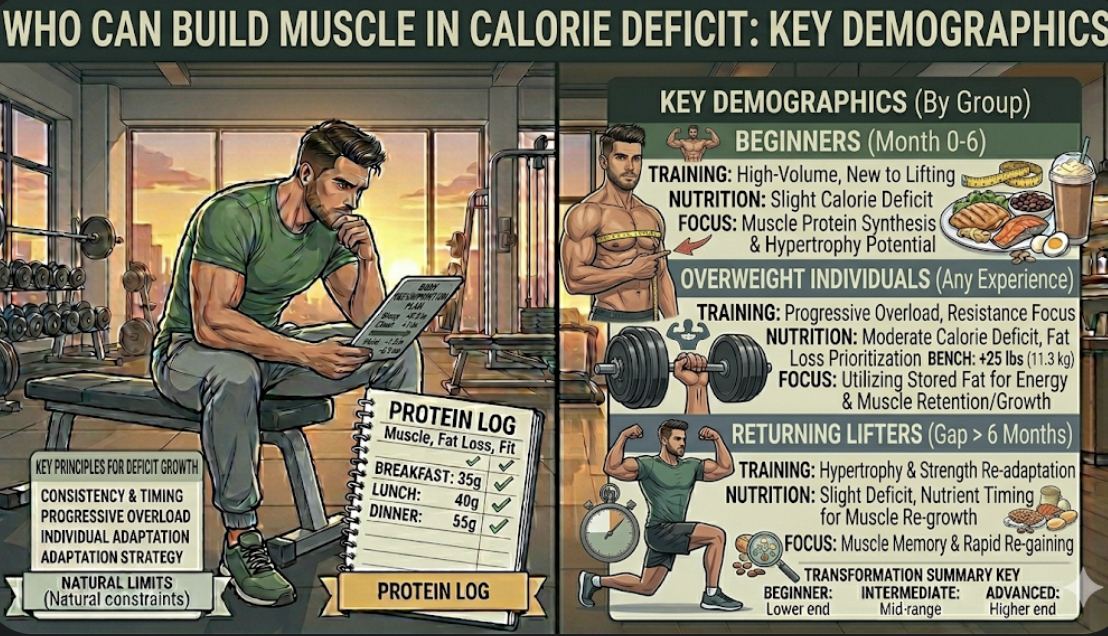
Body recomposition candidates showing beginners, overweight individuals, and returning lifters who can gain muscle while losing fat
Image 2: Body recomposition works best for specific populations—beginners, overweight individuals, and returning lifters.

2. The Science: How Body Recomposition Works

Body recomposition occurs when you're in a slight calorie deficit but provide enough protein and training stimulus to signal muscle growth. Key mechanisms:

  • High protein intake: 1.8-2.4 g/kg preserves muscle mass during deficit
  • Progressive overload: Strength training signals body to build muscle despite low calories
  • Fat as fuel: Stored body fat provides energy for the deficit, sparing muscle
  • Novel stimulus: Beginners and returning lifters respond dramatically to training

📊 Who Can Build Muscle in a Deficit?

.= "Beginners (0-12 months)" ? 'Beginners (0-12 months)' : '' ?>Beginners (0-12 months) .= "Overweight (20%+ BF men, 30%+ BF women)" ? 'Overweight (20%+ BF men, 30%+ BF women)' : '' ?>Overweight (20%+ BF men, 30%+ BF women) .= "Returning lifters (muscle memory)" ? 'Returning lifters (muscle memory)' : '' ?>Returning lifters (muscle memory) .= "Intermediates (1-3 years training)" ? 'Intermediates (1-3 years training)' : '' ?>Intermediates (1-3 years training) .= "Advanced (3+ years)" ? 'Advanced (3+ years)' : '' ?>Advanced (3+ years)

3. How Much of a Calorie Deficit for Recomposition?

For fat loss and muscle gain, use a slight deficit of 200-300 calories below maintenance (not 500+). Aggressive deficits make muscle gain very difficult. Track weight loss: aim for 0.25-0.5% body weight loss weekly. Slower loss preserves muscle while allowing fat reduction.

4. Protein: The Key to Muscle Preservation

How much protein do you need per day? For body recomposition, consume 1.8-2.4 grams per kilogram body weight (0.82-1.1 g per lb). This is higher than standard muscle building to preserve muscle mass in a calorie deficit. Spread across 3-5 meals with 20-40g protein each.

5. Training for Body Recomposition

Strength training is non-negotiable for muscle gain in deficit:

  • Frequency: 3-5 strength sessions per week
  • Progressive overload: Add weight or reps weekly
  • Compound lifts: Squat, deadlift, bench press, rows, overhead press
  • Volume: 10-20 working sets per muscle group weekly
  • Cardio: Moderate (2-3 sessions/week, 20-30 min) to increase deficit without interfering with recovery

6. Sample Body Recomposition Meal Plan (2,200 kcal, 170g Protein)

Omnivore Plan

  • Breakfast: 3 eggs, 1 cup oats, ½ cup berries (500 kcal, 28g protein)
  • Lunch: 150g chicken breast, 1.5 cups roasted vegetables, ½ cup quinoa (450 kcal, 40g protein)
  • Pre-Workout: 1 apple + 1 tbsp peanut butter (200 kcal, 5g protein)
  • Post-Workout: 1 scoop whey + 1 banana (250 kcal, 25g protein)
  • Dinner: 150g white fish or lean beef, 2 cups spinach, 1 tbsp olive oil (450 kcal, 35g protein)
  • Evening: 1 cup cottage cheese (200 kcal, 25g protein)
  • Total: ~2,050 kcal, ~158g protein

Vegan/Vegetarian Recomp Plan

  • Breakfast: Tofu scramble (150g tofu), 1 cup oats, ½ cup berries (500 kcal, 25g protein)
  • Lunch: 1.5 cups lentils, 1 cup quinoa, 2 cups spinach, 1 tbsp olive oil (550 kcal, 25g protein)
  • Snack: 1 cup edamame, 1 apple (200 kcal, 11g protein)
  • Post-Workout: 1 scoop plant protein, 1 banana (200 kcal, 20g protein)
  • Dinner: 150g tempeh, 1.5 cups brown rice, 2 cups broccoli, 1 tbsp olive oil (550 kcal, 30g protein)
  • Total: ~2,000 kcal, ~111g protein (add another shake for higher)

Gluten-Free Options

  • Use certified gluten-free oats
  • Choose rice, quinoa, buckwheat
  • Verify protein sources are gluten-free certified

7. Sample Body Recomposition Training Week

  • Monday: Full body strength (compound lifts, 3-4 sets each)
  • Tuesday: Light cardio (20-30 min walk) + core work
  • Wednesday: Full body strength (different exercises)
  • Thursday: Rest or active recovery (yoga, stretching)
  • Friday: Full body strength (focus on progressive overload)
  • Saturday: Moderate cardio (30 min) + accessory work
  • Sunday: Complete rest

8. Quick Recomposition Recipes

  • High-Protein Breakfast Bowl (400 kcal, 35g protein): 3 eggs, 100g cottage cheese, spinach, 1 slice whole grain toast
  • Post-Workout Shake (300 kcal, 35g protein): 1 scoop whey, 1 cup unsweetened almond milk, ½ banana, 1 tbsp peanut butter
  • Lentil & Chickpea Salad (450 kcal, 20g protein): 1 cup lentils, ½ cup chickpeas, cucumber, tomato, lemon juice, olive oil

9. Common Recomposition Mistakes

  • Deficit too large: >500 calories makes muscle gain impossible
  • Insufficient protein: Below 1.6 g/kg causes muscle loss
  • No progressive overload: Same weights every week = no growth stimulus
  • Too much cardio: Excessive cardio impairs recovery and muscle growth
  • Poor sleep: <7 hours increases cortisol, impairs recovery
  • Expecting rapid results: Recomposition is slow (0.25-0.5% body weight loss weekly)

10. Frequently Asked Questions

How much protein do you need per day?

Protein needs vary by goal: Muscle growth: 1.6-2.2 g per kg body weight (0.73-1 g per lb). General fitness: 1.2-1.6 g/kg (0.55-0.73 g/lb). Higher intake during bulking or dieting. For an 80 kg person, that's 128-176g for muscle growth.

Can you gain muscle while in a calorie deficit?

Yes, you can gain muscle while in a calorie deficit, especially for: beginners, overweight individuals, and people returning after a training break. Conditions needed: high protein intake (1.8-2.4 g/kg), strength training with progressive overload, and proper recovery (7-9 hours sleep). This is called body recomposition.

What is body recomposition?

Body recomposition is the process of simultaneously building muscle and losing fat while maintaining stable body weight. It requires a slight calorie deficit (or maintenance), high protein intake (1.8-2.4 g/kg), and progressive overload strength training. Most effective for beginners, overweight individuals, and those returning from a break.

How much protein for body recomposition?

For body recomposition (building muscle while losing fat), consume 1.8-2.4 grams of protein per kilogram of body weight daily (0.82-1.1 g per lb). This is higher than standard muscle building to preserve muscle mass in a calorie deficit. Spread across 3-5 meals with 20-40g protein each.

What calorie deficit for muscle gain?

For body recomposition, use a slight deficit of 200-300 calories below maintenance (not 500+). Larger deficits make muscle gain very difficult. Track weight loss: aim for 0.25-0.5% body weight loss weekly. Slower loss preserves muscle while allowing fat reduction.

Can intermediates build muscle in a deficit?

Intermediate and advanced lifters struggle to build muscle in a deficit. They typically need a calorie surplus (bulk) to gain muscle, then a cut to lose fat. Body recomposition works best for beginners, overweight individuals, and those with significant body fat (20%+ for men, 30%+ for women).

11. Related Resources

12. Scientific References

  1. Morton, R. W., et al. (2018). A systematic review, meta-analysis and meta-regression of the effect of protein supplementation on resistance training-induced gains in muscle mass and strength. British Journal of Sports Medicine, 52(6), 376–384. PubMed
  2. Helms, E. R., et al. (2014). Evidence-based recommendations for natural bodybuilding contest preparation. Journal of the International Society of Sports Nutrition, 11(1), 20. PubMed
  3. Barakat, C., et al. (2020). Body recomposition: Can trained individuals build muscle and lose fat? Sports Medicine, 50(11), 1929–1940. PubMed
  4. Garthe, I., et al. (2013). Effect of two different weight-loss rates on body composition and strength and power-related performance in elite athletes. International Journal of Sport Nutrition and Exercise Metabolism, 23(1), 20–30. PubMed
  5. ACSM. (2021). Nutrition and Athletic Performance. Medicine & Science in Sports & Exercise, 53(3), 600–618. PubMed
FitForge Lab. Created by Techly420
FitForge Lab Welcome to WhatsApp chat
Hi! Need help with fitness or diet? 💪
Type here...
PopulationLikelihood of Muscle Gain in DeficitReason
HighNovel stimulus, rapid neural and muscle adaptations
HighStored fat provides energy for deficit
HighMuscle memory accelerates regrowth
LowNeed surplus for significant growth
Very LowSurplus required for muscle gain