How Long Does It Take to Build Muscle Naturally? (Realistic Timeline Guide)

Learn how long it takes to build muscle naturally with a realistic timeline and tips to maximize results.
How Long Does It Take to Build Muscle Naturally? Realistic Timeline Guide (2026)
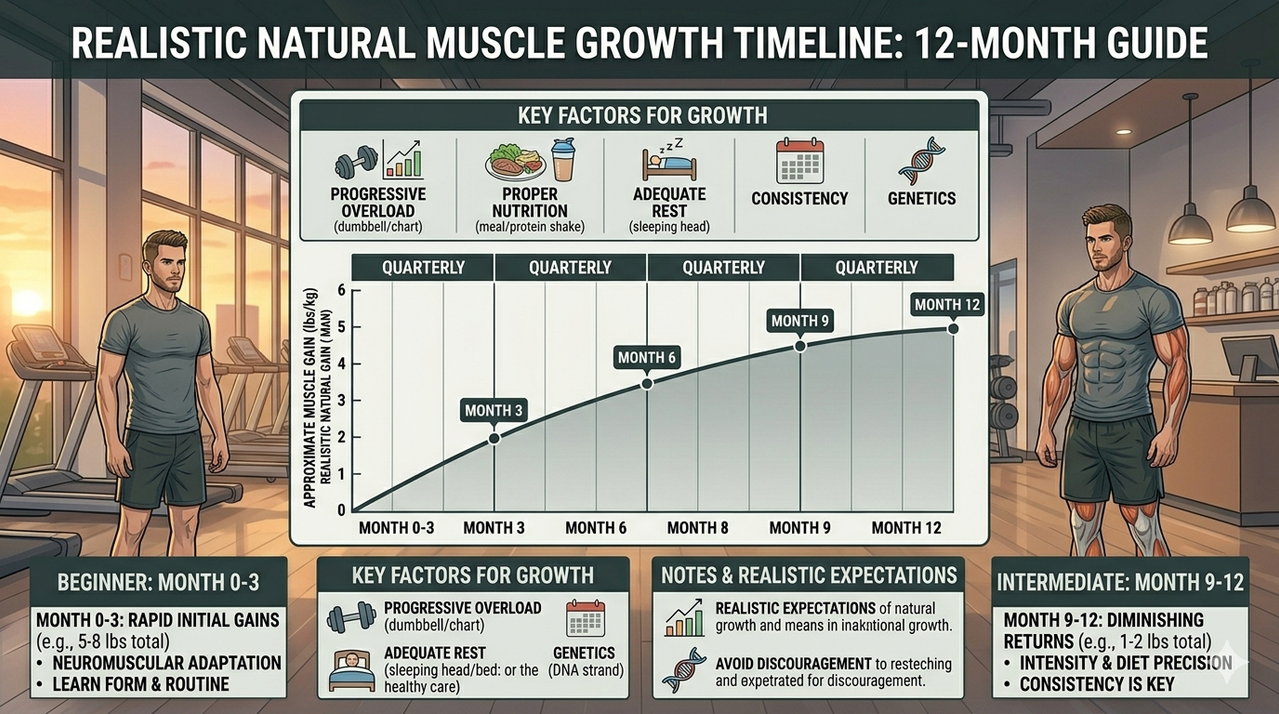
How Long Does It Take to Build Muscle Naturally? Realistic Timeline Guide (2026)

Muscle growth timeline infographic showing how long to build muscle naturally over 12 months for beginners
Image 1: Building muscle naturally takes time—understand realistic timelines to stay motivated.

⚡ TL;DR

How long to build muscle naturally? Beginners see noticeable changes in 4-8 weeks, visible muscle growth in 3-6 months, and significant transformation in 12-24 months. The natural muscle gain rate for beginners is 0.5-1 kg (1-2 lbs) per month in the first year (10-12 kg/22-26 lbs total). This rate halves each subsequent year. Factors affecting speed: protein intake (1.6-2.2 g/kg), calorie surplus (250-500 kcal), progressive overload, sleep (7-9 hours), and genetics. Consistency over years—not months—produces real results .

1. The Patience Problem: Why Realistic Expectations Matter

You've been training for three weeks. You're eating well. But the mirror shows no change. The problem isn't your effort—it's your expectations. Understanding how long to build muscle naturally prevents discouragement and dropout. This muscle growth timeline guide provides realistic natural muscle gain rate expectations for beginners, intermediates, and advanced lifters. Muscle growth is slow, but consistent training produces dramatic changes over years.

How long does it take to see muscle growth?

How long does it take to see muscle growth? Beginners see noticeable changes in 4-8 weeks (strength gains, subtle muscle definition). Visible muscle growth appears in 3-6 months of consistent training. Significant transformation takes 12-24 months. Consistency is key—muscle growth requires progressive overload, adequate protein (1.6-2.2 g/kg), and 7-9 hours sleep.
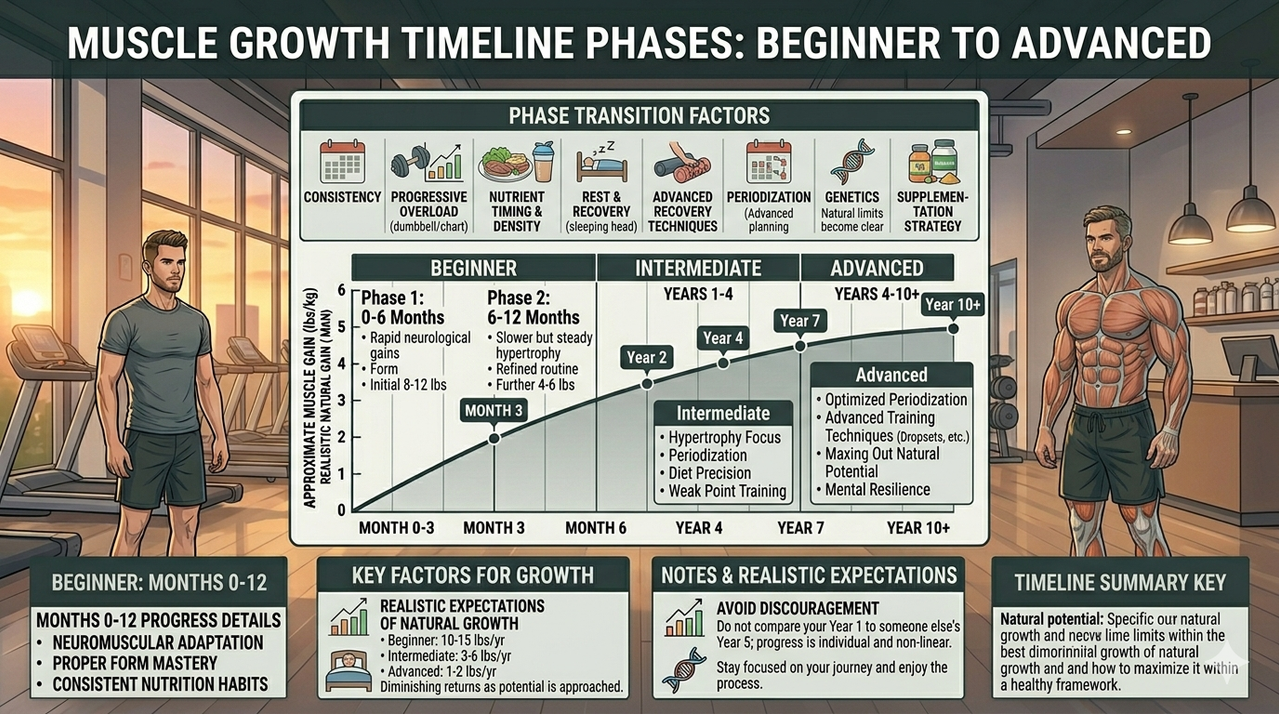
Muscle growth timeline phases from beginner to advanced showing natural muscle gain rate over 24 months
Image 2: Muscle growth accelerates in the first year then gradually slows as you advance.

2. The Science: How Fast Can Humans Gain Muscle?

Research on how fast can you gain muscle shows maximum rates:

  • First year of training: 10-12 kg (22-26 lbs) total muscle gain under optimal conditions
  • Second year: 5-6 kg (11-13 lbs)
  • Third year: 2-3 kg (4-6 lbs)
  • After 3+ years: 1-2 kg (2-4 lbs) annually

📊 Natural Muscle Gain Potential by Experience

.= "Beginner (0-12 months)" ? 'Beginner (0-12 months)' : '' ?>Beginner (0-12 months) .= "Intermediate (1-3 years)" ? 'Intermediate (1-3 years)' : '' ?>Intermediate (1-3 years) .= "Advanced (3+ years)" ? 'Advanced (3+ years)' : '' ?>Advanced (3+ years)

3. Beginner Timeline (First 12 Months)

📅 Month 1-2: Neural Adaptations

Strength gains come from improved nerve-muscle communication, not muscle growth. You'll lift more but size changes minimal. Muscle growth timeline starts here—foundation building.

📅 Month 3-6: First Visible Changes

Muscle definition appears. Clothes fit differently. You've gained 1.5-3 kg (3-6 lbs) of muscle. Strength has increased 25-50% on key lifts. Friends notice changes.

📅 Month 6-12: Significant Transformation

Total muscle gain: 5-10 kg (11-22 lbs). Strength has doubled or tripled on compound lifts. Your physique looks noticeably different. Consistency pays off.

4. Intermediate Timeline (Years 1-3)

Progress slows but continues. You'll gain 0.25-0.5 kg monthly. Focus on periodization, weak points, and advanced techniques. Strength gains require more effort. Many people quit here because progress feels slow—but this is where advanced physiques are built.

5. Factors That Affect Muscle Growth Speed

  • Protein intake: 1.6-2.2 g/kg body weight (more = faster up to this range)
  • Calorie surplus: 250-500 kcal above maintenance (necessary for growth)
  • Training consistency: 3-5 sessions per week, progressive overload
  • Sleep: 7-9 hours nightly (hormone production and recovery)
  • Genetics: Muscle fiber type, hormone levels, bone structure
  • Age: Younger individuals typically gain faster (testosterone peaks in 20s)
  • Sex: Men gain muscle faster due to testosterone (2-3x higher than women)

6. Nutrition for Optimal Muscle Growth

To maximize natural muscle gain rate, nutrition is non-negotiable:

  • Protein: 1.6-2.2 g per kg body weight (spread over 3-5 meals)
  • Calories: 250-500 kcal surplus above maintenance
  • Carbs: 4-7 g per kg (fuel for training)
  • Fats: 0.8-1.2 g per kg (hormone production)

Sample Muscle-Building Meal Plan (3,000 kcal, 180g Protein)

  • Breakfast: 4 eggs, 1 cup oats, 1 banana, 1 cup milk (650 kcal, 40g protein)
  • Lunch: 200g chicken breast, 2 cups rice, 1 cup broccoli, 1 tbsp olive oil (700 kcal, 55g protein)
  • Snack: 200g Greek yogurt, 30g almonds, 1 tbsp honey (350 kcal, 22g protein)
  • Post-Workout: 2 scoops whey, 1 banana, 1 cup oats (550 kcal, 48g protein)
  • Dinner: 200g lean beef or salmon, 1.5 cups sweet potato, 1 tbsp olive oil (700 kcal, 45g protein)
  • Total: ~2,950 kcal, ~210g protein

Vegan/Vegetarian Muscle-Building Plan

  • Breakfast: Tofu scramble (200g tofu), 1.5 cups oats, 2 tbsp peanut butter, banana (700 kcal, 40g protein)
  • Lunch: 200g tempeh, 1.5 cups quinoa, 1 cup edamame, 1 tbsp olive oil (700 kcal, 48g protein)
  • Snack: 1 cup soy yogurt, 1 scoop pea protein, 30g almonds (400 kcal, 32g protein)
  • Dinner: 1.5 cups cooked lentils, 2 cups brown rice, 1 tbsp coconut oil, spinach (650 kcal, 28g protein)
  • Total: ~2,450 kcal, ~148g protein (add another shake for higher)

Gluten-Free Options

  • Use certified gluten-free oats
  • Choose rice, quinoa, buckwheat
  • Verify protein sources are gluten-free certified

7. Tracking Progress: How to Know You're Growing

Since daily changes are imperceptible, use these methods:

  • Progress photos: Same lighting, clothes, angle monthly
  • Strength logs: Are you adding weight or reps weekly?
  • Measurements: Track arm, chest, thigh circumference monthly
  • Body weight: Weekly weigh-ins (0.25-0.5% gain weekly for bulking)
  • Clothing fit: Do shirts feel tighter in shoulders/chest?

8. Common Reasons for Slow Muscle Growth

  • Insufficient protein: Below 1.6 g/kg body weight
  • Not enough calories: No surplus = no growth
  • Poor sleep: Less than 7 hours impairs recovery
  • No progressive overload: Same weights every week
  • Inconsistent training: Missing weeks resets adaptations
  • Unrealistic expectations: Expecting monthly 5kg muscle gain
  • Overtraining: Too much volume, insufficient recovery

9. Realistic 2-Year Transformation Example

  • Starting point (80kg, 15% body fat): Beginner, minimal muscle
  • Year 1 result: 88kg, 12% body fat (+8kg muscle, -3kg fat)
  • Year 2 result: 92kg, 10% body fat (+4kg muscle, -2kg fat)
  • Total transformation: +12kg lean mass, -5kg fat in 2 years

10. Frequently Asked Questions

How long does it take to see muscle growth?

Beginners see noticeable changes in 4-8 weeks (strength gains, subtle muscle definition). Visible muscle growth appears in 3-6 months of consistent training. Significant transformation takes 12-24 months. Consistency is key—muscle growth requires progressive overload, adequate protein (1.6-2.2 g/kg), and 7-9 hours sleep.

How fast can a beginner gain muscle?

Beginners can gain 0.5-1 kg (1-2 lbs) of muscle per month in the first year. Total first-year muscle gain potential is 10-12 kg (22-26 lbs) under optimal conditions. This rate is significantly faster than intermediate (0.25-0.5 kg/month) or advanced (0.1-0.25 kg/month) lifters.

Why am I not seeing muscle growth?

Common reasons for slow muscle growth: insufficient protein intake (below 1.6 g/kg), not eating enough calories (no surplus), lack of progressive overload (same weights every week), poor sleep (<7 hours), inconsistent training, or unrealistic expectations (muscle growth is slow for everyone).

Can you build muscle in 3 months?

Yes, significant muscle can be built in 3 months with consistent training. Beginners can gain 1.5-3 kg (3-6 lbs) of muscle in 3 months. You'll notice strength increases within 4-8 weeks and visible changes by 12 weeks. However, dramatic transformations typically take 12-24 months.

How much muscle can you gain in a year naturally?

Natural lifters can gain 10-12 kg (22-26 lbs) of muscle in their first year of optimal training. Year 2: 5-6 kg (11-13 lbs). Year 3+: 2-3 kg (4-6 lbs) annually. These are maximum potentials under ideal conditions (progressive overload, protein intake, sleep, surplus). Most people gain less.

How long does muscle growth take to notice?

Strength gains: 2-4 weeks (neural adaptations). Muscle definition: 4-8 weeks (beginners). Visible size increase: 3-6 months (consistent training). Significant transformation: 12-24 months. Take progress photos monthly—daily changes are imperceptible, but monthly photos reveal progress.

11. Related Resources

12. Scientific References

  1. Morton, R. W., et al. (2018). A systematic review, meta-analysis and meta-regression of the effect of protein supplementation on resistance training-induced gains in muscle mass and strength. British Journal of Sports Medicine, 52(6), 376–384. PubMed
  2. Helms, E. R., et al. (2014). Evidence-based recommendations for natural bodybuilding contest preparation. Journal of the International Society of Sports Nutrition, 11(1), 20. PubMed
  3. Schoenfeld, B. J., et al. (2017). Effects of different weekly sets-equated resistance training frequencies on muscular strength, muscle hypertrophy, and body composition. Journal of Strength and Conditioning Research, 31(12), 3271–3278. PubMed
  4. Slater, G., et al. (2019). Is an energy surplus required to maximize skeletal muscle hypertrophy associated with resistance training? Frontiers in Nutrition, 6, 131. PubMed
  5. ACSM. (2021). Nutrition and Athletic Performance. Medicine & Science in Sports & Exercise, 53(3), 600–618. PubMed
FitForge Lab. Created by Techly420
FitForge Lab Welcome to WhatsApp chat
Hi! Need help with fitness or diet? 💪
Type here...
Experience LevelMonthly Gain (Men)Monthly Gain (Women)Annual Potential
0.5-1 kg (1-2 lbs)0.25-0.5 kg (0.5-1 lb)10-12 kg / 5-6 kg
0.25-0.5 kg (0.5-1 lb)0.1-0.25 kg (0.2-0.5 lb)5-6 kg / 2-3 kg
0.1-0.25 kg (0.2-0.5 lb)0.05-0.1 kg (0.1-0.2 lb)1-2 kg / 0.5-1 kg