How Much Protein Do You Really Need Per Day? (Expert Guide)

Learn how much protein you really need per day for muscle growth, fat loss, and optimal health.
How Much Protein Do You Really Need Per Day? Expert Guide (2026)
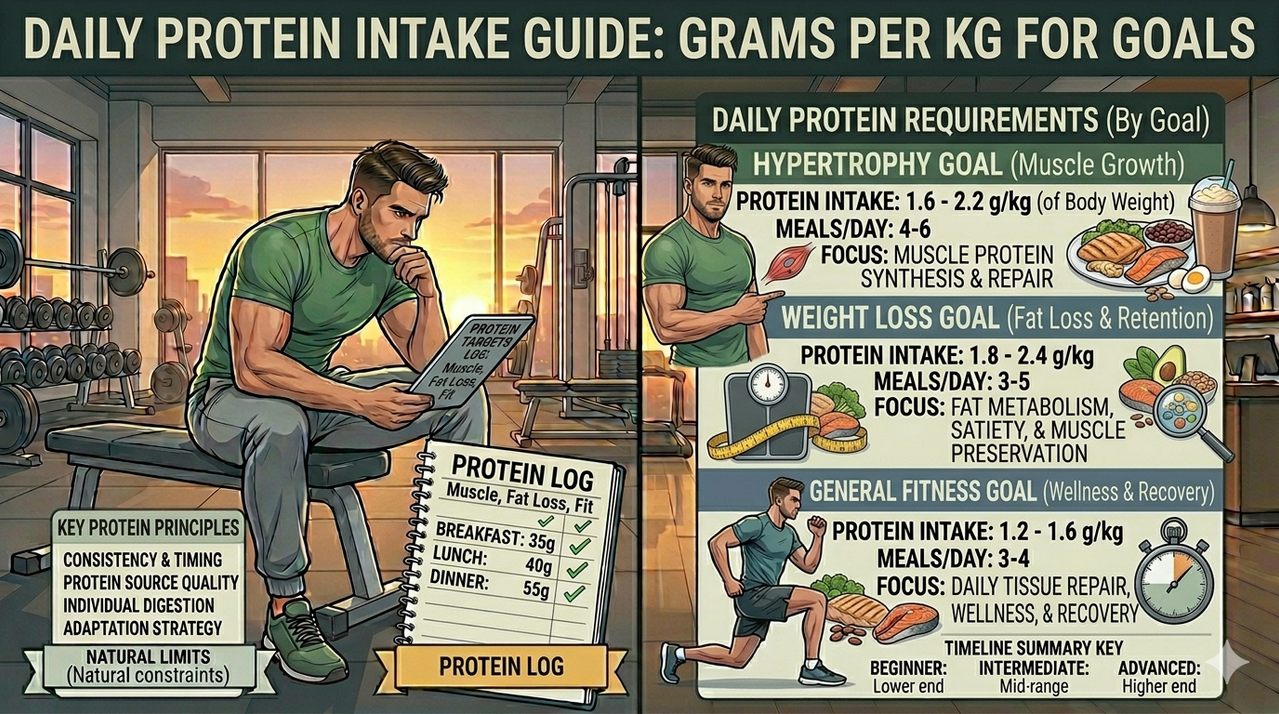
How Much Protein Do You Really Need Per Day? Expert Guide (2026)

Infographic showing how much protein per day for muscle growth, weight loss, and general fitness
Image 1: Protein needs vary by goal—learn exactly how much you need daily.

⚡ TL;DR

Your daily protein intake depends on your goal. For muscle growth: 1.6–2.2 g per kg body weight (0.73–1 g per lb). For general fitness: 1.2–1.6 g/kg. For weight loss (cutting): 1.8–2.4 g/kg. Sedentary adults need only 0.8 g/kg. For an 80 kg (176 lb) person, that's 128–176g protein daily for muscle building. Spread across 3–5 meals with 20–40g per meal to optimize muscle protein synthesis. Higher protein requirements during cutting preserve muscle mass. Research consistently supports these ranges .

1. The Protein Confusion: Why Everyone Gives Different Answers

Ask ten people how much protein per day you need, and you'll get ten different answers. Bodybuilders say 300g. Your doctor says 50g. Social media influencers claim you need "your body weight in grams." The truth lies somewhere in between—and depends on your goals. This evidence-based guide provides clear protein requirements for muscle growth, weight loss, and general health. Understanding how much protein to build muscle will transform your results.

How much protein do you need per day?

How much protein do you need per day? Protein needs vary by goal: Muscle growth: 1.6-2.2 g per kg body weight (0.73-1 g per lb). General fitness: 1.2-1.6 g/kg (0.55-0.73 g/lb). Weight loss (cutting): 1.8-2.4 g/kg (0.82-1.1 g/lb). Sedentary adults: 0.8 g/kg (0.36 g/lb). For an 80 kg person, that's 128-176g for muscle growth.

Daily protein requirements chart showing protein intake per kg for muscle growth, weight loss, general fitness
Image 2: Protein requirements increase with activity level and specific goals.

2. The Science: How Your Body Uses Protein

Protein provides amino acids for muscle repair, enzyme production, hormone synthesis, and immune function. Unlike carbs and fats, your body doesn't store excess protein. Key concepts:

  • Muscle protein synthesis (MPS): Building new muscle tissue
  • Muscle protein breakdown (MPB): Breaking down existing muscle
  • Net protein balance: MPS minus MPB (positive balance = muscle growth)

📊 Daily Protein Recommendations by Goal

.= "Sedentary adult" ? 'Sedentary adult' : '' ?>Sedentary adult .= "Muscle growth (bulking)" ? 'Muscle growth (bulking)' : '' ?>Muscle growth (bulking) .= "Weight loss (cutting)" ? 'Weight loss (cutting)' : '' ?>Weight loss (cutting) .= "Endurance athletes" ? 'Endurance athletes' : '' ?>Endurance athletes

3. How Much Protein to Build Muscle

Research consistently shows how much protein to build muscle: 1.6-2.2 g per kg body weight daily . Higher intakes (above 2.2 g/kg) show no additional benefit for natural lifters. Key points:

  • Spread protein across 3-5 meals: 20-40g per meal maximizes MPS
  • Post-workout window: Consume 20-40g within 2 hours of training
  • Pre-bed protein: 30-40g casein (cottage cheese, Greek yogurt) supports overnight MPS

4. Protein for Weight Loss (Cutting)

During calorie deficits, protein requirements increase to preserve muscle mass. Aim for 1.8-2.4 g/kg body weight . Higher protein also increases satiety, reducing hunger .

5. Protein Per Meal: Timing and Distribution

Research shows spreading protein intake across 3-5 meals (20-40g per meal) is superior to consuming most protein in one meal .

💡 Pro Tip: Aim for 0.4 g protein per kg body weight per meal (about 30-40g for an 80 kg person). This optimally stimulates MPS.

6. Sample High-Protein Meal Plans

Muscle Building Plan (3,000 kcal, 170g Protein) - 80 kg person

  • Breakfast: 4 eggs, 1 cup oats, 1 cup milk (650 kcal, 40g protein)
  • Lunch: 200g chicken breast, 2 cups rice, 1 cup broccoli (700 kcal, 55g protein)
  • Snack: 200g Greek yogurt, 30g almonds (350 kcal, 22g protein)
  • Post-Workout: 2 scoops whey, 1 banana (350 kcal, 48g protein)
  • Dinner: 200g lean beef or salmon, 1.5 cups sweet potato, 1 tbsp olive oil (700 kcal, 45g protein)
  • Evening: 1 cup cottage cheese (200 kcal, 25g protein)
  • Total: ~2,950 kcal, ~235g protein (adjust portions to reach 170g target)

Weight Loss Plan (2,000 kcal, 150g Protein) - 80 kg person

  • Breakfast: 3 eggs, ½ cup oats, ½ cup berries (450 kcal, 25g protein)
  • Lunch: 150g chicken breast, 1 cup quinoa, 2 cups spinach, 1 tbsp vinaigrette (450 kcal, 40g protein)
  • Snack: 170g Greek yogurt, ½ cup berries (150 kcal, 18g protein)
  • Dinner: 150g white fish or tofu, 1.5 cups roasted vegetables, 1 tbsp olive oil (450 kcal, 35g protein)
  • Evening: 1 cup cottage cheese (200 kcal, 25g protein)
  • Total: ~1,700 kcal, ~143g protein

Vegan/Vegetarian High-Protein Plan

  • Breakfast: Tofu scramble (200g tofu), 1.5 cups oats, 2 tbsp peanut butter (700 kcal, 40g protein)
  • Lunch: 200g tempeh, 1.5 cups quinoa, 1 cup edamame, 1 tbsp olive oil (700 kcal, 48g protein)
  • Snack: 1 cup soy yogurt, 1 scoop pea protein, 30g almonds (400 kcal, 32g protein)
  • Dinner: 1.5 cups cooked lentils, 2 cups brown rice, 1 tbsp coconut oil, spinach (650 kcal, 28g protein)
  • Total: ~2,450 kcal, ~148g protein

Gluten-Free Options

  • Use certified gluten-free oats
  • Choose rice, quinoa, buckwheat
  • Verify protein powders are gluten-free certified

7. Quick High-Protein Recipes

  • Protein Shake (300 kcal, 35g protein): 1 scoop whey, 1 cup milk, 1 banana, 1 tbsp peanut butter
  • Greek Yogurt Bowl (250 kcal, 25g protein): 200g Greek yogurt, ½ cup berries, 1 tbsp chia seeds
  • Egg Muffins (200 kcal, 15g protein per 2): 4 eggs, spinach, bell peppers, bake in muffin tin
  • Lentil Soup (400 kcal, 20g protein): 1 cup lentils, vegetable broth, carrots, celery, onion

8. Common Protein Mistakes

  • Eating most protein in one meal: MPS only elevated for 3-5 hours; spread intake
  • Relying on processed protein bars: Many have high sugar, low-quality protein
  • Not eating enough during cutting: Higher protein needed to preserve muscle
  • Ignoring protein at breakfast: Missed opportunity to stimulate MPS
  • Overlooking plant protein quality: Combine complementary proteins for complete amino profile

9. Frequently Asked Questions

How much protein do you need per day?

Protein needs vary by goal: Muscle growth: 1.6-2.2 g per kg body weight (0.73-1 g per lb). General fitness: 1.2-1.6 g/kg (0.55-0.73 g/lb). Weight loss (cutting): 1.8-2.4 g/kg (0.82-1.1 g/lb). Sedentary adults: 0.8 g/kg (0.36 g/lb). For an 80 kg person, that's 128-176g for muscle growth.

How much protein to build muscle?

To build muscle, consume 1.6-2.2 grams of protein per kilogram of body weight daily (0.73-1 g per lb). Spread across 3-5 meals with 20-40g protein per meal to maximize muscle protein synthesis (MPS). Timing: prioritize post-workout (within 2 hours).

Is 100g of protein enough per day?

100g protein daily is sufficient for a 60-70 kg (132-154 lb) person for general fitness. For muscle growth in larger individuals (80+ kg), 100g may be insufficient. Calculate based on body weight: 1.6-2.2 g/kg. For an 80 kg person, target 128-176g protein daily for muscle building.

How much protein do I need for weight loss?

During weight loss (cutting), consume higher protein: 1.8-2.4 grams per kilogram of body weight (0.82-1.1 g per lb). This preserves muscle mass while in a calorie deficit. Higher protein also increases satiety, reducing hunger. For an 80 kg person, that's 144-192g protein daily.

Can you eat too much protein?

For healthy individuals, intakes up to 2.5-3 g/kg (200-240g for 80kg person) are safe. Excessive protein (3.5+ g/kg) may cause digestive issues, dehydration, and in extreme cases, kidney stress for those with pre-existing kidney disease. Most people don't need more than 2.2 g/kg for muscle growth.

How much protein per meal for muscle growth?

Consume 20-40 grams of protein per meal to maximize muscle protein synthesis (MPS). Research shows 0.4 g/kg per meal (about 30-40g for an 80kg person) optimally stimulates MPS. Spread protein across 3-5 meals daily rather than eating most protein in one meal.

10. Related Resources

11. Scientific References

  1. Morton, R. W., et al. (2018). A systematic review, meta-analysis and meta-regression of the effect of protein supplementation on resistance training-induced gains in muscle mass and strength. British Journal of Sports Medicine, 52(6), 376–384. PubMed
  2. Schoenfeld, B. J., & Aragon, A. A. (2018). How much protein can the body use in a single meal for muscle-building? Implications for daily protein distribution. Journal of the International Society of Sports Nutrition, 15, 10. PubMed
  3. Phillips, S. M., & Van Loon, L. J. (2011). Dietary protein for athletes: from requirements to optimum adaptation. Journal of Sports Sciences, 29(sup1), S29–S38. PubMed
  4. Helms, E. R., et al. (2014). Evidence-based recommendations for natural bodybuilding contest preparation. Journal of the International Society of Sports Nutrition, 11(1), 20. PubMed
  5. Leidy, H. J., et al. (2015). The role of protein in weight loss and maintenance. American Journal of Clinical Nutrition, 101(6), 1320S–1329S. PubMed
  6. ACSM. (2021). Nutrition and Athletic Performance. Medicine & Science in Sports & Exercise, 53(3), 600–618. PubMed
FitForge Lab. Created by Techly420
FitForge Lab Welcome to WhatsApp chat
Hi! Need help with fitness or diet? 💪
Type here...
Goalg per kg body weightg per lb body weightExample (80 kg / 176 lb)
0.8 g/kg0.36 g/lb64 g/day
.= "General fitness" ? 'General fitness' : '' ?>General fitness1.2-1.6 g/kg0.55-0.73 g/lb96-128 g/day
1.6-2.2 g/kg0.73-1 g/lb128-176 g/day
1.8-2.4 g/kg0.82-1.1 g/lb144-192 g/day
1.2-1.6 g/kg0.55-0.73 g/lb96-128 g/day