Why Your Muscles Are Not Sore After Workout (Is It a Bad Sign?)

Learn why your muscles are not sore after a workout and whether it affects muscle growth or results.
Why Your Muscles Are Not Sore After Workout: Is It a Bad Sign? (2026)
Why Your Muscles Are Not Sore After Workout: Is It a Bad Sign? (2026)

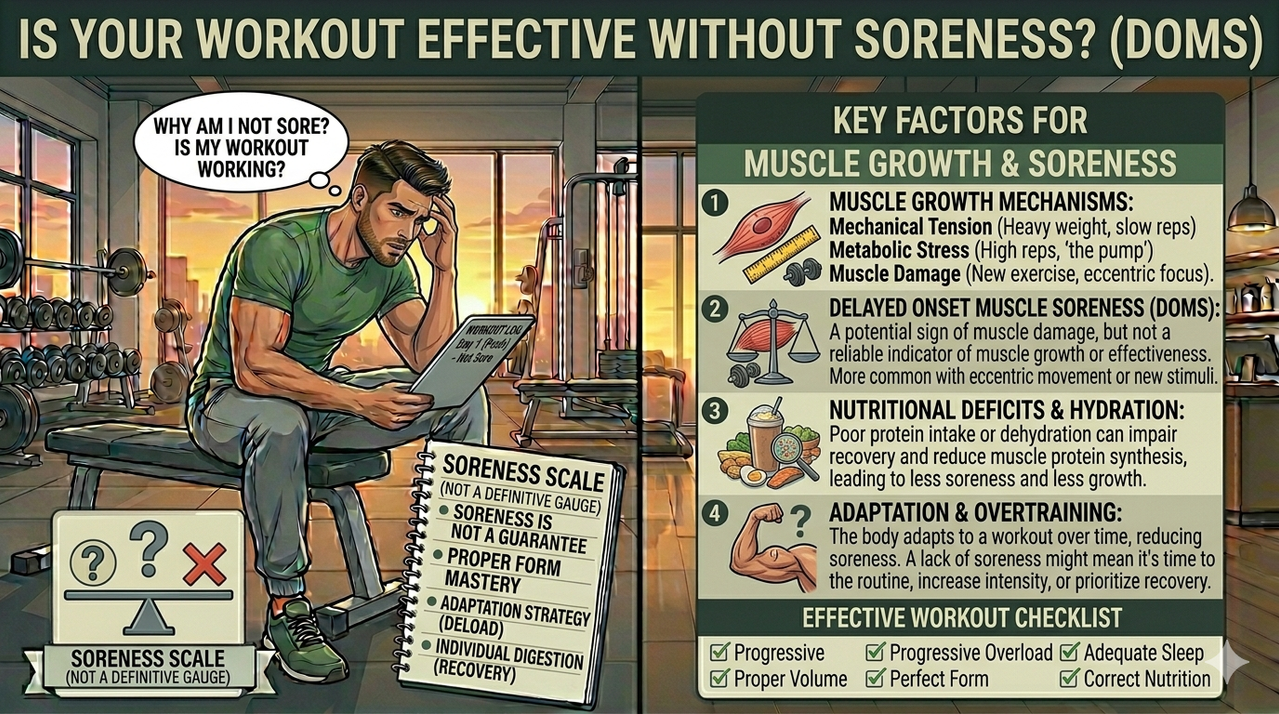
Infographic explaining why muscles not sore after workout and DOMS and muscle growth relationship
Image 1: No muscle soreness doesn't mean no progress—learn what truly matters for growth.

⚡ TL;DR

Is it bad if my muscles are not sore after a workout? No—soreness (DOMS) is NOT required for muscle growth. Your muscles adapt to training, reducing soreness over time (repeated bout effect). Focus on progressive overload (increasing weight/reps), good form, and consistency—these matter more than soreness. Many people build significant muscle without regular soreness. Signs of workout effectiveness without soreness include increased strength, better performance, and consistent progress in your training log. Don't chase soreness; chase progress .

1. The Soreness Trap: Why You Think Pain Equals Gain

You crushed your workout yesterday. Today, you feel nothing. No soreness, no stiffness. Immediately, you wonder: "Did I even work hard enough?" This experience—muscles not sore after workout—is common and often misunderstood. The belief that is soreness needed for muscle growth is one of fitness's most persistent myths. This guide explains why no muscle soreness occurs, what DOMS really means, and the true workout effectiveness signs you should track.

Is it bad if my muscles are not sore after a workout?

Is it bad if my muscles are not sore after a workout? No, it's not bad if your muscles aren't sore. Soreness (DOMS) is not required for muscle growth. Muscles adapt to training, reducing soreness over time. Focus on progressive overload (increasing weight/reps), good form, and consistency—these matter more than soreness. Many people build significant muscle without regular soreness.
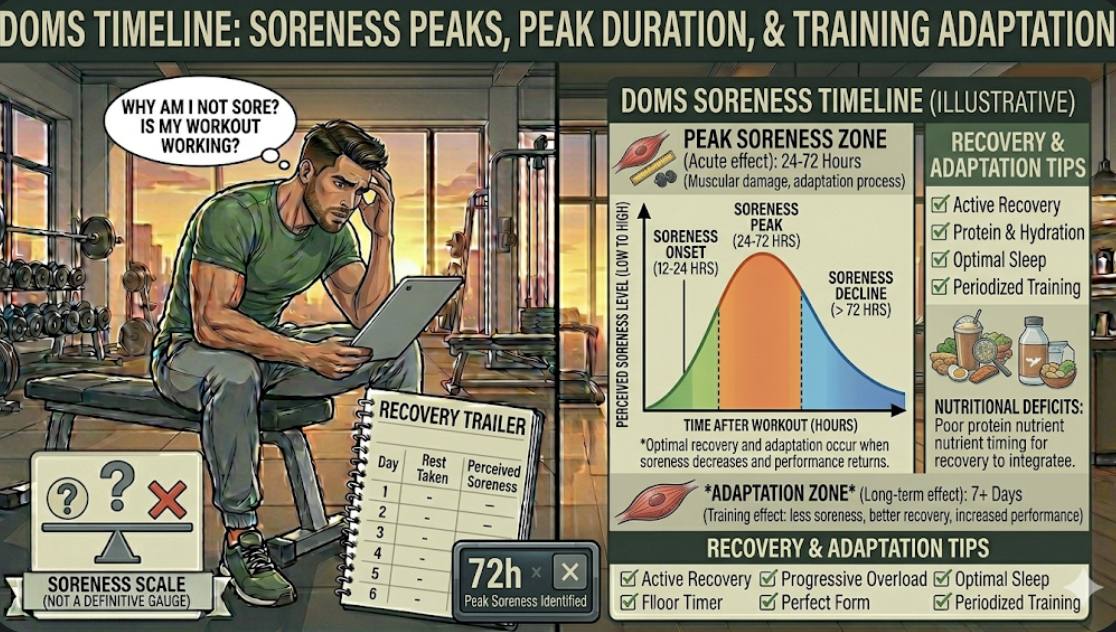
DOMS timeline showing soreness peaks 24-72 hours after workout and repeated bout effect on no soreness after exercise
Image 2: DOMS (Delayed Onset Muscle Soreness) peaks 24-72 hours after unfamiliar exercise and decreases with repeated training.

2. The Science: What Is DOMS and Why Does It Happen?

Delayed Onset Muscle Soreness (DOMS) is muscle pain and stiffness that develops 24-72 hours after unfamiliar or intense exercise. It results from:

  • Microscopic muscle damage: Small tears in muscle fibers, especially from eccentric movements (lengthening under tension)
  • Inflammation: Immune response to damage, causing swelling and pain
  • Metabolite accumulation: Lactic acid and other byproducts (though lactic acid clears within hours, not days)

📊 DOMS Timeline

.= "0-12 hours" ? '0-12 hours' : '' ?>0-12 hours .= "12-24 hours" ? '12-24 hours' : '' ?>12-24 hours .= "24-48 hours" ? '24-48 hours' : '' ?>24-48 hours .= "48-72 hours" ? '48-72 hours' : '' ?>48-72 hours .= "72-96 hours" ? '72-96 hours' : '' ?>72-96 hours

3. Why You're Not Sore: The Repeated Bout Effect

The primary reason for no soreness after exercise is the repeated bout effect. When you perform the same exercises regularly, your muscles adapt:

  • Neural adaptations: Improved motor unit recruitment reduces muscle damage
  • Structural adaptations: Muscle fibers become more resilient to damage
  • Inflammatory response: Reduced inflammatory reaction to exercise
  • Recovery improvements: Better blood flow and repair mechanisms
💡 Key Insight: Lack of soreness after consistent training is a sign of adaptation and progress—not a sign of inadequate effort. Your body is getting stronger and more resilient.

4. Does Soreness Mean Muscle Growth?

Does soreness mean muscle growth? No—soreness is not a reliable indicator of muscle growth. While muscle damage (one mechanism of soreness) can contribute to hypertrophy, it's not required. The primary drivers of muscle growth are:

  • Mechanical tension: Force production during exercise (most important)
  • Metabolic stress: The "pump" and metabolite accumulation
  • Muscle damage: Contributes but isn't necessary

Research shows you can build significant muscle with minimal soreness, especially after the first few weeks of a new program .

5. True Signs of Workout Effectiveness

Instead of chasing soreness, track these workout effectiveness signs:

  • Increased strength: Are you lifting heavier or doing more reps than last week?
  • Improved performance: Better endurance, faster times, more power
  • Muscle pumps: Temporary swelling during workout indicates metabolic stress
  • Feeling of fatigue: Muscles feel worked during and immediately after training
  • Consistent progress: Your training log shows improvement over weeks/months
  • Progress photos: Visible changes in muscle definition and size
  • Clothing fit: Tighter around muscles, looser around waist

6. When Soreness Is a Problem (Overtraining Signs)

While mild soreness is normal, excessive or persistent soreness indicates problems:

  • Extreme soreness lasting 5+ days: You may have overdone volume or intensity
  • Joint pain (not muscle soreness): Could indicate injury, not normal DOMS
  • Soreness with every workout despite weeks of training: You may be overtraining or not recovering
  • Accompanied by fatigue, poor sleep, irritability: Signs of overtraining syndrome

7. How to Reduce DOMS (If It Bothers You)

If soreness is uncomfortable, try these strategies:

  • Light activity: Walking, cycling, or light stretching increases blood flow
  • Foam rolling: May temporarily reduce soreness perception
  • Protein intake: 1.6-2.2 g/kg supports muscle repair
  • Sleep: 7-9 hours accelerates recovery
  • Hydration: Adequate water supports metabolic processes

8. Sample Recovery Nutrition Plan

Proper nutrition helps recovery whether you're sore or not:

Post-Workout Recovery Meal (450 kcal, 35g protein)

  • 150g chicken breast or tofu
  • 1 cup quinoa or sweet potato
  • 2 cups spinach or mixed vegetables
  • 1 tbsp olive oil

Vegan/Vegetarian Recovery Options

  • 150g tempeh or seitan
  • 1.5 cups brown rice
  • 2 cups broccoli
  • 1 tbsp flaxseed oil

Gluten-Free Options

  • Use certified gluten-free grains
  • Choose rice, quinoa, buckwheat
  • Verify protein sources are gluten-free certified

9. Sample Recovery Schedule (Without Chasing Soreness)

  • Monday: Full body strength (heavy compound lifts)
  • Tuesday: Light cardio (20-30 min walk) + stretching
  • Wednesday: Full body strength (different exercises)
  • Thursday: Rest or active recovery (yoga, foam rolling)
  • Friday: Full body strength (focus on progressive overload)
  • Saturday: Moderate cardio + accessory work
  • Sunday: Complete rest

10. Frequently Asked Questions

Is it bad if my muscles are not sore after a workout?

No, it's not bad if your muscles aren't sore after a workout. Soreness (DOMS) is not required for muscle growth. Muscles adapt to training, reducing soreness over time. Focus on progressive overload (increasing weight/reps), good form, and consistency—these matter more than soreness. Many people build significant muscle without regular soreness.

Why are my muscles not sore after workout?

Muscles aren't sore due to: the repeated bout effect (muscles adapt to exercises you do regularly), improved recovery (better sleep, nutrition), lower training volume or intensity, or simply because soreness isn't a reliable indicator of growth. No soreness doesn't mean no progress.

Does soreness mean muscle growth?

No, soreness (DOMS) does not directly indicate muscle growth. Soreness is caused by muscle damage and inflammation, which is one pathway to growth but not required. Muscle growth primarily occurs through mechanical tension and metabolic stress. You can build muscle without significant soreness.

How do I know if my workout was effective without soreness?

Signs of workout effectiveness without soreness: increased strength (lifting heavier or more reps), improved performance (faster times, more endurance), better muscle pumps during training, feeling of fatigue after workout, consistent progress in your training log, and positive changes in progress photos over time.

Should I be sore after every workout?

No, you shouldn't be sore after every workout. In fact, if you're consistently very sore after every session, you may be overtraining or not recovering adequately. Mild soreness occasionally is fine, but lack of soreness indicates your body has adapted—which is a sign of progress, not failure.

What is DOMS and how long does it last?

DOMS (Delayed Onset Muscle Soreness) is muscle pain and stiffness that peaks 24-72 hours after unfamiliar or intense exercise. It results from microscopic muscle damage and inflammation. DOMS typically lasts 3-5 days. It decreases with repeated training as muscles adapt (repeated bout effect).

11. Related Resources

12. Scientific References

  1. Schoenfeld, B. J. (2012). Does exercise-induced muscle damage play a role in skeletal muscle hypertrophy? Journal of Strength and Conditioning Research, 26(5), 1441–1453. PubMed
  2. McHugh, M. P. (2003). Recent advances in the understanding of the repeated bout effect. Sports Medicine, 33(5), 331–342. PubMed
  3. Cheung, K., et al. (2003). Delayed onset muscle soreness: treatment strategies and performance factors. Sports Medicine, 33(2), 145–164. PubMed
  4. Morton, R. W., et al. (2018). A systematic review, meta-analysis and meta-regression of the effect of protein supplementation on resistance training-induced gains in muscle mass and strength. British Journal of Sports Medicine, 52(6), 376–384. PubMed
  5. ACSM. (2021). Nutrition and Athletic Performance. Medicine & Science in Sports & Exercise, 53(3), 600–618. PubMed
FitForge Lab. Created by Techly420
FitForge Lab Welcome to WhatsApp chat
Hi! Need help with fitness or diet? 💪
Type here...
Time After WorkoutSoreness LevelWhat's Happening
Little to noneMuscles fatigued but not sore yet
Mild soreness beginsInflammation starts
Peak sorenessMaximum inflammation and damage
Moderate sorenessRepair and adaptation begin
Soreness subsidesRecovery nearly complete