Why You’re Not Getting Stronger in the Gym (Top Mistakes & Fixes)

Learn why you’re not getting stronger in the gym and how to fix common mistakes in training, diet, and recovery.
Why You're Not Getting Stronger in the Gym: Top Mistakes & Fixes (2026)
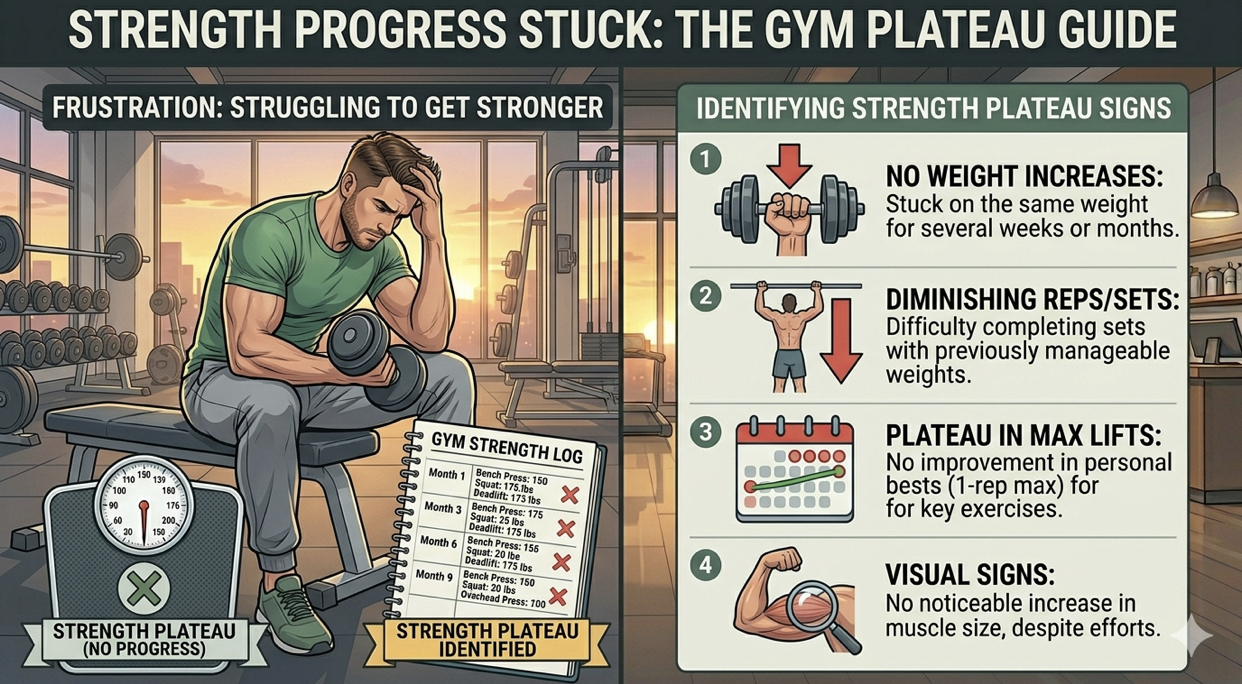
Why You're Not Getting Stronger in the Gym: Top Mistakes & Fixes (2026)

Person frustrated with not getting stronger in gym showing strength plateau and lack of progress
Image 1: Strength plateaus are frustrating but fixable—identify the cause and break through.

⚡ TL;DR

Why are you not getting stronger in the gym? The top strength plateau causes are: no progressive overload (same weights weekly), poor nutrition (low protein/calories), lack of recovery (poor sleep, no deload weeks), inconsistent training (missing sessions), and bad exercise form. To improve strength training and get stronger fast, increase protein to 1.6-2.2 g/kg, ensure calorie surplus (250-500 kcal), sleep 7-9 hours, add a deload week, and focus on progressive overload. Fix these and you'll break through plateaus within 2-4 weeks .

1. The Strength Plateau: Why Your Progress Has Stalled

You train hard. You're consistent. But the weight on the bar hasn't moved in weeks. This frustrating experience—not getting stronger in the gym—hits every lifter eventually. Understanding why strength not increasing is the first step to breaking through. This guide covers the most common gym strength mistakes and provides actionable fixes to restart your progress. Whether you're a beginner or advanced, these strategies will help you how to get stronger fast.

Why am I not getting stronger?

Why am I not getting stronger? You're not getting stronger due to: no progressive overload (same weights every week), poor nutrition (low protein/calories, insufficient for recovery), lack of recovery (poor sleep, no deload weeks), inconsistent training (missing sessions), or bad exercise form (using momentum instead of muscles). Fix these to restart strength gains.
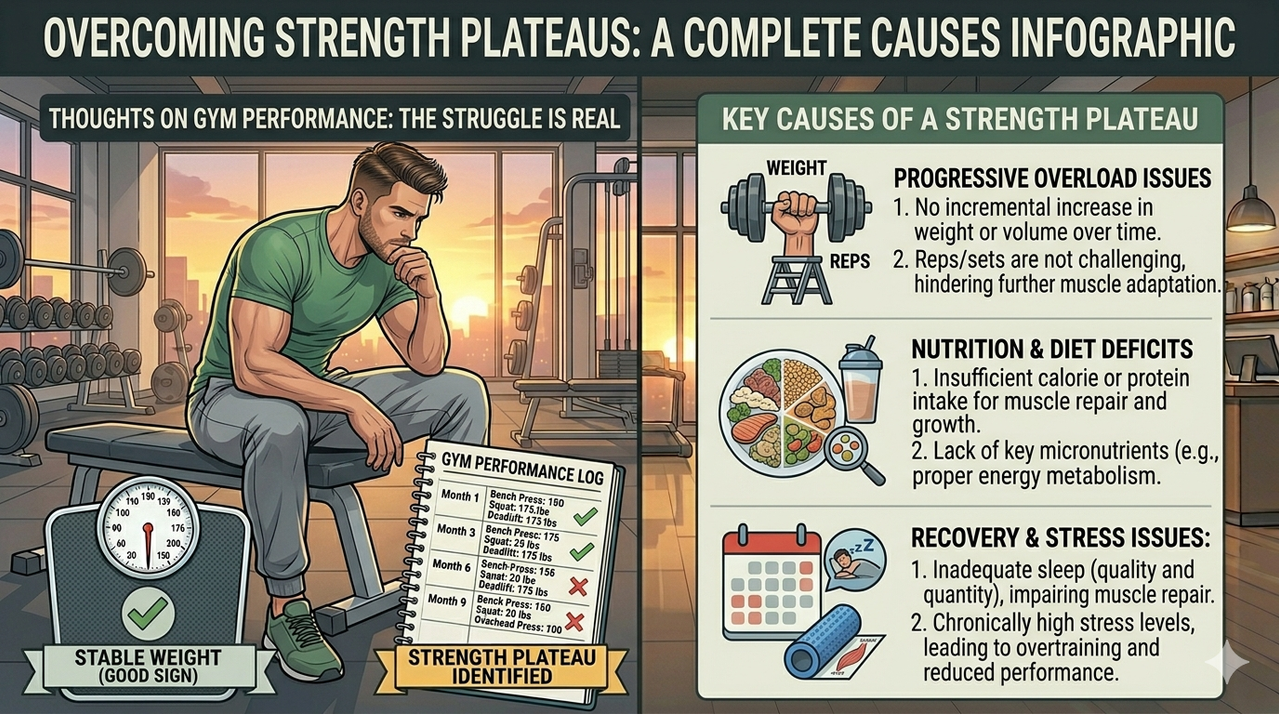
Strength plateau causes infographic showing progressive overload, nutrition, recovery issues for why strength not increasing
Image 2: Most strength plateaus stem from progressive overload, nutrition, or recovery issues.

2. Mistake #1: No Progressive Overload

The #1 reason for why I am not gaining strength is failing to progressively overload. Your body adapts to stress; without increasing demands, progress stops.

  • Fix: Add weight (2.5-5 kg) weekly when you can complete all reps with good form
  • Alternative: Add reps (e.g., 8 → 10 → 12) before increasing weight
  • Alternative: Add sets (3 → 4 → 5) or reduce rest time (90 sec → 60 sec)
  • Track: Log every workout to ensure progression

3. Mistake #2: Poor Nutrition (Low Protein/Calories)

Strength gains require fuel. Common nutrition mistakes:

  • Insufficient protein: Below 1.6 g/kg body weight (muscle repair requires amino acids)
  • Not enough calories: No surplus = no energy for strength gains
  • Poor timing: Training fasted or without pre-workout fuel
  • Fix: Protein: 1.6-2.2 g/kg, Calories: 250-500 kcal surplus, Carbs before training

📊 Strength-Building Nutrition Targets (80 kg Person)

.= "Calories" ? 'Calories' : '' ?>Calories .= "Protein" ? 'Protein' : '' ?>Protein .= "Carbs" ? 'Carbs' : '' ?>Carbs .= "Fats" ? 'Fats' : '' ?>Fats

4. Mistake #3: Lack of Recovery

Strength is built during rest, not training. Recovery mistakes:

  • Poor sleep: Less than 7 hours impairs hormone production (testosterone, growth hormone)
  • No deload weeks: Training at max intensity for months leads to overtraining
  • Too much volume: Excessive sets/reps without adequate recovery
  • Fix: Sleep 7-9 hours nightly, deload every 8-10 weeks (reduce volume 40-50%), take rest days

5. Mistake #4: Inconsistent Training

Strength gains require consistency. Skipping sessions disrupts progressive overload:

  • Fix: Schedule workouts like appointments (same days/times weekly)
  • Fix: Have a backup plan (10-15 min home workout for busy days)
  • Fix: Track your streak (don't break the chain)
  • Minimum effective dose: 2-3 strength sessions weekly maintains progress

6. Mistake #5: Bad Exercise Form

Poor form limits strength by using the wrong muscles:

  • Squat: Knees caving, rounded back → reduces quad/glute activation
  • Deadlift: Rounded back → reduces hamstring/glute engagement
  • Bench press: Flaring elbows → increases shoulder stress, reduces chest activation
  • Fix: Reduce weight by 30-50%, focus on perfect form, record yourself, work with a coach

7. Sample Strength-Building Meal Plan (3,000 kcal, 170g Protein)

Omnivore Plan

  • Breakfast: 4 eggs, 1 cup oats, 1 banana, 1 cup milk (650 kcal, 40g protein)
  • Lunch: 200g chicken breast, 2 cups rice, 1 cup broccoli, 1 tbsp olive oil (700 kcal, 55g protein)
  • Pre-Workout: 1 apple + 2 tbsp peanut butter (250 kcal, 8g protein)
  • Post-Workout: 2 scoops whey + 1 banana (350 kcal, 48g protein)
  • Dinner: 200g lean beef or salmon, 1.5 cups sweet potato, 1 tbsp olive oil (700 kcal, 45g protein)
  • Evening: 1 cup cottage cheese (200 kcal, 25g protein)
  • Total: ~2,850 kcal, ~221g protein

Vegan/Vegetarian Strength Plan

  • Breakfast: Tofu scramble (200g tofu), 1.5 cups oats, 2 tbsp peanut butter, banana (700 kcal, 40g protein)
  • Lunch: 200g tempeh, 1.5 cups quinoa, 1 cup edamame, 1 tbsp olive oil (700 kcal, 48g protein)
  • Snack: 1 cup soy yogurt, 1 scoop pea protein, 30g almonds (400 kcal, 32g protein)
  • Dinner: 1.5 cups cooked lentils, 2 cups brown rice, 1 tbsp coconut oil, spinach (650 kcal, 28g protein)
  • Post-Workout: 1 scoop plant protein, 1 banana (200 kcal, 20g protein)
  • Total: ~2,650 kcal, ~168g protein

Gluten-Free Options

  • Use certified gluten-free oats
  • Choose rice, quinoa, buckwheat
  • Verify protein sources are gluten-free certified

8. How to Break a Strength Plateau: 4-Week Protocol

  • Week 1 (Deload): Reduce weight by 40-50%, focus on form. Sleep 8+ hours nightly.
  • Week 2 (Return): Return to previous weights (where you plateaued). Expect to feel stronger.
  • Week 3 (Progressive overload): Add 2.5-5 kg to compound lifts.
  • Week 4 (Continue): Continue adding weight weekly. If you plateau again, repeat protocol.

9. Quick Strength-Building Recipes

  • Pre-Workout Energy Balls (250 kcal, 10g protein): 1 cup oats, ½ cup peanut butter, 2 tbsp honey, 1 scoop protein. Roll into balls.
  • Post-Workout Shake (400 kcal, 45g protein): 2 scoops whey, 1 banana, 1 cup milk, 1 tbsp peanut butter.
  • Strength Bowl (600 kcal, 45g protein): 150g chicken, 1.5 cups rice, 1 cup broccoli, 1 tbsp olive oil.

10. Frequently Asked Questions

Why am I not getting stronger?

You're not getting stronger due to: no progressive overload (same weights every week), poor nutrition (low protein/calories, insufficient for recovery), lack of recovery (poor sleep, no deload weeks), inconsistent training (missing sessions), or bad exercise form (using momentum instead of muscles). Fix these to restart strength gains.

Why is my strength not increasing in the gym?

Strength may plateau due to: insufficient protein intake (below 1.6 g/kg), not eating enough calories (no surplus), poor sleep (less than 7 hours), overtraining (no rest days), no progressive overload, or doing too much cardio that interferes with recovery.

How can I break a strength plateau?

Break a strength plateau by: increasing protein to 1.6-2.2 g/kg, ensuring calorie surplus (250-500 kcal), sleeping 7-9 hours, adding a deload week (reduce volume by 40-50%), varying rep ranges (5-8 reps for strength), and adding accessory work for weak points.

How long does it take to see strength gains?

Beginners see strength gains in 2-4 weeks (neural adaptations). Intermediates see progress every 2-4 weeks. Advanced lifters may take 4-8 weeks to see measurable strength increases. If you haven't progressed in 4-6 weeks, you've hit a plateau that needs addressing.

Should I take a break if I'm not getting stronger?

Yes, if you've been training hard for 8-12 weeks without progress, take a deload week (reduce volume by 40-50%) or complete rest for 3-7 days. Overtraining causes strength plateaus. After deload, you'll often return stronger.

How much protein do I need to get stronger?

To maximize strength gains, consume 1.6-2.2 grams of protein per kilogram of body weight daily. For an 80 kg person, that's 128-176g protein. Spread across 3-5 meals with 20-40g per meal. Protein provides amino acids for muscle repair and growth.

11. Related Resources

12. Scientific References

  1. Schoenfeld, B. J., et al. (2017). Effects of different weekly sets-equated resistance training frequencies on muscular strength, muscle hypertrophy, and body composition. Journal of Strength and Conditioning Research, 31(12), 3271–3278. PubMed
  2. Morton, R. W., et al. (2018). A systematic review, meta-analysis and meta-regression of the effect of protein supplementation on resistance training-induced gains in muscle mass and strength. British Journal of Sports Medicine, 52(6), 376–384. PubMed
  3. Fullagar, H. H., et al. (2015). Sleep and athletic performance: the effects of sleep loss on exercise performance, and physiological and cognitive responses to exercise. Sports Medicine, 45(2), 161–186. PubMed
  4. Helms, E. R., et al. (2014). Evidence-based recommendations for natural bodybuilding contest preparation. Journal of the International Society of Sports Nutrition, 11(1), 20. PubMed
  5. ACSM. (2021). Nutrition and Athletic Performance. Medicine & Science in Sports & Exercise, 53(3), 600–618. PubMed
FitForge Lab. Created by Techly420
FitForge Lab Welcome to WhatsApp chat
Hi! Need help with fitness or diet? 💪
Type here...
NutrientTargetExample Sources
2,800-3,200 kcalSurplus for strength gains
128-176 gChicken, eggs, whey, Greek yogurt
350-450 gRice, oats, potatoes, fruit
70-90 gNuts, avocado, olive oil