What to Do When Fat Loss Stops Completely (Plateau Fix Guide)
What to Do When Fat Loss Stops Completely (Plateau Fix Guide)

⚡ TL;DR
When fat loss stops completely, it's usually due to metabolic adaptation, reduced calorie needs, or inconsistent adherence. To break the plateau: 1) Recalculate your maintenance calories—as you lose weight, your needs drop. 2) Increase NEAT (steps, daily movement) rather than cutting more calories. 3) Consider a diet break (1–2 weeks at maintenance) to restore hormones and metabolic rate. 4) Audit your consistency—hidden calories often creep in. Research shows that metabolic adaptation is real, but strategic adjustments can restart fat loss . This guide provides step-by-step fixes.
1. The Frustration: When the Scale Won't Budge
You've been consistent for weeks. You're eating in a deficit, training hard, and then... nothing. The scale hasn't moved for 2–3 weeks. Your waist measurement is stuck. You're not losing fat, and you're starting to question everything. First, know this: plateaus are normal. They're not a sign of failure—they're a sign that your body is adapting. This guide will show you exactly what to do when fat loss stops and how to restart progress.
What should you do when fat loss stops?
When fat loss stops, you should: 1) Adjust calories—recalculate your maintenance, as your smaller body requires fewer calories. 2) Increase activity—add 2,000–3,000 steps daily or increase NEAT. 3) Review diet consistency—track hidden calories and ensure you're actually in a deficit. 4) Consider a diet break—1–2 weeks at maintenance can reverse metabolic adaptation and restore hunger hormones . If no progress after 4 weeks, reassess training or consult a professional.
2. Reason #1: Metabolic Adaptation – Your Body Fights Back
2.1. What Is Metabolic Adaptation?
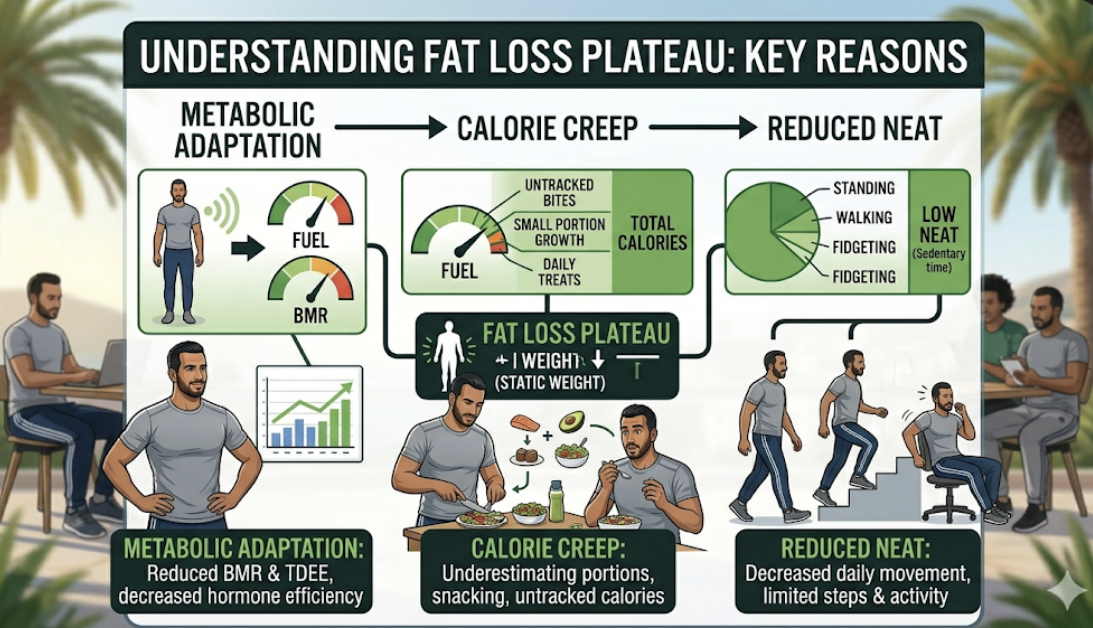
When you lose weight, your resting metabolic rate (RMR) drops—often more than expected based on weight loss alone. This is your body's defense mechanism against starvation . Studies show that after weight loss, RMR can be 5–15% lower than predicted .
2.2. How to Fix It
- Recalculate your maintenance: Your old deficit may now be maintenance.
- Take a diet break: 1–2 weeks at maintenance can restore leptin, thyroid, and metabolic rate .
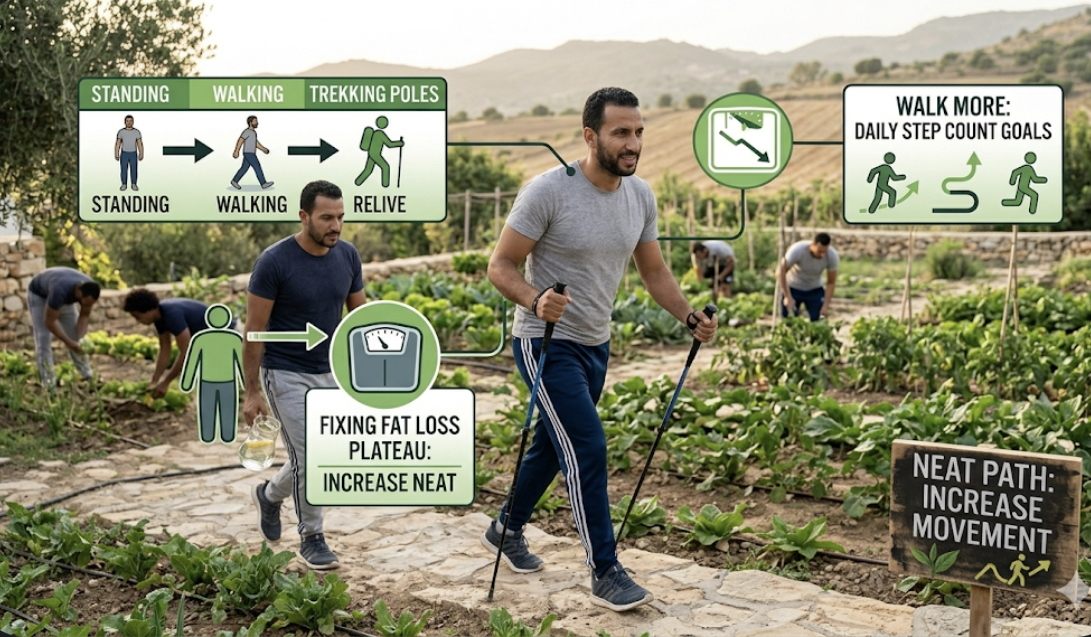
- Increase NEAT: Walking, standing, and daily movement add calories burned without triggering further adaptation.
3. Reason #2: Reduced Calorie Needs – You're Smaller Now
3.1. The Math of Weight Loss
If you started at 90 kg and lost 10 kg, your maintenance calories have dropped by roughly 200–300 kcal daily . Eating the same as when you started may now be maintenance, not a deficit.
3.2. How to Fix It
- Recalculate your TDEE: Use an updated weight to find new maintenance.
- Adjust deficit: If you're eating at old maintenance, reduce by 200–300 kcal or increase activity.
- Reassess every 4–6 weeks: As you lose weight, your calorie needs change.
4. Reason #3: Inconsistent Adherence – Hidden Calories
4.1. The Calorie Creep
Over time, portion sizes increase, snacks creep in, and "cheat meals" become cheat days. A 300 kcal daily surplus erases a 300 kcal deficit .
4.2. How to Fix It
- Track everything for 3–5 days: Use an app to audit your intake.
- Be honest about portions: Weigh or measure key foods.
- Account for "bites, licks, and tastes": They add up.
5. Reason #4: Reduced NEAT – Moving Less Unconsciously
5.1. NEAT Declines During Dieting
Your body unconsciously reduces non-exercise activity (fidgeting, posture, spontaneous movement) during a calorie deficit . This can account for a 200–400 kcal drop in daily expenditure.
5.2. How to Fix It
- Increase steps: Aim for 7,000–10,000 daily.
- Stand more: Use a standing desk or take standing breaks.
- Park farther away, take stairs.
- Schedule movement: Short walks after meals.
6. Strategy: Diet Breaks – Reset Your Metabolism
6.1. The Science of Diet Breaks
A 2018 study found that taking a 2-week diet break (eating at maintenance) improved weight loss efficiency and reduced metabolic adaptation compared to continuous dieting . Diet breaks restore leptin, thyroid hormones, and motivation .
6.2. How to Implement
- Duration: 1–2 weeks
- Calories: Eat at maintenance (not surplus)
- Food choices: Focus on whole foods, but allow more flexibility
- Training: Maintain intensity; strength often improves with more fuel
7. Strategy: Refeed Days – Strategic Carb Loading
7.1. What Is a Refeed?
A refeed is a short period (1 day) of eating at maintenance with higher carbohydrates. It replenishes glycogen, increases leptin, and temporarily boosts metabolic rate .
7.2. How to Implement
- Frequency: Once per week, especially during later stages of cutting
- Calories: Eat at maintenance (or slightly above)
- Carbs: Increase carbs by 50–100g, reduce fats slightly
- Protein: Keep high (1.6–2.2 g/kg)
8. Sample Meal Plan – 1,800 kcal (After Recalculating)
Omnivore Plan
- Breakfast: 3 eggs, 1 cup oatmeal with berries (450 kcal, 30g protein)
- Lunch: 150g grilled chicken breast, 2 cups mixed greens, ½ cup quinoa, 1 tbsp olive oil (500 kcal, 40g protein)
- Snack: 200g Greek yogurt, 1 apple (250 kcal, 20g protein)
- Dinner: 150g salmon, 2 cups roasted broccoli, 1.5 cups sweet potato (550 kcal, 35g protein)
- Evening: 150g cottage cheese (150 kcal, 15g protein)
Vegan/Vegetarian Plan
- Breakfast: Tofu scramble (200g firm tofu), 1 cup oatmeal with 2 tbsp peanut butter, berries (550 kcal, 35g protein)
- Lunch: 1.5 cups cooked lentils, 2 cups mixed greens, 1 cup roasted chickpeas (550 kcal, 30g protein)
- Snack: 1 cup edamame, 1 apple (250 kcal, 15g protein)
- Dinner: 1.5 cups quinoa, 200g baked tofu, 2 cups roasted vegetables (550 kcal, 35g protein)
- Evening: 1 cup unsweetened soy milk (100 kcal, 8g protein)
Gluten-Free Options
- Use certified gluten-free oats, quinoa, rice, or buckwheat.
- Ensure tempeh and tofu are gluten-free certified.
9. Sample Refeed Day – 2,400 kcal (Higher Carbs)
- Breakfast: 4 eggs, 1.5 cups oatmeal with banana, 1 tbsp honey (650 kcal, 35g protein, 90g carbs)
- Lunch: 200g chicken breast, 2 cups brown rice, 1 cup mixed vegetables (700 kcal, 45g protein, 100g carbs)
- Snack: 200g Greek yogurt, 1 apple, 1 oz almonds (400 kcal, 20g protein, 35g carbs)
- Dinner: 200g salmon, 2 cups sweet potato, 2 cups greens (650 kcal, 40g protein, 80g carbs)
Total: ~2,400 kcal, 140g protein, 305g carbs
10. Common Mistakes That Prolong Plateaus
- Mistake #1: Cutting calories too low. Severe deficits increase cortisol and metabolic adaptation. Stick to 300–500 kcal deficit.
- Mistake #2: Doing the same cardio forever. Your body adapts; vary intensity or mode.
- Mistake #3: Ignoring sleep and stress. Poor sleep increases ghrelin and cortisol, stalling progress.
- Mistake #4: Not tracking progress accurately. Use measurements and photos, not just scale.
- Mistake #5: Giving up too soon. Plateaus can last 1–4 weeks. Stay consistent.
11. Frequently Asked Questions
What should you do when fat loss stops?
Recalculate calories, increase NEAT (steps), audit your consistency, and consider a diet break or refeed day. If no progress after 4 weeks, reassess training.
How long does a fat loss plateau last?
Typically 1–4 weeks. If it lasts longer, it's likely due to metabolic adaptation or calorie consistency issues.
Should I eat less when I hit a plateau?
Not necessarily. First, recalc maintenance. If you're already in a deficit, try increasing activity or a diet break before cutting more calories.
What is metabolic adaptation?
Your body's natural response to weight loss—resting metabolic rate drops more than expected, making continued loss harder.
How do diet breaks help with fat loss?
Diet breaks restore leptin, thyroid function, and metabolic rate, making subsequent fat loss more effective and sustainable.
How much protein should I eat during a plateau?
1.6–2.2 grams per kilogram of body weight daily. High protein preserves muscle and increases satiety.
Can stress cause a fat loss plateau?
Yes. Chronic stress elevates cortisol, which can promote fat storage and increase appetite, making fat loss harder.
12. Related Resources
- How to Avoid Muscle Loss While Cutting (Science-Based Guide)
- Why Fat Loss Slows Down After 2 Weeks (And How to Fix It Fast)
- How Many Steps Per Day for Fat Loss Beginners? (Simple Walking Guide)
- Best Simple Habits for Sustainable Fat Loss (Easy Daily Strategies)
- Why You Feel Tired During a Cutting Phase (And How to Fix It)
- How to Stay Full While Cutting Calories (Hunger Control Guide)
13. Scientific References
- Müller, M. J., et al. (2015). Metabolic adaptation to calorie restriction. International Journal of Obesity, 39(6), 921–927. PubMed
- Leibel, R. L., et al. (1995). Changes in energy expenditure resulting from altered body weight. New England Journal of Medicine, 332(10), 621–628. PubMed
- Byrne, N. M., et al. (2018). Intermittent energy restriction improves weight loss efficiency in obese women. Obesity Research & Clinical Practice, 12(2), 123–132. PubMed
- Trexler, E. T., et al. (2014). Metabolic adaptation and weight regain. Journal of the International Society of Sports Nutrition, 11(1), 24. PubMed
- Levine, J. A. (2004). Nonexercise activity thermogenesis (NEAT): environment and biology. American Journal of Physiology-Endocrinology and Metabolism, 286(5), E675–E685. PubMed
- Nedeltcheva, A. V., et al. (2010). Insufficient sleep undermines dietary efforts to reduce adiposity. Annals of Internal Medicine, 153(7), 435–441. PubMed
- ACSM. (2021). Nutrition and Athletic Performance. Medicine & Science in Sports & Exercise, 53(3), 600–618. PubMed
Join the conversation