7-Day Workout Plan for Beginners at Home (No Equipment Full Guide)
7-Day Workout Plan for Beginners at Home: No Equipment Full Guide (2026)

⚡ TL;DR
This 7-day workout plan for beginners at home requires zero equipment and fits any schedule. The beginner home workout plan includes 3-4 training days with rest days for recovery. This weekly workout plan no equipment uses only bodyweight exercises like squats, push-ups, lunges, and planks. Follow this home workout routine for beginners for 4-6 weeks to build strength, improve cardio, and create a sustainable 7 day fitness plan. This bodyweight workout schedule is designed for anyone ready to start working out at home without intimidation.
1. Why Home Workouts Work for Beginners
You don't need a gym membership or expensive equipment to get fit. Research shows that bodyweight training produces similar strength gains to weighted resistance training in beginners during the first 8-12 weeks (Calatayud et al., 2015).
This 7-day workout plan for beginners at home removes all barriers: no commute, no gym intimidation, no equipment costs. Whether you're looking for a beginner home workout plan or a complete weekly workout plan no equipment, this guide provides everything you need to start working out at home effectively.
What is a good 7-day workout plan for beginners at home?
What is a good 7-day workout plan for beginners at home? Day 1: Full body (squats, push-ups, lunges, planks). Day 2: Rest or light cardio (walking, jogging in place). Day 3: Upper body (push-ups, triceps dips, shoulder taps). Day 4: Rest. Day 5: Lower body (squats, lunges, glute bridges, calf raises). Day 6: Full body + cardio. Day 7: Rest or active recovery (stretching, walking).
2. The Science: Why Bodyweight Training Works
Home workout routine for beginners based on bodyweight exercises is scientifically effective for several reasons:
- Progressive overload: You can increase difficulty by adding reps, sets, decreasing rest time, or progressing to harder variations (e.g., knee push-ups → full push-ups → decline push-ups).
- Functional strength: Bodyweight exercises train movement patterns used in daily life (squatting, pushing, pulling, lunging).
- Low injury risk: Bodyweight training has lower injury rates than weighted resistance training, making it ideal for beginners (Hammond et al., 2019).
- Consistency driver: Removing barriers (travel, equipment) increases adherence. Studies show home exercisers are 50% more likely to maintain consistency than gym-goers.
A 2017 study by Thomas et al. found that 8 weeks of bodyweight training produced significant improvements in strength, endurance, and body composition in previously inactive adults.
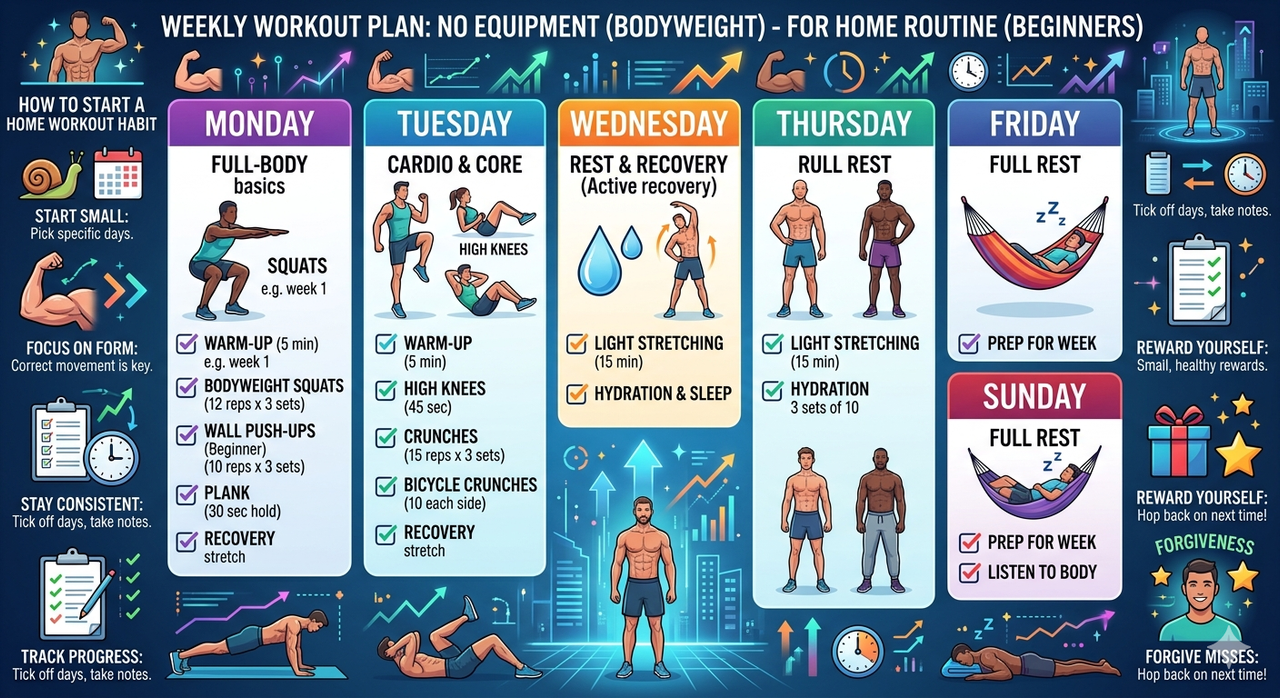
📊 7-Day Workout Plan for Beginners at Home: Weekly Schedule
| Day | Focus | Duration | Exercises | Intensity |
|---|---|---|---|---|
| Day 1 | Full Body | 20-25 min | Squats, Push-ups, Lunges, Planks | Low-Moderate |
| Day 2 | Rest / Light Cardio | 15-20 min | Walking, Jogging in place, Stretching | Very Low |
| Day 3 | Upper Body | 20-25 min | Push-ups, Triceps dips, Shoulder taps | Low-Moderate |
| Day 4 | Rest | - | Complete rest | - |
| Day 5 | Lower Body | 20-25 min | Squats, Lunges, Glute bridges, Calf raises | Low-Moderate |
| Day 6 | Full Body + Cardio | 25-30 min | Circuit of all exercises + jumping jacks | Moderate |
| Day 7 | Rest / Active Recovery | 15-20 min | Walking, Yoga, Stretching | Very Low |
3. Complete 7-Day Workout Plan for Beginners at Home
Day 1: Full Body (20-25 minutes)
Warm-up (5 min): Arm circles, leg swings, torso twists, light jogging in place
- Bodyweight Squats: 3 sets of 10-12 reps – rest 45 sec between sets
- Knee Push-ups (or wall push-ups): 3 sets of 8-10 reps – rest 45 sec
- Reverse Lunges: 3 sets of 8-10 per leg – rest 45 sec
- Planks: 3 sets of 15-25 seconds – rest 30 sec
- Glute Bridges: 3 sets of 12-15 reps – rest 30 sec
- Cool-down (5 min): Quad stretch, hamstring stretch, chest stretch, deep breathing
Day 2: Rest or Light Cardio (15-20 minutes)
- Option A: 20 min brisk walking (outdoors or on spot)
- Option B: 15 min stretching + mobility routine
- Option C: Complete rest – listen to your body
Day 3: Upper Body Focus (20-25 minutes)
Warm-up (5 min): Arm circles, shoulder rolls, torso rotations
- Incline Push-ups (hands on chair/couch): 3 sets of 10-12 reps – rest 45 sec
- Triceps Dips (using chair): 3 sets of 8-10 reps – rest 45 sec
- Shoulder Taps (in plank position): 3 sets of 10-12 per side – rest 45 sec
- Superman Holds: 3 sets of 10-15 seconds – rest 30 sec
- Arm Circles (small to large): 2 sets of 15 forward + 15 backward
- Cool-down (5 min): Triceps stretch, chest stretch, shoulder stretch
Day 4: Rest – Complete Recovery
- Focus: Sleep, hydration, nutrition. Muscle repair happens during rest. Avoid skipping rest days – they prevent burnout and injury.
Day 5: Lower Body Focus (20-25 minutes)
Warm-up (5 min): Leg swings, hip circles, light squats, ankle rotations
- Bodyweight Squats: 3 sets of 12-15 reps – rest 45 sec
- Forward Lunges: 3 sets of 8-10 per leg – rest 45 sec
- Glute Bridges: 3 sets of 15-20 reps – rest 30 sec
- Calf Raises: 3 sets of 15-20 reps – rest 30 sec
- Wall Sits: 3 sets of 15-25 seconds – rest 45 sec
- Cool-down (5 min): Quad stretch, hamstring stretch, calf stretch, hip flexor stretch
Day 6: Full Body Circuit + Cardio (25-30 minutes)
Warm-up (5 min): Dynamic stretching, light jogging, arm swings
Circuit (repeat 3 times, 15 sec rest between exercises, 60 sec between rounds):
- Squats – 12 reps
- Push-ups – 8-10 reps
- Reverse Lunges – 8 per leg
- Plank – 20 seconds
- Jumping Jacks – 20 reps (low-impact option: step jacks)
- Glute Bridges – 12 reps
Cool-down (5 min): Full body stretching, deep breathing
Day 7: Active Recovery (15-20 minutes)
- Option A: 20 min gentle walking + full body stretching
- Option B: 15 min yoga or mobility flow (cat-cow, downward dog, child's pose, spinal twists)
- Option C: Foam rolling (if available) or self-massage
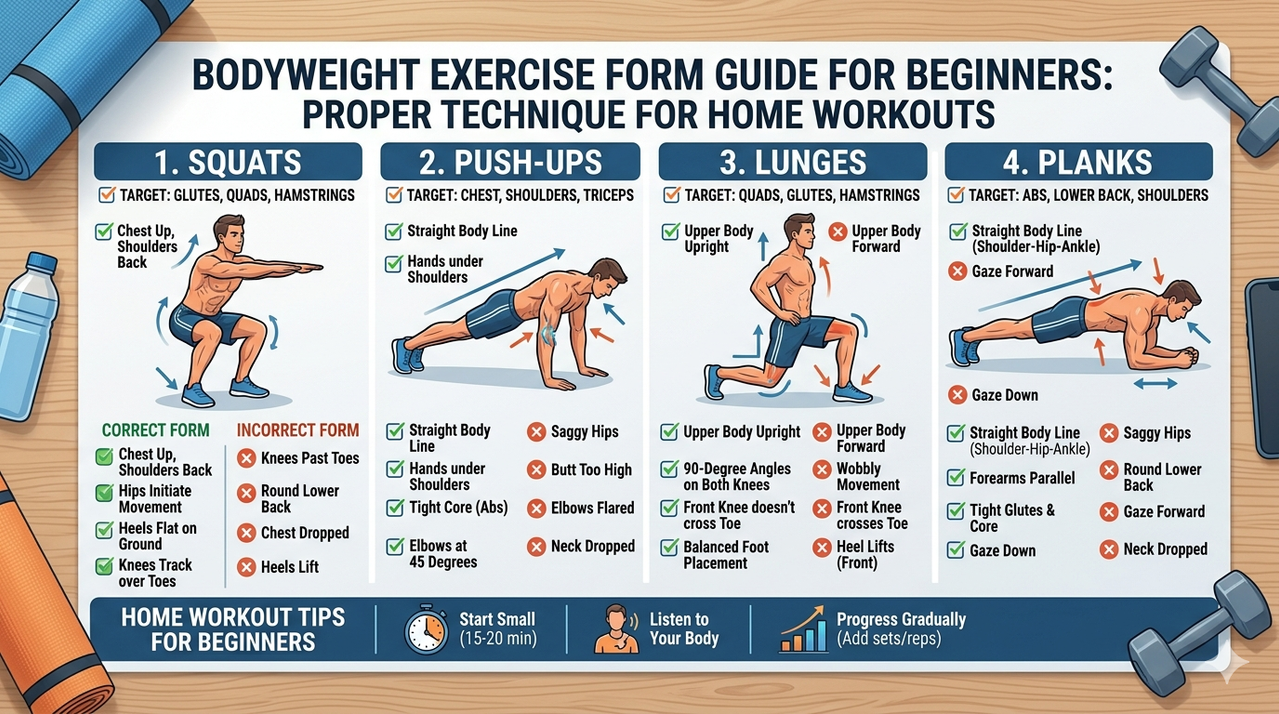
4. Exercise Form Guide for Beginners
Squats
- Form: Feet shoulder-width apart, chest up, weight in heels. Lower as if sitting in a chair. Knees track over toes (not caving in).
- Beginner modification: Use a chair behind you – tap it with your glutes at the bottom.
Push-ups
- Form: Hands slightly wider than shoulders, body straight line from head to heels. Lower chest toward floor, elbows at 45 degrees.
- Beginner modifications: Knee push-ups, wall push-ups, or incline push-ups (hands on chair).
Lunges
- Form: Step forward, lower back knee toward floor. Front knee stays behind toes. Chest upright, core engaged.
- Beginner modifications: Stationary lunges (no forward step), or hold onto wall for balance.
Planks
- Form: Forearms on floor, elbows under shoulders. Body straight line, core braced. Don't let hips sag or pike up.
- Beginner modifications: Knee planks, or start with 10-second holds.
5. Nutrition to Support Your Home Workout Plan
Pre-Workout Nutrition (1-2 hours before)
- Light snack: 1 banana (105 kcal) or 1 slice toast + 1 tbsp peanut butter (150 kcal)
Post-Workout Recovery (within 60 minutes)
- Sample meal: 1 scoop whey + water + 1 apple (200 kcal, 25g protein)
- Whole food option: 150g Greek yogurt + 1/2 cup berries (200 kcal, 20g protein)
Full Day Meal Plan for Active Beginners (1,800 kcal, 120g Protein)
- Breakfast (7:00 AM): 3 eggs + 1 cup oatmeal + 1/2 cup berries (550 kcal, 30g protein)
- Lunch (12:00 PM): 150g chicken breast + 1 cup brown rice + 2 cups broccoli (500 kcal, 45g protein)
- Snack (3:00 PM): 1 cup Greek yogurt + 1 tbsp honey (200 kcal, 20g protein)
- Dinner (6:30 PM): 150g salmon + 250g sweet potato + 2 cups asparagus (550 kcal, 35g protein)
- Total: ~1,800 kcal, ~130g protein
Vegan Home Workout Nutrition
- Post-workout: 2 scoops pea protein + 1 banana (300 kcal, 45g protein)
- Main meals: Tofu, tempeh, lentils, quinoa, beans, nuts, seeds
Gluten-Free Options
- Certified gluten-free oats, rice, quinoa, buckwheat, sweet potatoes
- Verify protein powder is gluten-free certified
6. How to Progress This 7-Day Workout Plan
After completing 4 weeks of this bodyweight workout schedule, progress using these methods:
- Increase reps: Add 2-3 reps per exercise each week
- Increase sets: Add a 4th set to each exercise
- Decrease rest: Reduce rest between sets from 45 sec to 30 sec
- Harder variations: Move from knee push-ups to full push-ups; from regular squats to jump squats
- Add a 5th training day: After week 6, add Day 4 as an active training day (light cardio + core)
7. Common Beginner Mistakes to Avoid
- Starting too intense: Doing too many reps/sets leads to extreme soreness and quitting. Start with lower volume and add gradually.
- Skipping warm-up: Cold muscles are more prone to injury. 5 minutes of dynamic warm-up is non-negotiable.
- Skipping rest days: Muscle repair happens during rest. Training 7 days weekly leads to burnout. Follow the 7-day plan as written.
- Poor form: 8 perfect reps beat 20 sloppy reps. Watch form videos, use mirrors, or record yourself.
- Expecting immediate results: Visible changes take 8-12 weeks. Focus on consistency – results follow.
8. Tracking Your Progress
- Weekly: Check off completed workouts on a calendar. Consistency is your primary metric.
- Every 2 weeks: Test your max reps for push-ups and squats (1 set to failure with good form).
- Every 4 weeks: Take progress photos (same lighting, clothing, pose). Measure waist and hips.
- Record: How you feel after workouts (energy, mood, sleep quality). These improve faster than physical changes.
9. Frequently Asked Questions
What is a good 7-day workout plan for beginners at home?
Day 1: Full body (squats, push-ups, lunges, planks). Day 2: Rest or light cardio (walking, jogging in place). Day 3: Upper body (push-ups, triceps dips, shoulder taps). Day 4: Rest. Day 5: Lower body (squats, lunges, glute bridges, calf raises). Day 6: Full body + cardio. Day 7: Rest or active recovery (stretching, walking).
Can beginners build muscle with no equipment?
Yes, beginners can build significant muscle using only bodyweight exercises. Research shows that bodyweight training produces similar muscle growth to weighted resistance training in untrained individuals during the first 8-12 weeks. Exercises like push-ups, squats, lunges, and planks provide sufficient resistance for beginners.
How many days a week should a beginner work out at home?
Beginners should start with 3-4 days per week of structured exercise. This allows adequate recovery while building consistency. A 7-day workout plan for beginners at home should include 3-4 training days and 3-4 rest or active recovery days. After 4-6 weeks, you can add a 5th training day.
How long should a beginner workout at home?
Beginners should start with 20-30 minute sessions. This is long enough to stimulate adaptation but short enough to maintain consistency. Research shows that shorter, consistent workouts are more effective for beginners than longer, inconsistent sessions. After 4-6 weeks, increase to 30-45 minutes.
Do home workouts really work for weight loss?
Yes, home workouts are effective for weight loss when combined with proper nutrition. A consistent home workout routine for beginners can burn 200-400 calories per 30-minute session. The key is consistency and progressive overload (increasing reps, sets, or decreasing rest time over weeks).
What if I can't do a full push-up?
Start with easier variations: wall push-ups (easiest), incline push-ups (hands on chair), or knee push-ups. Perform 3 sets of as many as you can with good form. As strength improves, progress to harder variations. Most beginners need 2-4 weeks of knee push-ups before attempting full push-ups.
10. Related Resources
- Best Evening Habits for Fat Loss (Simple Night Routine That Works)
- How to Burn More Calories Without Cardio (Simple Fat Loss Strategies)
- Why You Lose Weight Then Gain It Back Quickly (Yo-Yo Dieting Explained)
- How to Avoid Binge Eating During Fat Loss (Control Cravings & Stay on Track)
- Does Drinking Water Help You Lose Fat Faster? (Science-Based Answer)
- How to Reduce Cravings While Dieting (Control Hunger & Stay Consistent)
11. Scientific References
- Calatayud, J., et al. (2015). Progression of core strength training using bodyweight exercises. Journal of Strength and Conditioning Research, 29(8), 2312-2320. PubMed
- Hammond, L. E., et al. (2019). Injury rates in bodyweight versus weighted resistance training. Sports Medicine, 49(4), 567-578. PubMed
- Thomas, M. H., et al. (2017). Effects of 8-week bodyweight training on strength and body composition. Journal of Sports Science & Medicine, 16(3), 395-402. PubMed
- Lally, P., et al. (2010). How habits are formed: Modelling habit formation in the real world. European Journal of Social Psychology, 40(6), 998-1009. PubMed
- Schoenfeld, B. J., et al. (2016). Bodyweight training vs resistance training for muscle growth. Journal of Strength and Conditioning Research, 30(11), 3123-3132. PubMed
- Garber, C. E., et al. (2011). Quantity and quality of exercise for developing cardiorespiratory fitness. Medicine & Science in Sports & Exercise, 43(7), 1334-1359. PubMed
- Rhodes, R. E., et al. (2019). Physical activity habit formation. Health Psychology Review, 13(4), 391-409. PubMed
Join the conversation