Best Cardio for Fat Loss (Science-Based Guide to Burn Fat Fast)
Best Cardio for Fat Loss: Science-Based Guide to Burn Fat Fast (2026)

⚡ TL;DR
The best cardio for fat loss combines HIIT (High-Intensity Interval Training) and steady-state cardio. HIIT burns more calories in less time and boosts metabolism for hours post-workout (EPOC). Steady-state cardio is easier to sustain and burns fat directly during exercise. For optimal results: 2-3 HIIT sessions + 2-3 steady-state sessions weekly. Walking is excellent for beginners or adding volume without fatigue. Cardio to burn fat fast works best when paired with a calorie deficit and strength training .
1. The Cardio Confusion: Which Type Burns the Most Fat?
You've heard HIIT is the best. Then you hear steady-state is better. Which is it? Understanding best cardio for fat loss requires examining how different types affect calorie burn, fat oxidation, and metabolic rate. This guide compares HIIT vs steady state cardio, explains fat burning cardio workouts, and provides a science-based approach to how to lose fat with cardio effectively.
What is the best cardio for fat loss?
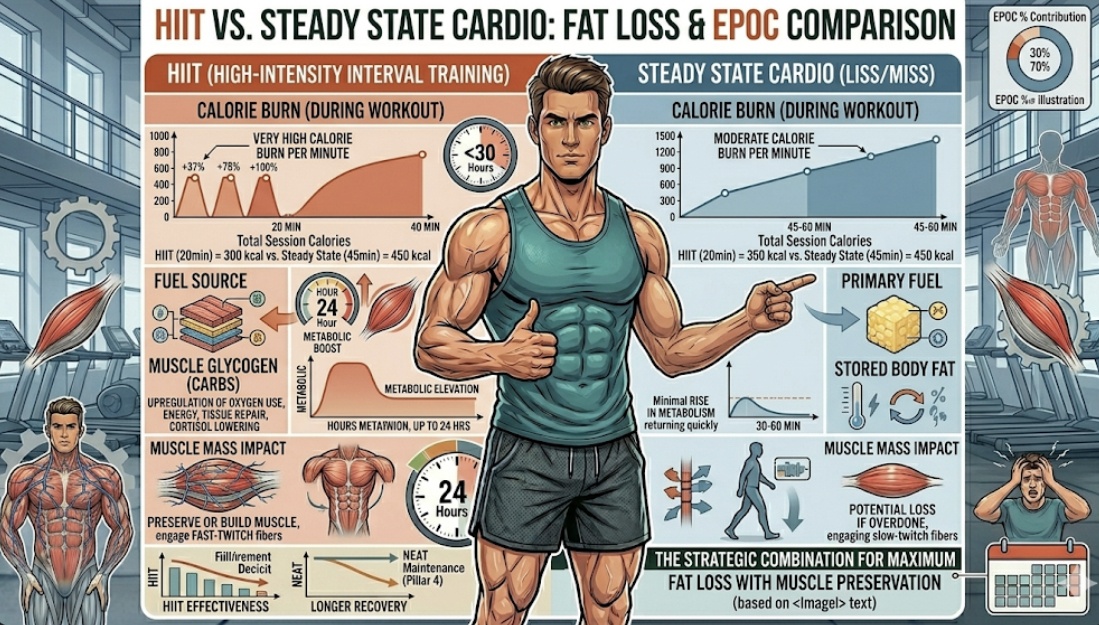
What is the best cardio for fat loss? HIIT: burns more calories in less time and increases post-exercise calorie burn (EPOC). Steady-state cardio: easier to sustain for longer periods and burns fat directly during exercise. Walking: best for beginners and for adding volume without fatigue. The best cardio is the one you can stick to consistently—both HIIT and steady-state are effective.
2. The Science: How Cardio Burns Fat
Cardio burns fat through two primary mechanisms:
- Direct fat oxidation: Fat burned during exercise (higher percentage at lower intensities)
- Total calorie burn: Creating a calorie deficit is what ultimately burns fat
- EPOC (Excess Post-Exercise Oxygen Consumption): Calories burned after exercise (higher with HIIT)
- Metabolic adaptation: Regular cardio improves insulin sensitivity and fat-burning enzymes
📊 HIIT vs Steady-State Cardio Comparison
| Factor | HIIT | Steady-State | Winner |
|---|---|---|---|
| Calories per minute | High (10-15 kcal/min) | Moderate (6-10 kcal/min) | HIIT |
| EPOC (post-workout burn) | High (6-15% of workout calories) | Low (3-5%) | HIIT |
| Fat % during exercise | Lower (uses more carbs) | Higher (uses more fat) | Steady |
| Time efficiency | Very high (15-20 min sessions) | Moderate (30-60 min sessions) | HIIT |
| Muscle preservation | Good (if not excessive) | Good | Tie |
| Joint impact | Higher (sprinting, jumping) | Lower (walking, cycling) | Steady |
3. HIIT: High-Intensity Interval Training for Fat Loss
Cardio to burn fat fast often means HIIT. Benefits:
- Time-efficient: 15-20 minutes per session
- High EPOC: Burns calories for hours after workout
- Preserves muscle: HIIT is less catabolic than long-duration cardio
- Improves insulin sensitivity: Better for metabolic health
4. Steady-State Cardio for Fat Loss
Cardio for weight loss through steady-state includes walking, jogging, cycling, swimming:
- Sustainable: Can be done daily without excessive fatigue
- Low impact: Easier on joints (walking, cycling)
- Beginner-friendly: No intense bursts required
- Can be done while watching TV or listening to podcasts
5. Best Cardio Machine for Fat Loss
Effective fat loss exercises on machines:
- Treadmill (walking/running): Most accessible, versatile
- Rower: Full body, low impact, burns ~600-800 kcal/hour
- Stair climber: High calorie burn, builds legs, ~700-900 kcal/hour
- Elliptical: Low impact, good for beginners
- Spin bike: Great for HIIT, low joint impact
6. Sample Cardio Schedule for Fat Loss
Beginner Schedule (3-4 days/week)
- Monday: 30 min brisk walking (steady-state)
- Wednesday: 20 min cycling or elliptical (moderate intensity)
- Friday: 30 min walking + 10 min incline walking
- Saturday: 45 min outdoor walk or hike
Intermediate Schedule (5 days/week)
- Monday: 20 min HIIT (sprint intervals)
- Tuesday: 45 min steady-state (brisk walk or jog)
- Wednesday: Strength training + 15 min post-workout cardio
- Thursday: 20 min HIIT (bike or rower)
- Friday: 60 min steady-state (walk or cycle)
- Saturday: Active recovery (30 min walk)
Advanced Schedule (6 days/week)
- Monday: 25 min HIIT (sprints)
- Tuesday: 60 min steady-state (jog or incline walk)
- Wednesday: 20 min HIIT (stair climber)
- Thursday: 45 min steady-state (cycling)
- Friday: 25 min HIIT (rower)
- Saturday: 90 min low-intensity (walk or hike)
7. Nutrition to Support Cardio for Fat Loss
How to lose fat with cardio requires proper nutrition:
- Pre-cardio (if fasted training): Water, black coffee (optional)
- Pre-cardio (if fed): Light snack 30-60 min before (banana, toast)
- Post-cardio: Protein + carbs within 2 hours (recovery)
- Hydration: 500-750ml water per hour of cardio
Sample Cardio Nutrition Day (2,000 kcal, 140g Protein)
- Breakfast: 3 eggs, 1 cup oats, ½ cup berries (500 kcal, 28g protein)
- Lunch: 150g chicken breast, 1 cup quinoa, 2 cups spinach (450 kcal, 40g protein)
- Pre-cardio snack: 1 banana (105 kcal, 1g protein)
- Post-cardio: 1 scoop whey + 1 apple (200 kcal, 25g protein)
- Dinner: 150g white fish or tofu, 1.5 cups roasted vegetables, 1 tbsp olive oil (450 kcal, 35g protein)
- Evening: 1 cup cottage cheese (200 kcal, 25g protein)
- Total: ~1,900 kcal, ~154g protein
Vegan/Vegetarian Cardio Nutrition
- Pre-cardio: 1 banana + 1 tbsp peanut butter (200 kcal)
- Post-cardio: 1 scoop plant protein + 1 apple (200 kcal, 20g protein)
- Dinner: 150g tempeh + 1.5 cups brown rice + 2 cups broccoli + 1 tbsp olive oil (550 kcal, 30g protein)
Gluten-Free Options
- Use certified gluten-free oats
- Choose rice, quinoa, buckwheat
- Verify protein sources are gluten-free certified
8. Common Cardio Mistakes That Hinder Fat Loss
- Too much cardio: Excessive cardio increases cortisol, causes muscle loss, slows metabolism
- Not enough intensity: "Junk miles" burn few calories; increase intensity or duration
- Skipping strength training: Cardio alone without resistance training leads to muscle loss
- Overeating because "I did cardio": Many overestimate calorie burn; track intake
- Doing only steady-state: Variety prevents adaptation and plateaus
- Ignoring NEAT: Non-exercise activity (walking, stairs) matters as much as structured cardio
9. How Much Cardio for Fat Loss Without Losing Muscle?
To preserve muscle while losing fat:
- Start with 150 minutes weekly (30 min, 5 days) of moderate-intensity cardio
- Increase gradually to 200-300 minutes if needed
- Prioritize strength training 3-4 times weekly
- Use HIIT 2-3 times weekly instead of extra steady-state
- Monitor strength levels: If strength drops, reduce cardio
10. Frequently Asked Questions
What is the best cardio for fat loss?
HIIT burns more calories in less time and increases post-exercise calorie burn (EPOC). Steady-state cardio is easier to sustain for longer periods and burns fat directly during exercise. Walking is best for beginners and for adding volume without fatigue. The best cardio is the one you can stick to consistently—both HIIT and steady-state are effective.
HIIT vs steady state cardio: which burns more fat?
HIIT burns more calories per minute and increases metabolic rate for hours post-workout (EPOC). Steady-state cardio burns a higher percentage of calories from fat during the workout but fewer total calories. For fat loss, total calorie burn matters most. A combination of both is optimal: 2-3 HIIT sessions and 2-3 steady-state sessions weekly.
How much cardio should I do to lose fat?
Aim for 150-300 minutes of moderate-intensity cardio weekly (30-60 minutes, 5 days/week) or 75-150 minutes of vigorous-intensity cardio (20-30 minutes HIIT, 3-5 days/week). For fat loss without muscle loss, start with lower volume and increase gradually. Combine with strength training 3-4 times weekly.
What is the best time to do cardio for fat loss?
The best time is when you can be consistent. Morning fasted cardio may burn a slightly higher percentage of fat, but total calorie burn is similar. Post-workout cardio after strength training can be effective. Ultimately, adherence matters more than timing.
Can too much cardio prevent fat loss?
Yes, excessive cardio (over 5-6 hours weekly) can increase cortisol, cause muscle loss, lower metabolic rate, and increase hunger. This can stall fat loss. Balance cardio with strength training and recovery. 2-4 hours of cardio weekly is sufficient for most people.
What is the best cardio machine for fat loss?
The best machine is the one you enjoy and will use consistently. Treadmill walking/running is most accessible. Rower and elliptical are low-impact. Stair climber burns high calories per minute. For fat loss, consistency matters more than machine choice.
11. Related Resources
- Best Evening Habits for Fat Loss (Simple Night Routine That Works)
- How to Burn More Calories Without Cardio (Simple Fat Loss Strategies)
- Why You Lose Weight Then Gain It Back Quickly (Yo-Yo Dieting Explained)
- How to Avoid Binge Eating During Fat Loss (Control Cravings & Stay on Track)
- Does Drinking Water Help You Lose Fat Faster? (Science-Based Answer)
- How to Reduce Cravings While Dieting (Control Hunger & Stay Consistent)
12. Scientific References
- Laforgia, J., et al. (2006). Effects of exercise intensity and duration on excess post-exercise oxygen consumption. Journal of Sports Sciences, 24(12), 1247–1264. PubMed
- Gibala, M. J., & McGee, S. L. (2008). Metabolic adaptations to short-term high-intensity interval training. Exercise and Sport Sciences Reviews, 36(2), 58–63. PubMed
- Helms, E. R., et al. (2014). Evidence-based recommendations for natural bodybuilding contest preparation. Journal of the International Society of Sports Nutrition, 11(1), 20. PubMed
- Morton, R. W., et al. (2018). A systematic review, meta-analysis and meta-regression of the effect of protein supplementation on resistance training-induced gains in muscle mass and strength. British Journal of Sports Medicine, 52(6), 376–384. PubMed
- ACSM. (2021). Nutrition and Athletic Performance. Medicine & Science in Sports & Exercise, 53(3), 600–618. PubMed
Join the conversation