Best Rep Range for Strength vs Size (Hypertrophy vs Power Guide)
Best Rep Range for Strength vs Size: Hypertrophy vs Power Guide (2026)

⚡ TL;DR
The best rep range for strength vs size depends on your goal. For maximal strength: 1-5 reps (85-100% 1RM). For muscle size (hypertrophy): 6-12 reps (65-85% 1RM). For endurance: 12-20+ reps (below 65% 1RM). This hypertrophy vs power guide explains the science behind best reps for muscle growth, strength training reps, and low reps vs high reps. Learn how to structure your bodybuilding rep ranges and muscle size vs strength training for optimal results. The most effective approach combines all rep ranges through periodization.
1. The Rep Range Spectrum: Strength vs Size vs Endurance
Not all reps are created equal. The number of repetitions you perform directly impacts which physiological adaptations occur. Understanding the rep range for strength vs size is fundamental to achieving your training goals.
This guide provides a complete hypertrophy vs power guide covering everything from best reps for muscle growth to strength training reps and low reps vs high reps. Whether you're focused on bodybuilding rep ranges or pure strength, you'll learn how to optimize your training.
What is the best rep range for strength vs size?
What is the best rep range for strength vs size? Strength: 1-5 reps (heavy weight, 85-100% 1RM). Size (Hypertrophy): 6-12 reps (moderate weight, 65-85% 1RM). Endurance: 12-20+ reps (lighter weight, below 65% 1RM). For most lifters, combining all ranges (periodization) produces best results.
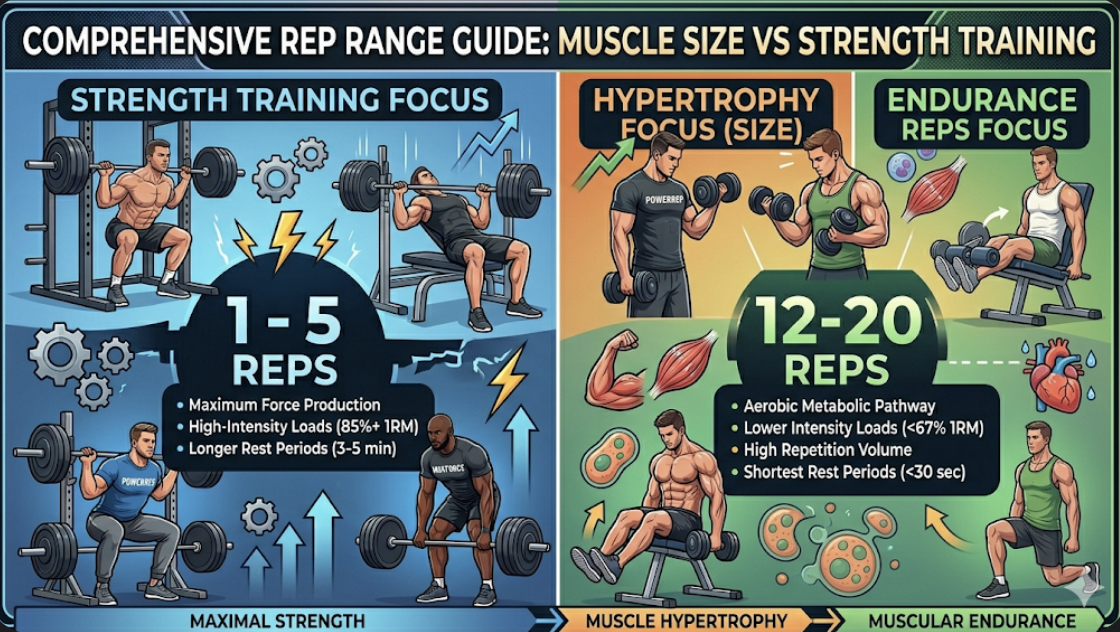
2. The Science: How Different Rep Ranges Affect Your Body
The rep range for strength vs size is rooted in three primary mechanisms of muscle adaptation:
- Mechanical tension (1-5 reps): Heavy loads create high mechanical tension, which drives neurological adaptations and strength gains. Primary driver for strength.
- Metabolic stress (6-12 reps): Moderate loads with shorter rest periods create metabolic stress (cell swelling, lactate accumulation), which is a key driver of hypertrophy (muscle growth).
- Muscle damage (8-12+ reps): Higher rep ranges with controlled tempo create muscle damage, which stimulates repair and growth when combined with proper recovery.
A 2015 meta-analysis by Schoenfeld et al. found that moderate rep ranges (6-12) produced slightly greater hypertrophy than low (1-5) or high (15+) rep ranges, but all rep ranges built muscle when taken close to failure. For strength, low rep ranges (1-5) were superior.
📊 Complete Rep Range Guide: Strength vs Hypertrophy vs Endurance
| Goal | Rep Range | % of 1RM | Sets per Exercise | Rest Period | Primary Adaptation |
|---|---|---|---|---|---|
| Maximal Strength | 1-5 | 85-100% | 3-6 | 3-5 min | Neural adaptations, CNS efficiency |
| Hypertrophy (Size) | 6-12 | 65-85% | 3-5 | 60-90 sec | Muscle fiber growth, metabolic stress |
| Strength-Endurance | 12-15 | 55-70% | 2-4 | 45-60 sec | Hypertrophy + endurance |
| Muscular Endurance | 15-25+ | <55% | 2-3 | 30-45 sec | Capillary density, fatigue resistance |
3. Low Reps (1-5): Maximal Strength Focus
Low reps vs high reps – low rep training (1-5 reps) is the foundation of strength training reps. Here's what you need to know:
- Primary adaptations: Neurological efficiency, motor unit recruitment, rate of force development, tendon stiffness
- Best for: Powerlifters, strength athletes, increasing 1RM on compound lifts
- Volume recommendation: 15-30 total reps per movement per week (e.g., 5x5 = 25 reps)
- Exercise selection: Compound lifts primarily (squat, deadlift, bench press, overhead press, rows)
- Frequency: Train each main lift 2-3x weekly
Research shows that low rep training produces superior strength gains compared to higher rep ranges (Schoenfeld et al., 2016). However, low reps alone may not maximize muscle growth – combining with hypertrophy work is ideal.
4. Moderate Reps (6-12): Maximum Hypertrophy (Size)
The hypertrophy rep range of 6-12 reps is widely considered optimal for best reps for muscle growth. Here's why:
- Primary adaptations: Muscle fiber hypertrophy (both Type I and Type II), metabolic stress, cell swelling, increased protein synthesis
- Best for: Bodybuilders, anyone prioritizing muscle size, general fitness
- Volume recommendation: 40-70 total reps per muscle group per week (e.g., 4x10 = 40 reps)
- Exercise selection: Mix of compound and isolation exercises
- Frequency: Train each muscle group 2x weekly
A 2017 meta-analysis by Schoenfeld et al. found that moderate rep ranges (6-12) produced slightly greater hypertrophy than low (1-5) or high (15-20) rep ranges when volume was equated. However, all rep ranges built muscle when taken close to failure.
5. High Reps (12-20+): Muscular Endurance & Metabolic Stress
High rep training (12-20+ reps) has its place in a well-rounded program, especially for muscle size vs strength training balance:
- Primary adaptations: Capillary density, mitochondrial biogenesis, metabolic stress, fatigue resistance, lactate threshold
- Best for: Endurance athletes, deload weeks, finishing sets, injury rehabilitation
- Volume recommendation: 60-100+ total reps per muscle group
- Exercise selection: Isolation exercises, machine work, bodyweight movements
- Frequency: Can be performed more frequently due to lower CNS fatigue
High reps can still build muscle – research shows that rep ranges from 5-30 produce similar hypertrophy when sets are taken to failure (Schoenfeld & Grgic, 2019). However, high rep sets are less time-efficient for hypertrophy.
6. Sample Training Programs for Each Goal
Program A: Strength Focus (Powerlifting Style)
- Monday (Squat Focus): Squat 5x5, Romanian Deadlift 3x8, Leg Press 3x10, Core 3x15
- Tuesday (Bench Focus): Bench Press 5x5, Overhead Press 3x8, Pull-ups 3x8, Triceps 3x10, Rows 3x10
- Wednesday: Rest
- Thursday (Deadlift Focus): Deadlift 3x3, Front Squat 3x8, Lunges 3x10, Core 3x15
- Friday (Overhead Press Focus): Overhead Press 5x5, Incline Bench 3x8, Pull-ups 3x8, Curls 3x10, Face Pulls 3x15
- Weekend: Rest or light cardio
Program B: Hypertrophy (Bodybuilding Style)
- Monday (Push): Bench Press 4x8-12, Incline DB Press 3x10-12, Overhead Press 3x10-12, Lateral Raises 3x12-15, Triceps 3x12-15
- Tuesday (Pull): Pull-ups 4x8-10, Barbell Rows 4x8-12, Face Pulls 3x15-20, Bicep Curls 3x10-12, Hammer Curls 3x10-12
- Wednesday (Legs): Squats 4x8-12, Romanian Deadlifts 3x10-12, Leg Press 3x10-15, Leg Curls 3x12-15, Calf Raises 4x15-20
- Thursday: Rest
- Friday (Upper): Incline Press 3x10-12, Seated Rows 3x10-12, Lateral Raises 3x12-15, Curls 3x10-12, Triceps 3x10-12
- Saturday (Lower): Deadlifts 3x5-8 (strength focus), Leg Press 3x10-15, Lunges 3x10-12, Leg Extensions 3x12-15, Calf Raises 4x15-20
- Sunday: Rest
For a complete training framework, consider following a upper lower split workout or push pull legs routine with appropriate rep ranges for your goal.
7. Periodization: Combining All Rep Ranges for Best Results
The most effective long-term approach is periodization – systematically varying rep ranges over time. This prevents plateaus and develops all qualities (strength, size, endurance).
- Linear periodization (classic): Weeks 1-4: 12-15 reps (hypertrophy), Weeks 5-8: 6-8 reps (strength-hypertrophy), Weeks 9-12: 3-5 reps (strength). Deload, then repeat or increase weights.
- Daily undulating periodization (DUP): Monday: Heavy (3-5 reps), Wednesday: Moderate (8-10 reps), Friday: Light (12-15 reps). Research shows DUP produces superior strength and hypertrophy gains (Miranda et al., 2011).
- Block periodization: 4-week hypertrophy block (6-12 reps), 4-week strength block (3-6 reps), 4-week power block (1-3 reps).
For most lifters, daily undulating periodization (DUP) is the most effective and easiest to implement. For more on progressive overload, see our how to build muscle fast guide.
8. Nutrition to Support Different Training Goals
For Strength Training (Maintenance or slight surplus)
- Calories: Maintenance to +200 surplus (minimize fat gain while maximizing strength)
- Protein: 1.8-2.2 g/kg (supports recovery and neural adaptations)
- Carbs: 4-5 g/kg (fuels high-intensity strength work)
For Hypertrophy (Moderate surplus)
- Calories: +200-400 surplus (supports muscle growth without excessive fat)
- Protein: 1.8-2.2 g/kg (optimal for muscle protein synthesis)
- Carbs: 4-6 g/kg (fuels volume work and recovery)
Sample Hypertrophy Meal Plan (2,800 kcal, 170g Protein)
- Breakfast (7:00 AM): 4 eggs + 1.5 cups oatmeal + 1 cup milk (650 kcal, 40g protein)
- Lunch (12:00 PM): 200g chicken breast + 1.5 cups brown rice + 2 cups broccoli (600 kcal, 50g protein)
- Pre-workout snack (3:00 PM): 1 banana + 1 tbsp peanut butter (200 kcal, 5g protein)
- Post-workout (5:30 PM): 2 scoops whey + 1 apple (250 kcal, 48g protein)
- Dinner (7:00 PM): 200g salmon + 300g sweet potato + 2 cups asparagus (700 kcal, 40g protein)
- Evening snack (9:30 PM): 1 cup Greek yogurt (150 kcal, 20g protein)
For more meal ideas, check out full day of eating for muscle gain or 7-day meal plan for muscle gain.
Vegan Bodybuilding Nutrition
- Breakfast: 1.5 cups tofu scramble + 1.5 cups oats + 2 cups soy milk (650 kcal, 45g protein)
- Lunch: 200g tempeh + 1.5 cups quinoa + 2 cups mixed vegetables (600 kcal, 45g protein)
- Post-workout: 2 scoops pea protein + 1 banana (300 kcal, 45g protein)
Gluten-Free Options
- Certified gluten-free oats, rice, quinoa, buckwheat, sweet potatoes
- Verify protein powder is gluten-free certified
9. Common Mistakes with Rep Ranges
- Always training in one rep range: Specializing exclusively in one rep range leads to imbalances and plateaus. Periodize or use DUP.
- Not taking sets close to failure: Reps need to be challenging. Leaving 5+ reps "in the tank" reduces stimulus, regardless of rep range.
- Using too much weight for high reps: High rep sets with poor form or momentum defeat the purpose. Reduce weight, control tempo.
- Insufficient rest for strength work: Low rep sets require 3-5 minutes rest for full ATP regeneration. Shortchanging rest limits strength gains.
- Too much rest for hypertrophy: 60-90 seconds rest optimizes metabolic stress. Longer rest reduces hypertrophy stimulus.
- Neglecting compound lifts for isolation: Compound lifts should form the foundation of any program, regardless of rep range.
10. Frequently Asked Questions
What is the best rep range for strength vs size?
Strength: 1-5 reps (heavy weight, 85-100% 1RM). Size (Hypertrophy): 6-12 reps (moderate weight, 65-85% 1RM). Endurance: 12-20+ reps (lighter weight, below 65% 1RM). For most lifters, combining all ranges (periodization) produces best results.
What rep range builds the most muscle?
The hypertrophy rep range of 6-12 reps per set is most effective for muscle growth. Research shows that 6-12 reps produce optimal mechanical tension and metabolic stress. However, rep ranges from 5-30 can build muscle when sets are taken close to failure, making 6-12 the most efficient range.
Do low reps build muscle?
Yes, low reps (1-5) build muscle, especially when combined with higher volume. Low reps with heavy weight produce mechanical tension and neurological adaptations. However, for pure hypertrophy, 6-12 reps are slightly more effective because they allow more total volume and metabolic stress. A mix of both is ideal.
How many sets and reps for strength training?
For strength: 3-5 sets of 1-5 reps at 85-100% 1RM. Rest 3-5 minutes between sets. Focus on compound lifts (squat, deadlift, bench press, overhead press, rows). Train each main lift 2-3 times weekly. Total weekly volume: 15-30 heavy reps per movement pattern.
What is better: high reps or low reps?
Neither is universally better – they serve different goals. Low reps (1-5) are best for maximal strength. Moderate reps (6-12) are best for muscle size (hypertrophy). High reps (12-20+) are best for muscular endurance. For most trainees, a periodized approach using all rep ranges produces best overall results.
How many reps for a mix of strength and size?
For a mix of strength and size, use daily undulating periodization (DUP): Heavy day (3-5 reps), Moderate day (8-10 reps), Light day (12-15 reps). This develops both qualities simultaneously. Research shows DUP produces superior strength and hypertrophy gains compared to linear periodization.
11. Related Resources
- Best Time to Work Out for Muscle Growth (Morning vs Evening Guide)
- How to Break a Muscle Growth Plateau Fast (Proven Strategies That Work)
- Why Your Muscles Are Not Sore After Workout (Is It a Bad Sign?)
- Can You Build Muscle in a Calorie Deficit? (Fat Loss & Muscle Gain Explained)
- How Much Protein Do You Really Need Per Day? (Expert Guide)
- Best Rest Time Between Sets for Muscle Growth (Science-Based Guide)
12. Scientific References
- Schoenfeld, B. J., et al. (2015). Effects of different volume-equated resistance training loading strategies on muscular adaptations in well-trained men. Journal of Strength and Conditioning Research, 29(10), 2772-2780. PubMed
- Schoenfeld, B. J., et al. (2016). Effects of resistance training frequency on measures of muscle hypertrophy: A systematic review and meta-analysis. Sports Medicine, 46(11), 1689-1697. PubMed
- Schoenfeld, B. J., & Grgic, J. (2019). Does training to failure maximize muscle hypertrophy? Strength and Conditioning Journal, 41(5), 101-108. PubMed
- Miranda, F., et al. (2011). Effects of linear versus daily undulatory periodized resistance training on maximal strength and muscle hypertrophy. Journal of Strength and Conditioning Research, 25(7), 1824-1830. PubMed
- Grgic, J., et al. (2018). Effects of resistance training frequency on skeletal muscle hypertrophy: A systematic review and meta-analysis. Sports Medicine, 48(9), 2145-2158. PubMed
- Morton, R. W., et al. (2018). A systematic review, meta-analysis and meta-regression of the effect of protein supplementation on resistance training-induced gains in muscle mass and strength. British Journal of Sports Medicine, 52(6), 376-384. PubMed
- Helms, E. R., et al. (2014). Evidence-based recommendations for natural bodybuilding contest preparation. Journal of the International Society of Sports Nutrition, 11(1), 20. PubMed
Join the conversation