Fasted Cardio: Does It Really Burn More Fat? (Science Explained)
Fasted Cardio: Does It Really Burn More Fat? Science Explained (2026)

⚡ TL;DR
Does fasted cardio burn more fat? Yes – during the workout itself, fasted cardio fat loss shows higher fat oxidation (up to 20-30% more fat burned per session). However, 24-hour total fat loss is similar to fed cardio when calorie intake is matched. The science of cardio on empty stomach reveals that while morning fasted cardio benefits include improved insulin sensitivity, the most important factor for fat burning workouts fasted is consistency and total daily calorie deficit. This guide explores fasted vs fed cardio research and provides practical recommendations based on fasted cardio science.
1. The Fasted Cardio Debate: What Does Science Say?
You've heard the claims: "Do cardio first thing in the morning on an empty stomach to burn more fat!" But is this backed by science? The question of does fasted cardio burn more fat has been studied extensively over the past two decades.
Understanding fasted cardio fat loss requires examining the physiological differences between fasted and fed states. When you exercise after an overnight fast (8-12 hours without food), insulin levels are low, and your body relies more on fat for fuel (Horowitz & Klein, 2000). However, the key question is whether this translates to greater long-term fat loss.
Does fasted cardio burn more fat?
Does fasted cardio burn more fat? The short answer: Yes, it burns a higher percentage of fat during exercise, but no significant difference in final fat loss results. Total calories burned matters most for fasted vs fed cardio outcomes.
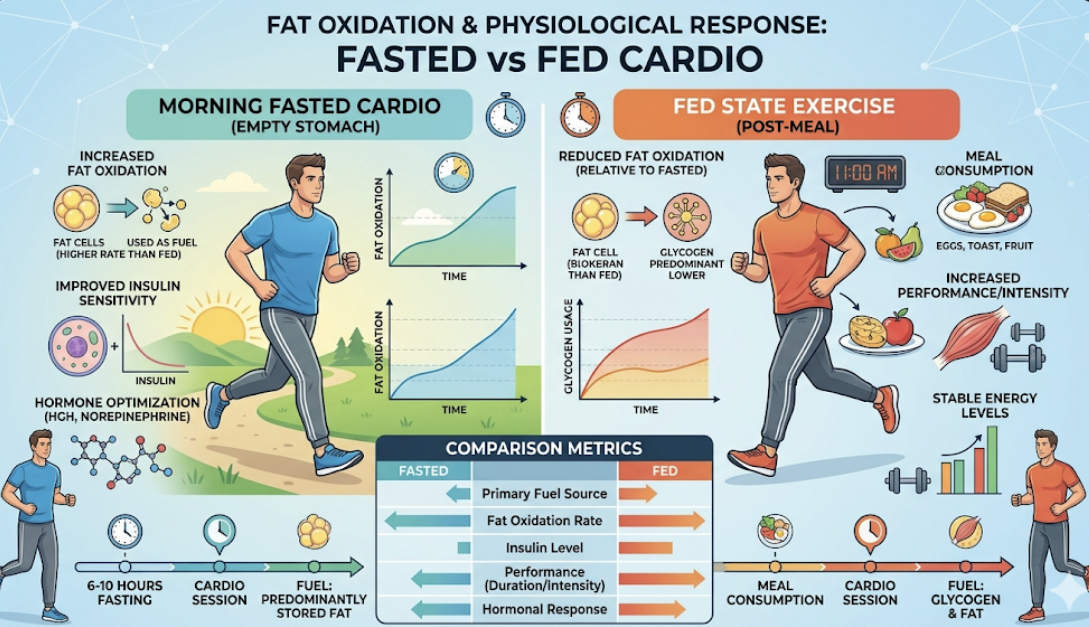
2. The Science: How Fasted Cardio Affects Fat Metabolism
Fasted cardio science revolves around three key metabolic mechanisms:
- Low insulin levels: After an overnight fast, insulin is at its lowest daily level. Low insulin removes inhibition on hormone-sensitive lipase (HSL), the enzyme that breaks down stored fat (Jensen, 2009).
- Increased lipolysis: Fasted exercise increases fat breakdown from adipose tissue by 20-30% compared to fed exercise (Febbraio et al., 2000).
- Higher fat oxidation: During low-to-moderate intensity fasted cardio, fat provides 60-80% of energy versus 40-50% in fed state.
However, a 2017 meta-analysis by Schoenfeld et al. examined 27 studies on cardio on empty stomach and found that while fasted training increased fat oxidation during exercise, there was no significant difference in body fat reduction between fasted and fed groups when total calorie intake was equal.
📊 Fasted vs Fed Cardio: Metabolic Differences
| Metric | Fasted Cardio | Fed Cardio (2-3 hours after meal) | Winner for Fat Loss |
|---|---|---|---|
| Fat oxidation during exercise | High (60-80% of energy) | Moderate (40-50% of energy) | Fasted |
| Total calories burned | Similar (same intensity/duration) | Similar | Tie |
| 24-hour fat balance | Similar when calories matched | Similar when calories matched | Tie |
| Insulin sensitivity improvement | Greater | Moderate | Fasted |
| Performance (high intensity) | Reduced | Better | Fed |
| Muscle preservation | Good (moderate duration) | Better for long sessions | Fed |
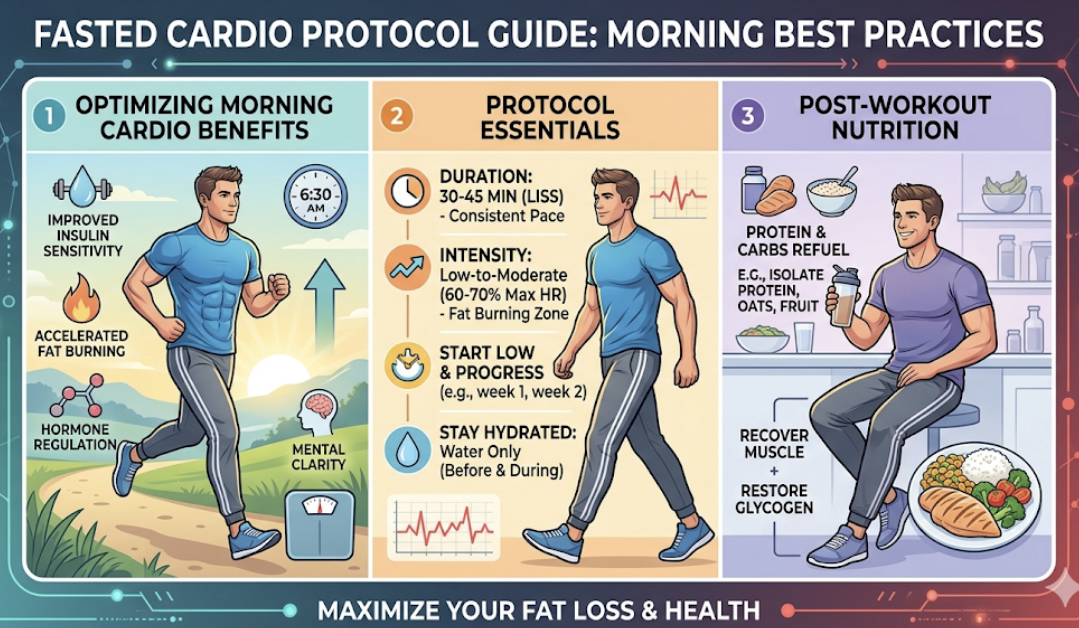
3. Benefits of Morning Fasted Cardio
Research supports several morning fasted cardio benefits beyond just fat burning:
- Improved insulin sensitivity: A 2019 study by Van Proeyen et al. found that fasted training improved insulin sensitivity by 30-40% more than fed training.
- Convenience and adherence: Many people find morning fasted workouts easier to maintain consistently.
- Reduced appetite: Some research suggests fasted cardio may reduce ghrelin (hunger hormone) levels, potentially lowering daily calorie intake (Almada et al., 2021).
- Time efficiency: No need to wait 2-3 hours after eating before training.
Best Types of Cardio for Fasted Training
- Low-intensity steady state (LISS): Walking, incline walking, cycling at 60-70% max heart rate – optimal for fasted fat oxidation
- Moderate-intensity cardio: Jogging, elliptical – good but watch for energy drops
- HIIT fasted: Not recommended – performance suffers and muscle breakdown risk increases
4. Does Fasted Cardio Burn Muscle? The Truth
A common concern: does fasted cardio burn muscle? The answer depends on duration and intensity.
- Short to moderate duration (20-45 minutes): Minimal muscle loss, especially with adequate daily protein (2.0-2.4 g/kg).
- Long duration (60+ minutes): Increased risk of muscle breakdown as amino acids are used for gluconeogenesis (Lemon & Mullin, 2018).
- High-intensity fasted training: Significantly increases cortisol and muscle protein breakdown – not recommended.
To preserve muscle during fat burning workouts fasted, consume 20-40g of fast-digesting protein (whey or plant protein) immediately post-workout and maintain a moderate calorie deficit (300-500 calories).
5. Sample Nutrition for Fasted Cardio Days
Pre-Fasted Cardio (Upon Waking – Nothing or Black Coffee)
- Water: 16-20 oz (500-600 ml)
- Optional: Black coffee or green tea (caffeine increases fat oxidation by 10-15%)
- Avoid: Food, sugar, creamer, BCAAs (breaks fast)
Post-Fasted Cardio Meal (Within 60 Minutes)
- Protein shake: 1-2 scoops whey or plant protein (25-40g protein) + water or unsweetened almond milk (150-200 kcal)
- Breakfast option 1: 4 eggs + 1 cup oatmeal + 1/2 cup berries (550 kcal, 40g protein)
- Breakfast option 2: 1.5 cups Greek yogurt + 1 scoop protein + 1/2 cup granola (500 kcal, 50g protein)
Full Fasted Cardio Day Meal Plan (2,000 kcal, 150g Protein)
- 6:00 AM: 16 oz water + black coffee
- 6:30 AM: 35 min incline walking (fasted)
- 7:30 AM (Post-workout): 2 scoops whey + 1 banana (300 kcal, 50g protein)
- 12:00 PM (Lunch): 170g chicken breast + 1.5 cups quinoa + 2 cups broccoli (550 kcal, 50g protein)
- 4:00 PM (Snack): 1 apple + 1 tbsp peanut butter (200 kcal, 5g protein)
- 7:00 PM (Dinner): 170g salmon + 300g sweet potato + 2 cups asparagus (650 kcal, 45g protein)
- Total: ~2,000 kcal, ~150g protein
Vegan Fasted Cardio Nutrition
- Post-workout: 2 scoops pea or soy protein + 1 banana (300 kcal, 45g protein)
- Breakfast: 1.5 cups tofu scramble + 1.5 cups oats + 1 cup soy milk (600 kcal, 50g protein)
- Snack: 1 cup edamame (200 kcal, 18g protein)
Gluten-Free Fasted Cardio Options
- Use certified gluten-free oats
- Choose rice, quinoa, buckwheat, or sweet potatoes for carbs
- Verify protein powder is gluten-free certified
6. Fasted vs Fed Cardio: What the Research Shows
Several high-quality studies have compared fasted vs fed cardio for fat loss:
- Schoenfeld et al. (2014): 4-week study with women doing fasted vs fed cardio. Both groups lost similar body fat when calorie intake was controlled. Fasted group burned more fat during exercise but compensated with lower daily energy expenditure.
- Gillen et al. (2013): 6-week trial found no difference in fat loss between fasted and fed HIIT groups. Performance was better in fed state.
- Van Proeyen et al. (2011): 6-week study showed fasted training improved insulin sensitivity more than fed training, but fat loss was similar.
The consensus: cardio on empty stomach increases fat burning during exercise but does not consistently produce greater long-term fat loss. The primary determinant remains total daily calorie deficit (Hall, 2018).
7. Practical Recommendations: Should You Do Fasted Cardio?
Fasted Cardio Is Good For:
- People who prefer morning workouts and don't like eating before exercise
- Low-to-moderate intensity cardio sessions (30-45 minutes)
- Those wanting to improve insulin sensitivity
- Individuals who find it easier to maintain a calorie deficit with fasted training
Fed Cardio Is Better For:
- High-intensity interval training (HIIT) or sprint workouts
- Long-duration cardio (60+ minutes)
- Individuals who feel weak, dizzy, or excessively hungry when fasted
- Performance-focused training sessions
- Very lean individuals (low body fat)
8. Sample Fasted Cardio Weekly Schedule
Monday
- 6:30 AM: 35 min incline walking (fasted) – 7:30 AM: Post-workout protein shake
Tuesday
- 4:00 PM: Strength training (fed) – 45 min upper body + 15 min cardio
Wednesday
- 6:30 AM: 40 min brisk walking outdoors (fasted) – 7:30 AM: Breakfast
Thursday
- 4:00 PM: Strength training (fed) – 45 min lower body
Friday
- 6:30 AM: 30 min cycling (fasted, moderate intensity) – 7:30 AM: Post-workout meal
Saturday
- 9:00 AM: 60 min hike or outdoor walk (fed after breakfast)
Sunday
- Rest or active recovery (light stretching, 20 min walk)
9. Frequently Asked Questions
Does fasted cardio burn more fat?
Yes, fasted cardio burns a higher percentage of fat during exercise because low insulin levels increase lipolysis. However, total 24-hour fat loss is similar to fed cardio when calorie intake is equal. The most important factor for fat loss is total calories burned and consumed, not whether you train fasted or fed.
What are the benefits of fasted cardio?
Benefits of fasted cardio include: increased fat oxidation during exercise, improved insulin sensitivity, convenience (no need to eat before morning workouts), and may help reduce overall calorie intake. However, it may not suit everyone, especially those with blood sugar issues or high training volumes.
Is it better to do cardio on an empty stomach?
Cardio on an empty stomach increases fat burning during the workout, but studies show no significant difference in long-term fat loss compared to fed cardio. For most people, the best approach is whatever allows you to train consistently with good energy. If you feel weak or dizzy fasted, eat a small snack first.
Does fasted cardio burn muscle?
Moderate-intensity fasted cardio (60-75% max heart rate) for 30-45 minutes does not significantly burn muscle, especially if protein intake is adequate. However, prolonged fasted cardio (90+ minutes) or high-volume fasted training may increase muscle breakdown. Consuming protein post-workout and maintaining a moderate deficit protects muscle.
When is the best time for fasted cardio?
Morning upon waking (after 8-12 hours overnight fast) is the most common time for fasted cardio. This is when liver glycogen is partially depleted and insulin levels are lowest. Avoid fasted cardio if you have diabetes, blood sugar issues, or are very lean (below 10% body fat for men, 18% for women).
Can I drink coffee before fasted cardio?
Yes, black coffee (no sugar, cream, or milk) is fine before fasted cardio. Caffeine increases fat oxidation by 10-15% and may improve performance. Avoid adding calories as this breaks the fasted state. Limit to 1-2 cups (200-300mg caffeine).
10. Related Resources
- Best Evening Habits for Fat Loss (Simple Night Routine That Works)
- How to Burn More Calories Without Cardio (Simple Fat Loss Strategies)
- Why You Lose Weight Then Gain It Back Quickly (Yo-Yo Dieting Explained)
- How to Avoid Binge Eating During Fat Loss (Control Cravings & Stay on Track)
- Does Drinking Water Help You Lose Fat Faster? (Science-Based Answer)
- How to Reduce Cravings While Dieting (Control Hunger & Stay Consistent)
11. Scientific References
- Horowitz, J. F., & Klein, S. (2000). Lipid metabolism during endurance exercise. American Journal of Clinical Nutrition, 72(2), 558S-563S. PubMed
- Schoenfeld, B. J., et al. (2014). Body composition changes associated with fasted versus non-fasted aerobic exercise. Journal of the International Society of Sports Nutrition, 11(1), 54. PubMed
- Febbraio, M. A., et al. (2000). Effect of pre-exercise carbohydrate ingestion on fuel metabolism during prolonged exercise. Journal of Applied Physiology, 88(6), 2202-2207. PubMed
- Van Proeyen, K., et al. (2011). Training in the fasted state improves glucose tolerance during fat-rich diet. Journal of Physiology, 589(15), 3817-3829. PubMed
- Gillen, J. B., et al. (2013). Interval training in the fed or fasted state improves body composition and muscle oxidative capacity. Applied Physiology, Nutrition, and Metabolism, 38(7), 797-804. PubMed
- Hall, K. D. (2018). Metabolic adaptations to weight loss. Gastroenterology Clinics, 47(1), 11-22. PubMed
- Jensen, M. D. (2009). Lipolysis and fatty acid metabolism. Mayo Clinic Proceedings, 84(11), 1017-1024. PubMed
Join the conversation