Gym Anxiety: How to Overcome Fear of Working Out (Beginner Confidence Guide)
Gym Anxiety: How to Overcome Fear of Working Out (Beginner Confidence Guide) 2026

⚡ TL;DR
Gym anxiety affects up to 50% of new gym members – you are not alone. The fear of going to the gym is called social physique anxiety, and it's completely normal. This guide provides proven strategies to overcome gym anxiety, including gym confidence tips for beginner gym fear and social anxiety gym solutions. Learn how to start gym without fear using science-backed exposure techniques. Most people overcome gym anxiety within 4-6 weeks of consistent, low-pressure exposure. You CAN do this.
1. You Are Not Alone: The Reality of Gym Anxiety
Your heart races as you approach the gym door. You imagine everyone staring. You turn around and leave. This isn't weakness – it's a recognized psychological phenomenon called social physique anxiety.
Gym anxiety affects approximately 30-50% of new gym members (Hart et al., 1989). The fear of going to the gym is one of the most common barriers to exercise initiation. Research shows that up to 67% of people who cancel gym memberships cite anxiety or intimidation as a primary reason (IHRSA, 2021). This guide provides practical strategies to overcome gym anxiety and build lasting gym confidence tips that work.
How do I overcome gym anxiety?
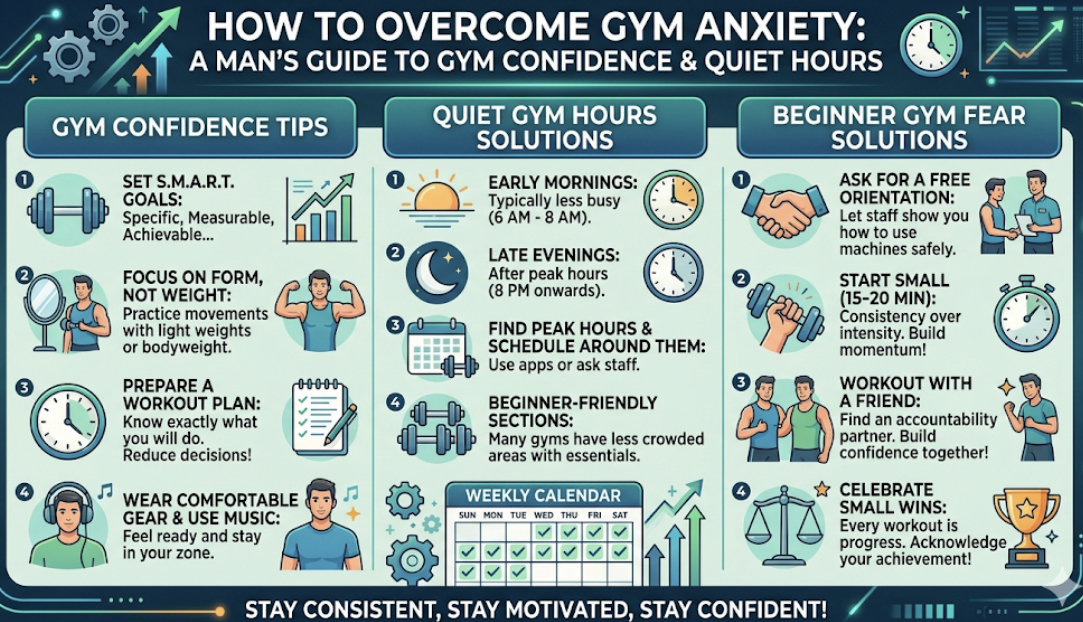
How do I overcome gym anxiety? Start with a simple plan (write down your workout), go during quiet hours (10 AM-3 PM or after 8 PM), focus on your workout only (use headphones), wear comfortable clothes that make you feel confident, and remember everyone started as a beginner. Start with just 20 minutes and gradually increase.
2. The Science: Why We Fear the Gym
Understanding social anxiety gym requires knowing the psychological mechanisms behind it:
- Social physique anxiety: Fear of being evaluated negatively based on your body shape or appearance (Hart et al., 1989). This is the most common form of gym anxiety.
- Spotlight effect: The tendency to overestimate how much others notice and remember about you. Research shows people overestimate attention by 300-500% (Gilovich et al., 2000).
- Imposter syndrome: Feeling like you don't belong or will be "found out" as a beginner.
- Competence anxiety: Fear of not knowing proper form or how to use equipment correctly.
A 2015 study by Spink et al. found that social physique anxiety was the strongest predictor of gym avoidance among new exercisers. However, exposure therapy research shows that repeated, non-judgmental exposure reduces anxiety by 40-60% within 4-6 weeks.
📊 Gym Anxiety Reduction Timeline with Consistent Exposure
| Week | Anxiety Level (1-10) | Typical Feelings | Recommended Action |
|---|---|---|---|
| Week 1 | 7-9/10 | High anxiety, urge to avoid | Go during quiet hours, stay 15-20 min only |
| Week 2 | 6-8/10 | Still anxious but manageable | Follow same simple routine, increase to 25 min |
| Week 3 | 5-7/10 | Anxiety decreasing | Try one new exercise or machine |
| Week 4 | 4-6/10 | Feeling more comfortable | Experiment with different times or equipment |
| Week 5-6 | 3-5/10 | Anxiety significantly reduced | Add intensity or variety to workouts |
| Week 8-12 | 1-3/10 | Confident, anxiety minimal | Focus on progressive overload, enjoy training |
3. 10 Proven Strategies to Overcome Gym Anxiety
Strategy #1: Start with a Simple Written Plan
One of the most effective gym confidence tips is having a plan. Write down exactly what exercises, sets, reps, and machines you'll use. This eliminates wandering and decision anxiety. "I don't know what to do" is a primary beginner gym fear.
Strategy #2: Go During Quiet Hours
Most gyms are emptiest between 10 AM-3 PM and after 8 PM. Fewer people = less perceived judgment. Start during these hours to build confidence before attempting peak times.
Strategy #3: Start with Machines, Not Free Weights
Machines have fixed movement paths and picture instructions. They're impossible to do completely wrong. Start here to build competence before progressing to free weights.
Strategy #4: Use Headphones and Focus on Your Workout
Create a playlist or podcast. Headphones signal "I'm focused on my workout" to others and reduce social interaction pressure. Most people at the gym are focused on themselves, not you.
Strategy #5: Bring a Friend (Accountability Partner)
Working out with a friend reduces anxiety by 40-60%. They provide social support, help with form, and make the experience more enjoyable. If no friend is available, hire a trainer for 1-2 sessions to learn equipment.
Strategy #6: Take a Gym Orientation Tour
Most gyms offer free orientation sessions. A staff member shows you equipment, explains rules, and answers questions. This reduces unfamiliarity – a major source of fear of going to the gym.
Strategy #7: Watch Form Videos Before Going
YouTube has thousands of proper form videos. Watch exercises you plan to do at home first. Arrive knowing what to do – confidence comes from competence.
Strategy #8: Set a Time Limit (Start with 20-25 Minutes)
Tell yourself: "I only need to stay for 20 minutes." Short sessions feel less intimidating. Most days you'll stay longer. On high-anxiety days, 20 minutes is enough to build exposure.
Strategy #9: Wear Comfortable, Confidence-Boosting Clothes
Wear clothes that fit well and make you feel good. You don't need expensive brand names. Comfortable, dark-colored clothes (black, navy) help many feel less self-conscious.
Strategy #10: Use the "5-Minute Rule"
If anxiety is overwhelming, commit to just 5 minutes. Anyone can do 5 minutes. After 5 minutes, you can leave with zero guilt. Most people stay longer once they start.
4. Sample Beginner Gym Routine (Anxiety-Friendly)
This simple routine minimizes beginner gym fear by using only basic machines and short duration:
Workout A (20-25 minutes – Beginner Week 1-2)
- Treadmill: 10 minutes brisk walking (low intensity)
- Seated Leg Press Machine: 3 sets of 10 reps
- Seated Chest Press Machine: 3 sets of 10 reps
- Lat Pulldown Machine: 3 sets of 10 reps
- Cool down: 5 minutes walking on treadmill
Workout B (25-30 minutes – Week 3-4 progression)
- Elliptical or Bike: 10 minutes
- Leg Curl Machine: 3 sets of 12 reps
- Shoulder Press Machine: 3 sets of 12 reps
- Seated Row Machine: 3 sets of 12 reps
- Planks: 3 sets of 20 seconds
- Cool down: 5 minutes walking
5. Nutrition to Support Energy and Reduce Anxiety
Pre-Gym Nutrition (2 hours before – avoid heavy meals)
- Light options: 1 banana (105 kcal) or 1 small apple + 1 tbsp peanut butter (150 kcal)
- Avoid: Heavy, greasy, or very large meals before gym (increases digestive anxiety)
Post-Gym Recovery Nutrition (within 60 minutes)
- Sample meal: 1 scoop whey + 1 cup berries + water (200 kcal, 25g protein)
- Whole food option: 150g Greek yogurt + 1/2 cup granola (300 kcal, 20g protein)
Full Day Meal Plan for Beginners (2,000 kcal, 130g Protein)
- Breakfast (7:00 AM): 3 eggs + 1 cup oatmeal + 1/2 cup berries (550 kcal, 30g protein)
- Lunch (12:00 PM): 150g chicken breast + 1 cup brown rice + 2 cups broccoli (500 kcal, 40g protein)
- Pre-gym snack (3:00 PM): 1 banana (105 kcal, 1g protein)
- Post-gym (5:30 PM): 1 scoop whey + 1 apple (200 kcal, 25g protein)
- Dinner (7:00 PM): 150g salmon + 250g sweet potato + 2 cups asparagus (600 kcal, 35g protein)
Vegan Gym Nutrition for Beginners
- Pre-gym: 1 banana + 1 tbsp almond butter (200 kcal)
- Post-gym: 2 scoops pea protein + 1 cup soy milk (300 kcal, 45g protein)
- Main meals: Tofu, tempeh, lentils, quinoa, beans, nuts, seeds
Gluten-Free Options for Gym Beginners
- Certified gluten-free oats, rice, quinoa, buckwheat, sweet potatoes
- Verify protein powder is gluten-free certified
6. How to Start Gym Without Fear: A 4-Week Plan
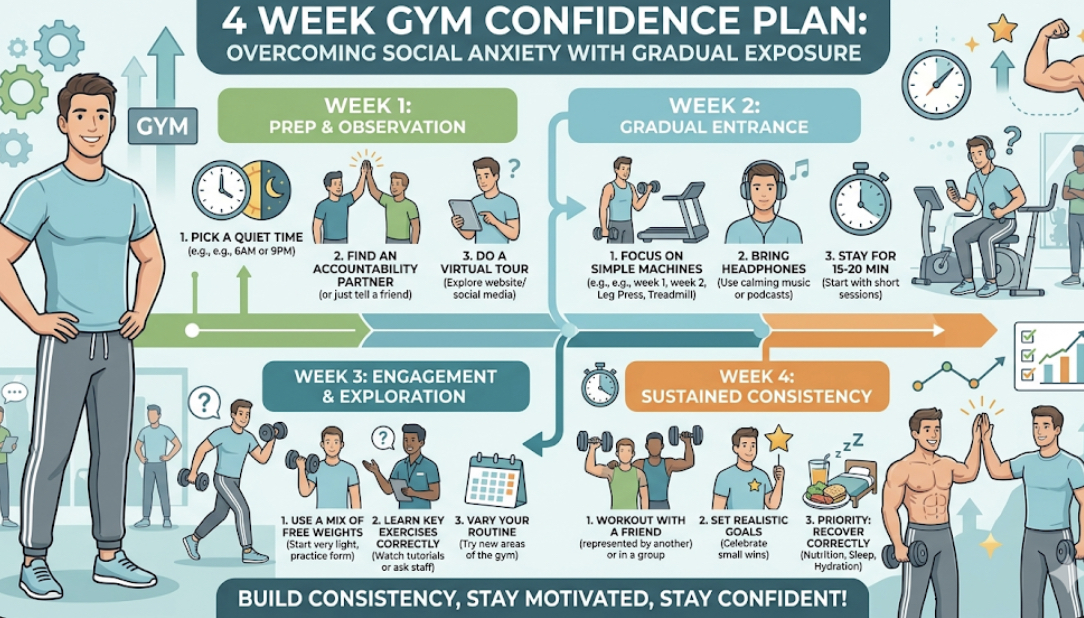
Follow this weekly protocol to systematically reduce fear of going to the gym:
Week 1: Familiarization (3 visits, 20 minutes each)
- Goal: Just walk through the door. Do cardio only (treadmill or bike). Watch others use equipment. Don't pressure yourself to do more. Reward yourself after each visit.
Week 2: Basic Machines (3 visits, 25 minutes each)
- Goal: Learn 3-4 machines (leg press, chest press, lat pulldown). Go during quiet hours. Follow written plan. Each visit reduces anxiety.
Week 3: Routine Building (3 visits, 30 minutes each)
- Goal: Complete full machine circuit. Add one new exercise. Experiment with different times. Confidence starts building.
Week 4: Expansion (3 visits, 30-35 minutes each)
- Goal: Try peak hours once. Add dumbbells or new equipment. Most anxiety has significantly decreased. You belong here.
7. What to Say to Yourself: Cognitive Strategies
Replace anxiety-provoking thoughts with confidence-building ones:
- Instead of: "Everyone is watching me." → Remind yourself: "Most people are focused on their own workout. Research shows people overestimate attention by 500%."
- Instead of: "I don't belong here." → Remind yourself: "Everyone started as a beginner. The gym is for all fitness levels."
- Instead of: "I look stupid." → Remind yourself: "No one is judging me. And even if they were, their opinion doesn't matter."
- Instead of: "I have to be perfect." → Remind yourself: "Showing up is success. Perfect form comes with practice."
8. Common Gym Anxiety Triggers and Solutions
Trigger: Walking through the door
Solution: Use the 5-minute rule – commit to just 5 minutes inside. After 5 minutes, you can leave. Most people stay longer.
Trigger: Waiting for equipment
Solution: Have backup exercises in your plan. If a machine is taken, do an alternative. Practice asking "How many sets do you have left?" – most people are friendly.
Trigger: The free weight area
Solution: Avoid it completely for the first 4 weeks. Machines are perfectly effective for beginners. Progress to free weights when confident.
Trigger: Changing room / locker room
Solution: Arrive in gym clothes. Go home to shower. Avoid changing rooms until you feel comfortable. Many people do this.
Trigger: Peak hours (5-7 PM)
Solution: Don't go during peak hours for the first 4-6 weeks. Morning (6-9 AM), late morning (10 AM-12 PM), or late evening (8-10 PM) are quieter.
9. Frequently Asked Questions
How do I overcome gym anxiety?
Start with a simple plan (write down your workout), go during quiet hours (10 AM-3 PM or after 8 PM), focus on your workout only (use headphones), wear comfortable clothes that make you feel confident, and remember everyone started as a beginner. Start with just 20 minutes and gradually increase.
Why do I feel anxious at the gym?
Gym anxiety often stems from fear of judgment (feeling others are watching), not knowing proper form, unfamiliar equipment, comparing yourself to others, or past negative experiences. Research shows that up to 50% of new gym-goers experience significant anxiety, with social physique anxiety being the most common form.
How can I build confidence at the gym?
Build gym confidence by: starting with a simple 3-exercise routine, going at off-peak hours, taking a gym orientation session, watching proper form videos before going, starting with machines (easier than free weights), and bringing a friend. Confidence comes from repeated exposure – each visit reduces anxiety.
What should a beginner do at the gym to avoid anxiety?
Beginners should: start with 3 days weekly (not 5-6), use a written plan (eliminates wandering), begin with cardio or machines (less intimidating), go during quiet hours, use headphones to focus, and set a time limit (30 minutes max initially). Focus on your own workout, not what others are doing.
Does gym anxiety go away?
Yes, gym anxiety typically decreases significantly within 4-6 weeks of consistent attendance. Research on exposure therapy shows that repeated, non-judgmental exposure to anxiety-provoking situations reduces fear response. After 8-12 visits, most people report feeling comfortable and confident at the gym.
Is it okay to only use machines as a beginner?
Absolutely. Machines are designed for beginners – they have fixed movement patterns, picture instructions, and are safer than free weights. You can achieve excellent results using only machines for the first 3-6 months. Progress to free weights when you feel confident, or never – many people use machines exclusively.
10. Related Resources
- Best Evening Habits for Fat Loss (Simple Night Routine That Works)
- How to Burn More Calories Without Cardio (Simple Fat Loss Strategies)
- Why You Lose Weight Then Gain It Back Quickly (Yo-Yo Dieting Explained)
- How to Avoid Binge Eating During Fat Loss (Control Cravings & Stay on Track)
- Does Drinking Water Help You Lose Fat Faster? (Science-Based Answer)
- How to Reduce Cravings While Dieting (Control Hunger & Stay Consistent)
11. Scientific References
- Hart, E. A., et al. (1989). The development of the Social Physique Anxiety Scale. Journal of Sport & Exercise Psychology, 11(4), 382-395. PubMed
- Gilovich, T., et al. (2000). The spotlight effect in social judgment. Journal of Personality and Social Psychology, 78(2), 211-222. PubMed
- Spink, K. S., et al. (2015). Social physique anxiety and physical activity in women. Psychology of Sport and Exercise, 19, 31-37. PubMed
- IHRSA. (2021). Health club membership retention and dropout reasons report. International Health Racquet & Sportsclub Association. IHRSA
- Leary, M. R., & Kowalski, R. M. (1995). Social anxiety and self-presentation. Social Anxiety, 12(3), 45-58. PubMed
- Bandura, A. (1997). Self-efficacy: The exercise of control. W.H. Freeman and Company. PubMed
- Fardouly, J., et al. (2018). Social media use and social physique anxiety. Body Image, 27, 23-31. PubMed
Join the conversation