How to Build Discipline in Fitness (Simple Habits That Actually Work)
How to Build Discipline in Fitness: Simple Habits That Actually Work (2026)

⚡ TL;DR
To build discipline in fitness, stop relying on motivation and start building systems. The best fitness discipline tips focus on small daily habits, not willpower. Learn how to stay disciplined in gym using science-backed strategies: start with 10-minute minimums, follow a fixed schedule, remove distractions, track progress visually, and use habit stacking. Build workout habits that become automatic by focusing on consistency over intensity. This gym discipline guide provides proven techniques to develop a fitness consistency mindset and master how to stay consistent with exercise for life.
1. The Discipline vs Motivation Trap
You wait for motivation to strike. Some days it does – you crush your workout. Most days it doesn't – you skip. This is why most people fail at fitness.
To truly build discipline in fitness, you must understand that motivation is unreliable. Motivation is an emotion – it fluctuates based on mood, sleep, stress, and coffee intake. Discipline is a behavior – it's doing what you said you would do regardless of how you feel. This guide provides science-backed fitness discipline tips that work even on days when you have zero motivation.
How do you build discipline in fitness?
How do you build discipline in fitness? Start with small habits (10-minute daily workouts), follow a fixed schedule (same time daily), remove distractions (prepare night before), focus on consistency over motivation (showing up matters more than intensity), and track progress visually (habit tracker). Discipline is built through repeated small actions, not willpower.
2. The Science: How Discipline Becomes Habit
Understanding how to build workout habits requires knowing the science of behavior change. According to Lally et al. (2010), it takes an average of 66 days to automate a new behavior – not 21 days as commonly believed.
- Weeks 1-4 (Conscious effort): Requires active discipline. You must deliberately choose to exercise. This is the hardest phase.
- Weeks 5-8 (Becoming easier): Less mental resistance. The behavior starts feeling normal.
- Weeks 9-12 (Approaching automatic): Exercise feels strange to skip. Discipline has transformed into habit.
A 2018 study by Gardner et al. found that habit strength was the strongest predictor of long-term exercise adherence, surpassing motivation. This is why how to stay consistent with exercise depends on building automatic habits, not finding infinite motivation.
📊 Discipline vs Motivation: Key Differences
| Factor | Discipline | Motivation | Winner for Long-Term Success |
|---|---|---|---|
| Reliability | Consistent regardless of feelings | Fluctuates daily | Discipline |
| Source | Behavioral (habit, systems) | Emotional (feeling) | Discipline |
| Builds over time | Yes – strengthens with practice | No – fades without maintenance | Discipline |
| Works on bad days | Yes | No | Discipline |
| Sustainability | High (years) | Low (weeks to months) | Discipline |
3. 10 Simple Habits to Build Fitness Discipline
Habit #1: The 10-Minute Minimum
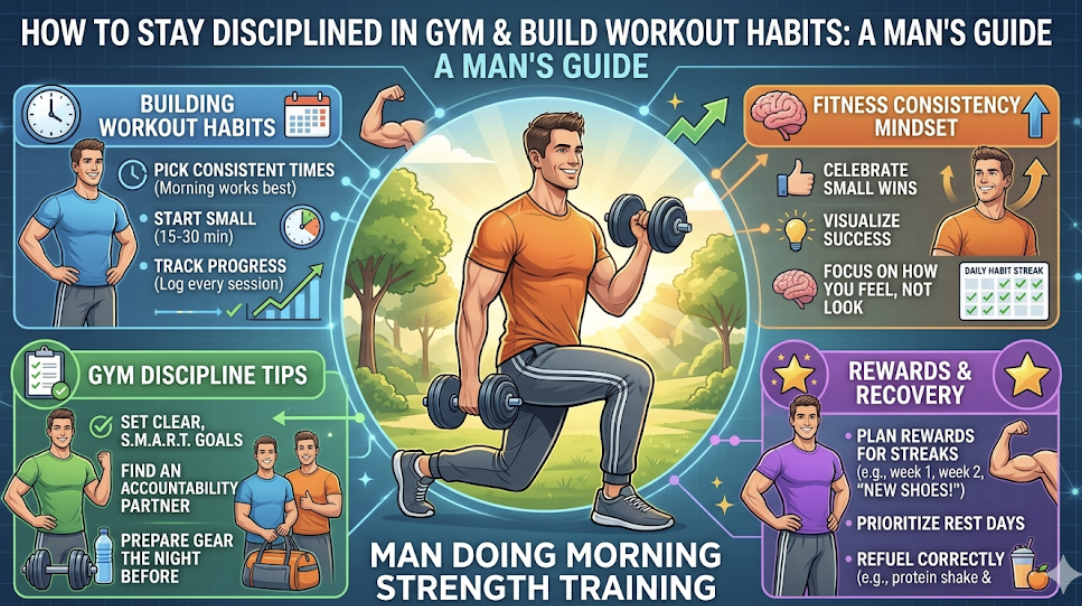
The biggest barrier to build discipline in fitness is getting started. Commit to just 10 minutes daily. Anyone can do 10 minutes. Most days, you'll continue past 10 minutes. On low-energy days, 10 minutes keeps the habit alive.
Habit #2: Fixed Schedule (Same Time Daily)
Research shows that training at the same time daily dramatically improves fitness consistency mindset. Morning workouts (6-9 AM) have the highest adherence rates – 80% of morning exercisers maintain their routine versus 50% of evening exercisers (Schumacher et al., 2020).
Habit #3: Prepare Everything the Night Before
Lay out gym clothes, fill water bottle, pack bag, set alarm, write workout plan. This reduces decision fatigue and eliminates morning excuses. This is one of the most effective gym discipline tips.
Habit #4: Use Habit Stacking
Attach your workout to an existing habit. "After I brush my teeth, I put on workout clothes." "After my first coffee, I do 10 minutes of movement." This leverages existing neural pathways to build workout habits faster.
Habit #5: Track Your Workout Streak
Use a habit tracker (calendar, app, journal). Visual progress is powerfully motivating for how to stay disciplined in gym. The "don't break the chain" method creates accountability to yourself.
Habit #6: The 2-Day Rule
Never skip two workouts in a row. One missed day is acceptable – life happens. Two missed days breaks the habit loop. This rule maintains consistency without perfectionism.
Habit #7: Remove Friction
Every barrier between you and working out reduces the probability you'll exercise. Sleep in gym clothes. Keep a mat visible. Have dumbbells in the living room. Join a gym on your commute route.
Habit #8: Create External Accountability
Workout partner, personal trainer, online community, or paid commitment contract. Accountability increases follow-through by 65-95% (ASTD). This is especially valuable when how to stay consistent with exercise feels difficult.
Habit #9: Focus on Process, Not Outcomes
Don't obsess over scale weight or muscle growth. Focus on showing up. "I worked out today" is a win regardless of results. Process goals are within your control; outcome goals are not.
Habit #10: Reward Yourself Immediately
Your brain needs immediate rewards, not distant outcomes. After each workout: mark habit tracker, listen to favorite podcast, drink protein shake you enjoy, or watch 10 minutes of entertainment.
4. How to Stay Disciplined When Motivation Is Zero
Everyone faces days when motivation is completely absent. Here's how how to stay disciplined in gym on those days:
The "Just Show Up" Protocol
- Step 1: Put on workout clothes (no commitment to exercise yet)
- Step 2: Drive to gym or unroll mat (still no commitment)
- Step 3: Commit to just 5 minutes
- Step 4: After 5 minutes, you can stop with zero guilt
Research shows that starting is the hardest part. Once you begin, continuation is much easier. On truly exhausted days, 5-10 minutes of gentle movement maintains the habit without depleting you.
Emergency Discipline Tools
- Accountability text: "I'm working out in 30 minutes – hold me accountable"
- 10-minute timer: Set timer for 10 minutes. Anyone can do 10 minutes.
- Non-negotiable rule: "I don't skip workouts" – make it an identity statement
- Backup routine: 10-minute bodyweight circuit for days you can't leave home
5. Sample Weekly Schedule for Building Fitness Discipline
Beginner Discipline Schedule (3-4 days/week, 20-30 min)
- Monday: 20 min brisk walking (same time: 7:00 AM)
- Tuesday: 20 min bodyweight circuit (squats, push-ups, lunges)
- Wednesday: Rest or 15 min stretching
- Thursday: 25 min walking or cycling
- Friday: 20 min strength (dumbbells or bands)
- Saturday: 30 min outdoor activity (hike, bike, swim)
- Sunday: Rest or 15 min gentle movement
Advanced Discipline Schedule (5-6 days/week, 45-60 min)
- Monday: 45 min strength training (upper body)
- Tuesday: 30 min HIIT + 15 min core
- Wednesday: 45 min strength training (lower body)
- Thursday: 40 min steady-state cardio
- Friday: 45 min strength training (full body)
- Saturday: 60 min outdoor run or hike
- Sunday: Active recovery (20 min walk, stretch)
6. Nutrition to Support Fitness Discipline
Pre-Workout Nutrition (For Sustained Energy)
- Timing: 60-90 minutes before exercise
- Sample meal: 1 banana + 1 tbsp peanut butter (200 kcal) or 1 cup oatmeal + 1 scoop protein (350 kcal)
Post-Workout Recovery Nutrition
- Timing: Within 60 minutes after exercise
- Sample meal: 2 scoops whey + 1 cup berries + water (250 kcal, 45g protein)
Full Day Meal Plan for Consistent Energy (2,200 kcal, 160g Protein)
- Breakfast (7:00 AM): 4 eggs + 1.5 cups oatmeal + 1/2 cup berries (600 kcal, 40g protein)
- Lunch (12:00 PM): 170g chicken breast + 1.5 cups brown rice + 2 cups broccoli (550 kcal, 50g protein)
- Pre-workout snack (3:00 PM): 1 banana + 1 tbsp peanut butter (200 kcal, 5g protein)
- Post-workout (5:30 PM): 1 scoop whey + 1 apple (200 kcal, 25g protein)
- Dinner (7:00 PM): 170g salmon + 300g sweet potato + 2 cups asparagus (650 kcal, 40g protein)
Vegan Fitness Discipline Meal Plan
- Pre-workout: 1 banana + 1 tbsp almond butter (200 kcal)
- Post-workout: 2 scoops pea protein + 1 cup soy milk (300 kcal, 45g protein)
- Main meals: Tofu, tempeh, lentils, quinoa, beans, nuts, seeds
Gluten-Free Options for Consistent Workout Energy
- Certified gluten-free oats, rice, quinoa, buckwheat, sweet potatoes
- Verify protein powder and supplements are gluten-free certified
7. Overcoming Common Discipline Breakers
"I'm Too Tired"
Research shows that fatigue often decreases after 5-10 minutes of light movement. Start with walking or stretching. Most days, energy increases. On truly exhausted days, do 10 minutes of gentle movement – this maintains the habit without depleting you.
"I Have No Time"
High-intensity interval training (HIIT) can provide similar benefits in 15-20 minutes. Split workouts into 10-minute chunks throughout the day. Something always beats nothing for how to stay consistent with exercise.
"I Don't Feel Motivated"
Discipline is for days when motivation is absent. Remind yourself: "I don't need to feel like it. I just need to do it." Use the 10-minute rule – anyone can do 10 minutes regardless of feelings.
"I Missed Yesterday"
Apply the 2-day rule immediately. One missed day is irrelevant. Two missed days is a pattern. Forgive yourself, then work out today. Guilt doesn't build discipline; action does.
8. The 66-Day Fitness Discipline Blueprint
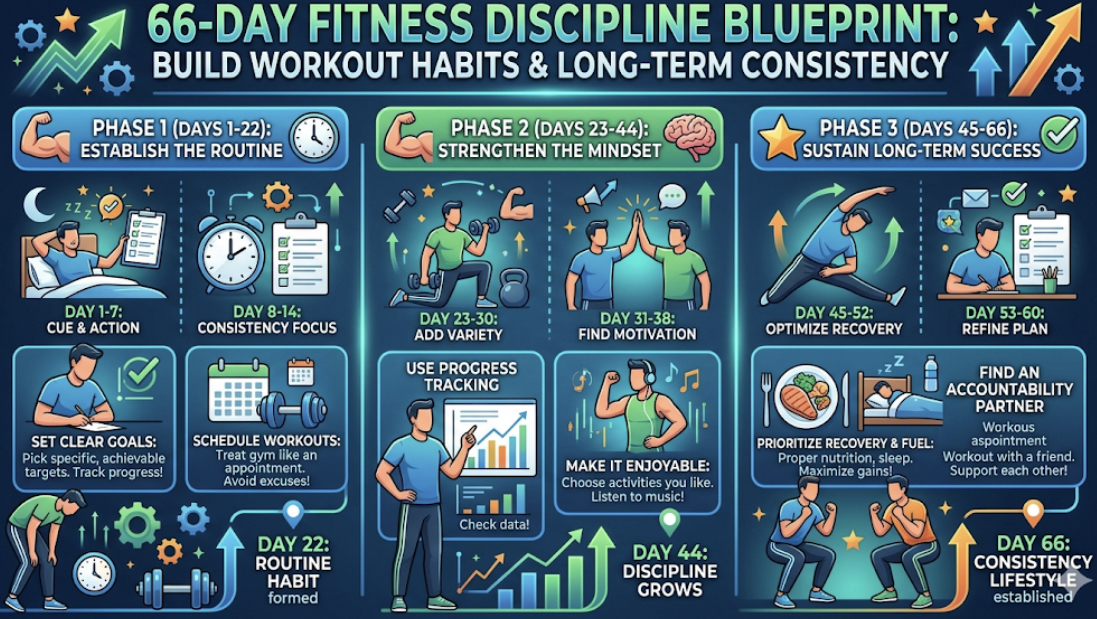
Follow this exact protocol to build discipline in fitness over 66 days:
- Days 1-21 (Foundation): Same time daily. 10-minute minimum. Any exercise counts. Goal: show up. Track every day. Reward each workout.
- Days 22-44 (Building): Increase to 20-30 minutes. Add structure (specific routine). Still focus on consistency over intensity. Prepare night before.
- Days 45-66 (Automation): Exercise feels strange to skip. Can add intensity or volume. Discipline is transforming into automatic habit.
- Day 67+ (Maintenance): Exercise is now a habit. Focus on progressive overload and goal-specific training. The discipline foundation is built.
9. Frequently Asked Questions
How do you build discipline in fitness?
Start with small habits (10-minute daily workouts), follow a fixed schedule (same time daily), remove distractions (prepare night before), focus on consistency over motivation (showing up matters more than intensity), and track progress visually (habit tracker). Discipline is built through repeated small actions, not willpower.
How to stay disciplined in gym long-term?
To stay disciplined in the gym: use habit stacking (attach workouts to existing habits), follow the 2-day rule (never skip two in a row), create accountability (partner or trainer), prepare everything the night before, have a 10-minute minimum, and focus on process goals (showing up) not outcome goals (weight loss).
Why is discipline more important than motivation for fitness?
Motivation is emotional and fluctuates daily based on mood, energy, and circumstances. Discipline is behavioral – it's doing what you said you would do regardless of how you feel. Research shows that individuals who rely on motivation have 70% dropout rates, while those with disciplined habits have 80% adherence at 6 months.
How long does it take to build fitness discipline?
According to Lally et al. (2010), it takes an average of 66 days (range 18-254 days) to form an automatic workout habit. The first 2-4 weeks require conscious effort. Weeks 5-8 become easier. After 12 weeks, exercise feels automatic and skipping feels wrong. Consistency during the first 66 days is critical.
What are the best daily habits to build fitness discipline?
Best daily habits: prepare gym clothes the night before (2 minutes), train at the same time daily (habit formation), do a 10-minute minimum (even on low days), track your streak visually, use the 2-day rule, and celebrate small wins. These micro-habits build the foundation for lasting fitness discipline.
Can discipline be learned or are you born with it?
Discipline is absolutely learned, not innate. Research in behavioral psychology shows that discipline functions like a muscle – it strengthens with practice. Individuals who successfully build fitness discipline do so through consistent small actions, not because they have superior willpower. Anyone can learn discipline with the right systems and habits.
10. Related Resources
- Best Evening Habits for Fat Loss (Simple Night Routine That Works)
- How to Burn More Calories Without Cardio (Simple Fat Loss Strategies)
- Why You Lose Weight Then Gain It Back Quickly (Yo-Yo Dieting Explained)
- How to Avoid Binge Eating During Fat Loss (Control Cravings & Stay on Track)
- Does Drinking Water Help You Lose Fat Faster? (Science-Based Answer)
- How to Reduce Cravings While Dieting (Control Hunger & Stay Consistent)
11. Scientific References
- Lally, P., et al. (2010). How habits are formed: Modelling habit formation in the real world. European Journal of Social Psychology, 40(6), 998-1009. PubMed
- Gardner, B., et al. (2018). Habit formation and behavior change. Health Psychology Review, 12(3), 219-237. PubMed
- Schumacher, L. M., et al. (2020). The importance of consistency in exercise timing. Obesity, 28(5), 891-898. PubMed
- Baumeister, R. F., et al. (2007). The strength model of self-control. Current Directions in Psychological Science, 16(6), 351-355. PubMed
- Teixeira, P. J., et al. (2012). Motivation, self-determination, and long-term weight control. International Journal of Behavioral Nutrition and Physical Activity, 9(1), 22. PubMed
- Duckworth, A. L., et al. (2019). Self-control and grit: Related but separable determinants of success. Current Directions in Psychological Science, 28(6), 571-576. PubMed
- Feil, K., et al. (2021). Habit formation interventions for physical activity. Psychology of Sport and Exercise, 52, 101827. PubMed
Join the conversation