How to Calculate Your Daily Calories for Bulking and Cutting (Step-by-Step Guide)

Learn how to calculate your daily calories for bulking and cutting with a simple step-by-step method.
How to Calculate Your Daily Calories for Bulking and Cutting: Step-by-Step Guide (2026)
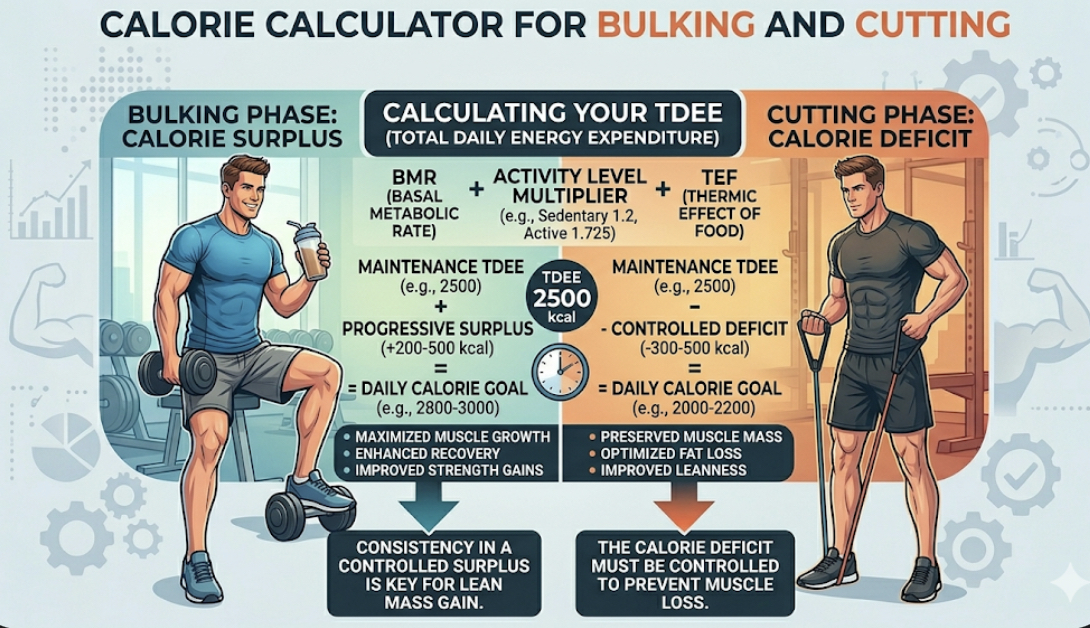
How to Calculate Your Daily Calories for Bulking and Cutting: Step-by-Step Guide (2026)

Step-by-step guide to calculate daily calories for bulking and cutting showing TDEE formula and calorie surplus/deficit
Image 1: Accurate calorie calculation is the foundation of successful bulking and cutting.

⚡ TL;DR

To calculate daily calories for bulking and cutting, first determine your TDEE (maintenance calories). For bulking: add +300 to +500 calories. For cutting: subtract -300 to -500 calories. Example: maintenance = 2500 kcal → bulking = 2800-3000 kcal → cutting = 2000-2200 kcal. Use the Mifflin-St Jeor equation: BMR = (10 × weight in kg) + (6.25 × height in cm) – (5 × age) + 5 (men) or -161 (women). Multiply BMR by activity factor (1.2–1.725). Adjust weekly based on weight change (0.25–0.5% body weight weekly) .

1. The Calorie Confusion: Why You Need a System

You've heard "calories in, calories out" but applying it to your goals feels overwhelming. Understanding how many calories should I eat for muscle gain or fat loss is the most critical skill for body transformation. This step-by-step guide to calorie calculator for muscle gain and fat loss provides a systematic method to determine your daily calorie intake for fitness. Whether you're bulking or cutting, these principles work.

How do I calculate my daily calories for bulking and cutting?

How do I calculate my daily calories for bulking and cutting? Calculate TDEE (maintenance calories) using Mifflin-St Jeor equation. For bulking: add +300 to +500 calories. For cutting: subtract -300 to -500 calories. Example: maintenance = 2500 kcal → bulking = 2800-3000 kcal → cutting = 2000-2200 kcal. Adjust based on weekly weight change (0.25-0.5% body weight weekly).
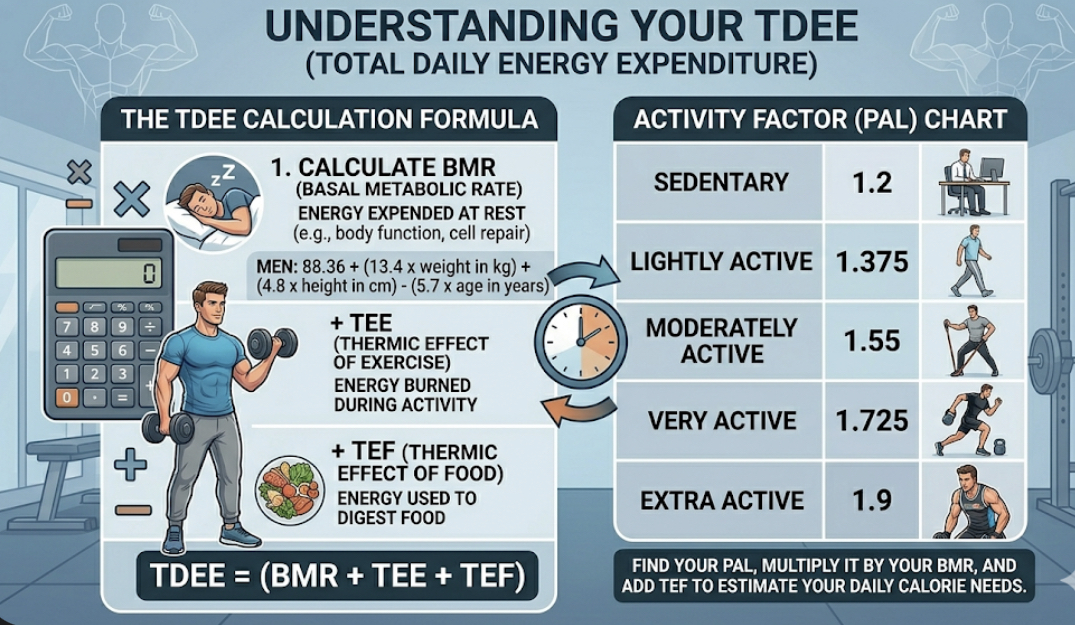
TDEE calculation formula and activity factor chart for calorie calculator for muscle gain and fat loss
Image 2: TDEE calculation is the first step to determining bulking and cutting calories.

2. Step 1: Calculate Your BMR (Basal Metabolic Rate)

BMR is calories burned at complete rest. Use the Mifflin-St Jeor equation, the most accurate for most individuals :

  • Men: BMR = (10 × weight in kg) + (6.25 × height in cm) – (5 × age) + 5
  • Women: BMR = (10 × weight in kg) + (6.25 × height in cm) – (5 × age) – 161
💡 Example (80 kg, 175 cm, 30-year-old man): BMR = (10 × 80) + (6.25 × 175) – (5 × 30) + 5 = 800 + 1093.75 – 150 + 5 = 1,748.75 kcal/day.

3. Step 2: Determine Your TDEE (Maintenance Calories)

TDEE = BMR × Activity Factor. Choose your activity level:

  • Sedentary (1.2): Little to no exercise, desk job
  • Lightly active (1.375): Light exercise 1-3 days/week
  • Moderately active (1.55): Moderate exercise 3-5 days/week
  • Very active (1.725): Hard exercise 6-7 days/week
  • Extremely active (1.9): Physical job + intense daily training
💡 Example (80 kg man, moderately active): TDEE = 1,749 × 1.55 = 2,711 kcal/day (maintenance).

4. Step 3: Set Your Calorie Surplus for Bulking

For calories for bulking and cutting, bulking requires a surplus:

  • Moderate surplus (recommended): TDEE + 250-500 kcal
  • Aggressive surplus (not recommended): TDEE + 500-1000 kcal (excess fat gain)
  • Weekly weight gain target: 0.25-0.5% body weight
💡 Example (TDEE 2,711 kcal): Bulking calories = 2,711 + 300 = 3,011 kcal/day.

5. Step 4: Set Your Calorie Deficit for Cutting

For cutting, create a deficit:

  • Moderate deficit (recommended): TDEE - 300-500 kcal
  • Aggressive deficit (short-term only): TDEE - 500-800 kcal (higher muscle loss risk)
  • Weekly weight loss target: 0.25-0.5% body weight
💡 Example (TDEE 2,711 kcal): Cutting calories = 2,711 - 400 = 2,311 kcal/day.

📊 Sample Calorie Targets (80 kg / 176 lb person)

.= "Lightly active" ? 'Lightly active' : '' ?>Lightly active .= "Moderately active" ? 'Moderately active' : '' ?>Moderately active .= "Very active" ? 'Very active' : '' ?>Very active

6. Step 5: Set Your Macronutrient Targets

Bulking Macros (3,000 kcal example)

  • Protein: 1.6-2.2 g/kg (128-176g for 80kg) → 512-704 kcal
  • Fats: 0.8-1.2 g/kg (64-96g) → 576-864 kcal (20-30% of total)
  • Carbs: Remaining calories → ~1,500-1,900 kcal (375-475g)

Cutting Macros (2,300 kcal example)

  • Protein: 1.8-2.4 g/kg (144-192g for 80kg) → 576-768 kcal
  • Fats: 0.5-0.8 g/kg (40-64g) → 360-576 kcal (15-25% of total)
  • Carbs: Remaining calories → ~1,000-1,300 kcal (250-325g)

7. Sample Bulking Meal Plan (3,000 kcal, 180g Protein)

  • Breakfast: 4 eggs, 1 cup oats, 1 banana, 1 cup milk (650 kcal, 40g protein)
  • Lunch: 200g chicken breast, 2 cups rice, 1 cup broccoli, 1 tbsp olive oil (700 kcal, 55g protein)
  • Snack: 200g Greek yogurt, 30g almonds, 1 tbsp honey (350 kcal, 22g protein)
  • Post-Workout: 2 scoops whey, 1 banana, 1 cup oats (550 kcal, 48g protein)
  • Dinner: 200g lean beef or salmon, 1.5 cups sweet potato, 1 tbsp olive oil (700 kcal, 45g protein)
  • Evening: 1 cup cottage cheese (200 kcal, 25g protein)
  • Total: ~3,150 kcal, ~235g protein

Sample Cutting Meal Plan (2,300 kcal, 160g Protein)

  • Breakfast: 3 eggs, 1 cup oats, ½ cup berries (500 kcal, 28g protein)
  • Lunch: 150g chicken breast, 1 cup quinoa, 2 cups spinach, 1 tbsp vinaigrette (450 kcal, 40g protein)
  • Snack: 170g Greek yogurt, ½ cup berries (150 kcal, 18g protein)
  • Dinner: 150g white fish or tofu, 1.5 cups roasted vegetables, 1 tbsp olive oil (450 kcal, 35g protein)
  • Post-Workout: 1 scoop whey, 1 banana (250 kcal, 25g protein)
  • Evening: 1 cup cottage cheese (200 kcal, 25g protein)
  • Total: ~2,000 kcal, ~171g protein

Vegan/Vegetarian Options

  • Bulking vegan: Tofu scramble (200g), 1.5 cups oats, 2 tbsp peanut butter, banana (700 kcal, 40g protein)
  • Cutting vegan: Tofu scramble (150g), 1 cup oats, ½ cup berries (500 kcal, 25g protein)

Gluten-Free Options

  • Use certified gluten-free oats
  • Choose rice, quinoa, buckwheat
  • Verify protein sources are gluten-free certified

8. How to Adjust Calories Based on Progress

Track weekly weight (same time, same day). Adjust if needed:

  • Bulking: Gain <0.25% body weight weekly → add 100-200 calories
  • Bulking: Gain >0.5% body weight weekly → reduce 100-200 calories
  • Cutting: Lose <0.25% weekly → reduce 100-200 calories
  • Cutting: Lose >0.5% weekly → add 100-200 calories

9. Common Calorie Calculation Mistakes

  • Overestimating activity level: Most people overestimate, leading to incorrect TDEE
  • Not tracking consistently: Daily fluctuations normal; track weekly averages
  • Not adjusting over time: As weight changes, TDEE changes—recalculate every 4-6 weeks
  • Too aggressive surplus/deficit: Extreme numbers lead to excess fat gain or muscle loss
  • Ignoring NEAT: Non-exercise activity (walking, fidgeting) affects TDEE significantly

10. Frequently Asked Questions

How do I calculate my daily calories for bulking and cutting?

Calculate TDEE (maintenance calories) using Mifflin-St Jeor equation. For bulking: add +300 to +500 calories. For cutting: subtract -300 to -500 calories. Example: maintenance = 2500 kcal → bulking = 2800-3000 kcal → cutting = 2000-2200 kcal. Adjust based on weekly weight change (0.25-0.5% body weight weekly).

What is TDEE and how do I calculate it?

TDEE (Total Daily Energy Expenditure) is total calories burned daily. Calculate BMR using Mifflin-St Jeor: Men: (10 × weight in kg) + (6.25 × height in cm) – (5 × age) + 5. Women: (10 × weight in kg) + (6.25 × height in cm) – (5 × age) – 161. Multiply BMR by activity factor: Sedentary (1.2), Light (1.375), Moderate (1.55), Very active (1.725).

How many calories for bulking?

For bulking, consume TDEE + 250-500 calories daily. Aim for 0.25-0.5% body weight gain weekly. For an 80 kg person, that's 0.2-0.4 kg gain per week. Protein: 1.6-2.2 g/kg. Carbs: 4-7 g/kg. Fats: 0.8-1.2 g/kg.

How many calories for cutting?

For cutting, consume TDEE - 300-500 calories daily. Aim for 0.25-0.5% body weight loss weekly. Protein is higher: 1.8-2.4 g/kg to preserve muscle. Carbs: 3-5 g/kg. Fats: 0.5-0.8 g/kg.

How do I adjust calories if I'm not progressing?

If bulking: gain <0.25% body weight weekly → add 100-200 calories. Gain >0.5% → reduce 100-200 calories. If cutting: lose <0.25% weekly → reduce 100-200 calories. Lose >0.5% → add 100-200 calories. Track weekly averages, not daily fluctuations.

What macronutrient ratio for bulking vs cutting?

Bulking: Protein 1.6-2.2 g/kg, Fats 0.8-1.2 g/kg (25-35% of calories), Carbs remaining (4-7 g/kg). Cutting: Protein 1.8-2.4 g/kg, Fats 0.5-0.8 g/kg (20-25% of calories), Carbs remaining (3-5 g/kg). Higher protein during cutting preserves muscle mass.

11. Related Resources

12. Scientific References

  1. Mifflin, M. D., et al. (1990). A new predictive equation for resting energy expenditure in healthy individuals. American Journal of Clinical Nutrition, 51(2), 241–247. PubMed
  2. Morton, R. W., et al. (2018). A systematic review, meta-analysis and meta-regression of the effect of protein supplementation on resistance training-induced gains in muscle mass and strength. British Journal of Sports Medicine, 52(6), 376–384. PubMed
  3. Helms, E. R., et al. (2014). Evidence-based recommendations for natural bodybuilding contest preparation. Journal of the International Society of Sports Nutrition, 11(1), 20. PubMed
  4. Slater, G., et al. (2019). Is an energy surplus required to maximize skeletal muscle hypertrophy associated with resistance training? Frontiers in Nutrition, 6, 131. PubMed
  5. ACSM. (2021). Nutrition and Athletic Performance. Medicine & Science in Sports & Exercise, 53(3), 600–618. PubMed
FitForge Lab. Created by Techly420
FitForge Lab Welcome to WhatsApp chat
Hi! Need help with fitness or diet? 💪
Type here...
Activity LevelTDEE (Maintenance)Bulking (+300)Cutting (-400)
.= "Sedentary" ? 'Sedentary' : '' ?>Sedentary~2,100 kcal~2,400 kcal~1,700 kcal
~2,400 kcal~2,700 kcal~2,000 kcal
~2,700 kcal~3,000 kcal~2,300 kcal
~3,000 kcal~3,300 kcal~2,600 kcal