How to Create a Fitness Routine That You Can Stick To (Beginner-Friendly Guide)
How to Create a Fitness Routine That You Can Stick To (Beginner-Friendly Guide) 2026

⚡ TL;DR
To create a fitness routine you can actually stick to, stop copying advanced programs and start with the basics. The best workout routine for beginners focuses on consistency, not intensity. Learn how to stick to a workout plan using science-backed strategies: start with 2-3 days weekly, choose simple exercises you enjoy, schedule your workouts like appointments, and track progress visually. Build a fitness habit that lasts by focusing on small wins. This guide helps you design a fitness routine that works for your lifestyle and build a consistent workout plan using a realistic beginner fitness schedule.
1. Why Most Fitness Routines Fail (And Yours Won't)
You've tried before. You created an ambitious workout plan – 6 days a week, 60-minute sessions, complex exercises. You lasted two weeks. Then quit. This isn't a personal failure; it's a planning failure.
To successfully create a fitness routine that sticks, you must understand why most routines fail. Research shows that 50% of new exercisers quit within 6 months, with the highest dropout occurring at weeks 3-6 (IHRSA, 2021). The primary reasons: unrealistic expectations, overtraining, lack of enjoyment, and no clear plan. This beginner-friendly guide provides a workout routine for beginners designed for long-term adherence.
How do I create a fitness routine I can stick to?
How do I create a fitness routine I can stick to? Set realistic goals (start with 2-3 days weekly), choose simple workouts you enjoy, schedule your sessions like appointments, start small (20-30 minutes), and track progress visually. Consistency matters more than intensity for beginners.
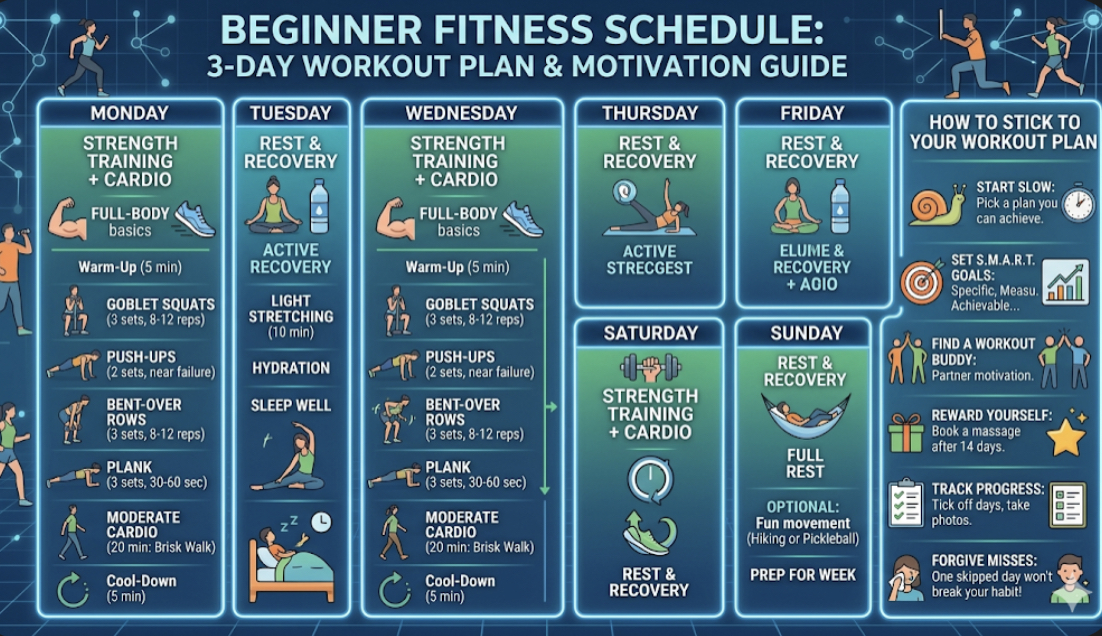
2. The Science of Building a Fitness Habit
Understanding how to build a fitness habit requires knowing the science of behavior change. According to Lally et al. (2010), it takes an average of 66 days to automate a new exercise habit – not 21 days.
- Weeks 1-4: Requires conscious effort. This is the hardest phase. Focus only on showing up.
- Weeks 5-8: Becoming easier. Less mental resistance. The behavior starts feeling normal.
- Weeks 9-12: Approaching automatic. Exercise feels strange to skip. The consistent workout plan becomes automatic.
A 2018 study by Gardner et al. found that habit strength was the strongest predictor of long-term exercise adherence. This means how to stick to a workout plan depends on building automatic habits, not finding infinite motivation.
📊 Beginner Fitness Schedule: 12-Week Progression
| Phase | Days/Week | Session Length | Focus | Goal |
|---|---|---|---|---|
| Weeks 1-4 | 2-3 days | 20-25 min | Form and consistency | Show up consistently |
| Weeks 5-8 | 3 days | 25-35 min | Adding intensity gradually | Build workout habit |
| Weeks 9-12 | 3-4 days | 35-45 min | Progressive overload | Habit automatic, visible results |
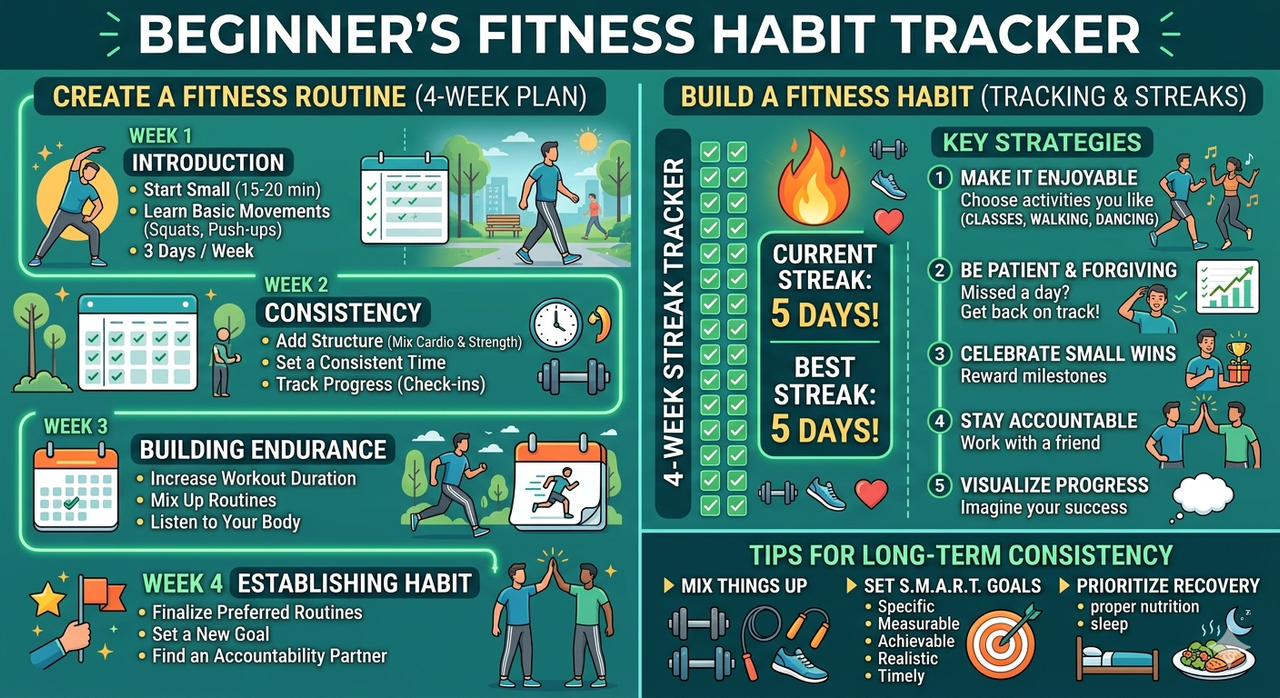
3. Step-by-Step: How to Create Your Fitness Routine
Step 1: Set Realistic Goals
Instead of "lose 20 pounds" or "get ripped," set process goals: "work out 3 days this week" or "complete 12 weeks of consistent training." Process goals are within your control; outcome goals are not.
Step 2: Choose Simple Workouts You Enjoy
You won't stick to a workout routine for beginners that you hate. Experiment: walking, bodyweight circuits, swimming, cycling, yoga, dance, or simple strength training. Enjoyment predicts long-term adherence better than any other factor (Teixeira et al., 2012).
Step 3: Schedule Your Sessions Like Appointments
Put your workouts in your calendar with specific times. "Monday 7:00 AM – 30 min walk" is more likely to happen than "work out sometime Monday." Research shows that scheduling increases follow-through by 2-3x.
Step 4: Start Small (2-3 Days Per Week)
Research shows that beginners who start with 3 training days weekly have 80% adherence at 6 months versus 40% for those starting with 5+ days. Build the habit first, then add volume.
Step 5: Track Your Progress Visually
Use a habit tracker (calendar, app, journal). Check off each workout. Visual progress is powerfully motivating. The "don't break the chain" method works exceptionally well for how to stick to a workout plan.
4. Sample Beginner Fitness Schedule (12 Weeks)
Weeks 1-4: Foundation Phase (2-3 days/week, 20-25 min)
- Monday: 20 min brisk walking OR 15 min bodyweight circuit (squats, push-ups on knees, lunges, planks)
- Wednesday: 20 min brisk walking OR 15 min bodyweight circuit
- Friday: 20 min brisk walking OR 20 min cycling/swimming
- Weekend (optional): 15-20 min outdoor walk or stretching
Weeks 5-8: Building Phase (3 days/week, 25-35 min)
- Monday: 25 min full-body strength (bodyweight or light dumbbells)
- Wednesday: 25 min cardio (walk/jog intervals or cycling)
- Friday: 25 min full-body strength (different exercises)
- Weekend: 20-30 min outdoor activity (hike, bike, swim)
Weeks 9-12: Consistency Phase (3-4 days/week, 35-45 min)
- Monday: 35 min strength training (upper body focus)
- Tuesday: 30 min cardio (steady-state or intervals)
- Thursday: 35 min strength training (lower body focus)
- Friday: 30 min cardio or active recovery
- Saturday: 45 min outdoor activity (hike, long walk, swim)
5. Sample Beginner Strength Training Routine
This full-body workout routine for beginners uses basic movements that build foundational strength:
Full Body Workout A (25-30 minutes)
- Goblet Squats (or bodyweight squats): 3 sets of 8-12 reps
- Push-ups (on knees if needed): 3 sets of 5-10 reps
- Seated Rows (or resistance band rows): 3 sets of 10-12 reps
- Planks: 3 sets of 15-30 seconds
- Walking Lunges: 3 sets of 8-10 per leg
Full Body Workout B (25-30 minutes)
- Deadlifts (light dumbbell or kettlebell): 3 sets of 8-10 reps
- Overhead Press (light dumbbells): 3 sets of 8-12 reps
- Lat Pulldowns (or band pull-aparts): 3 sets of 10-12 reps
- Glute Bridges: 3 sets of 12-15 reps
- Side Planks: 3 sets of 15-20 seconds per side
6. Nutrition to Support Your Fitness Routine
Pre-Workout Nutrition (For Energy)
- Timing: 60-90 minutes before exercise
- Sample meal: 1 banana + 1 tbsp peanut butter (200 kcal) or 1 cup oatmeal + 1 scoop protein (350 kcal)
Post-Workout Recovery Nutrition
- Timing: Within 60 minutes after exercise
- Sample meal: 2 scoops whey + 1 cup berries + water (250 kcal, 45g protein)
Full Day Meal Plan for Beginners (2,000 kcal, 130g Protein)
- Breakfast (7:00 AM): 3 eggs + 1 cup oatmeal + 1/2 cup berries (550 kcal, 30g protein)
- Lunch (12:00 PM): 150g chicken breast + 1 cup brown rice + 2 cups broccoli (500 kcal, 40g protein)
- Pre-workout snack (3:00 PM): 1 banana (105 kcal, 1g protein)
- Post-workout (5:30 PM): 1 scoop whey + 1 apple (200 kcal, 25g protein)
- Dinner (7:00 PM): 150g salmon + 250g sweet potato + 2 cups asparagus (600 kcal, 35g protein)
Vegan Beginner Meal Plan
- Breakfast: 1.5 cups tofu scramble + 1 cup oats + 1 cup soy milk (550 kcal, 40g protein)
- Lunch: 150g tempeh + 1.5 cups quinoa + 2 cups roasted vegetables (550 kcal, 45g protein)
- Post-workout: 2 scoops pea protein + 1 banana (300 kcal, 45g protein)
Gluten-Free Beginner Options
- Certified gluten-free oats, rice, quinoa, buckwheat, sweet potatoes
- Verify protein powder is gluten-free certified
7. How to Stick to Your Workout Plan Long-Term
The 2-Day Rule
Never skip two workouts in a row. One missed day is acceptable – life happens. Two missed days breaks the habit loop. This rule is the most effective strategy for how to stick to a workout plan.
Prepare Everything the Night Before
Lay out workout clothes, fill water bottle, set alarm, write workout plan. This reduces decision fatigue and eliminates morning excuses. This simple habit increases workout adherence by 2-3x.
The 10-Minute Minimum
On low-motivation days, commit to just 10 minutes. Anyone can do 10 minutes. Most days, you'll continue past 10 minutes. On hard days, 10 minutes maintains your consistent workout plan.
Create Accountability
Workout partner, personal trainer, online community, or social media commitment. Accountability increases follow-through by 65-95% (ASTD).
Track Your Streak
Use a habit tracker (calendar, app, journal). Visual progress is powerfully motivating. A 30-day streak feels amazing and builds momentum.
8. Common Beginner Mistakes to Avoid
Mistake #1: Starting Too Intense
Training 6 days weekly for 60 minutes leads to burnout by week 2. Start with 2-3 days, 20-30 minutes. Build the habit first.
Mistake #2: No Structured Plan
Walking into the gym without a plan leads to wandering and quitting. Have a written plan for every workout.
Mistake #3: Expecting Fast Results
Visible muscle growth takes 8-12 weeks. Fat loss of 1-2 lbs weekly is excellent. Unrealistic expectations cause quitting. Trust the process.
Mistake #4: All-or-Nothing Thinking
"I missed Monday, so the whole week is ruined." Use the 2-day rule – return tomorrow. Perfectionism kills consistency.
Mistake #5: No Enjoyment Factor
Doing workouts you hate is unsustainable. Find movement you genuinely enjoy. This is the #1 predictor of long-term adherence.
9. Weekly Motivation Maintenance for Beginners
- Sunday evening: Plan workout schedule for the week. Prepare clothes and bags.
- Daily morning: Review your "why" (1-2 minutes). Set workout time as non-negotiable.
- Post-workout: Mark habit tracker. Celebrate with a small reward.
- Friday: Review weekly consistency (not performance). Adjust for next week.
- Every 4 weeks: Take progress photos and measurements. Physical changes motivate continued consistency.
10. Frequently Asked Questions
How do I create a fitness routine I can stick to?
Set realistic goals (start with 2-3 days weekly), choose simple workouts you enjoy, schedule your sessions like appointments, start small (20-30 minutes), and track progress visually. Consistency matters more than intensity for beginners.
What is the best workout routine for beginners?
The best beginner workout routine includes: 2-3 days of full-body strength training (squats, push-ups, rows, lunges), 2-3 days of cardio (walking, cycling, swimming), and daily mobility/stretching. Start with 20-30 minute sessions. Focus on form and consistency over weight or intensity.
How do I stick to a workout plan long-term?
To stick to a workout plan: start with only 2-3 days weekly, train at the same time daily (habit formation), prepare everything the night before, use the 2-day rule (never skip two in a row), track your streak visually, and find workouts you genuinely enjoy. After 66 days, exercise becomes automatic.
How many days a week should a beginner exercise?
Beginners should start with 2-3 days per week of structured exercise. Research shows that beginners who start with 3 training days weekly have 80% adherence at 6 months versus 40% for those starting with 5+ days. After 8-12 weeks of consistency, add a 4th day if desired.
What is the 2-day rule for workout consistency?
The 2-day rule states: never skip two workouts in a row. One missed day is acceptable – life happens. Two missed days breaks the habit loop. This rule maintains consistency without perfectionism. If you miss a day, forgive yourself and return immediately the next day.
How long does it take to see results as a beginner?
Visible muscle definition typically takes 8-12 weeks of consistent training (3 days weekly). Strength increases can be seen in 4-6 weeks. Fat loss of 1-2 lbs weekly is excellent progress. Non-scale victories (better sleep, more energy, looser clothes) often appear within 2-4 weeks.
11. Related Resources
- Best Evening Habits for Fat Loss (Simple Night Routine That Works)
- How to Burn More Calories Without Cardio (Simple Fat Loss Strategies)
- Why You Lose Weight Then Gain It Back Quickly (Yo-Yo Dieting Explained)
- How to Avoid Binge Eating During Fat Loss (Control Cravings & Stay on Track)
- Does Drinking Water Help You Lose Fat Faster? (Science-Based Answer)
- How to Reduce Cravings While Dieting (Control Hunger & Stay Consistent)
12. Scientific References
- IHRSA. (2021). Health club membership retention report. International Health Racquet & Sportsclub Association. IHRSA
- Lally, P., et al. (2010). How habits are formed: Modelling habit formation in the real world. European Journal of Social Psychology, 40(6), 998-1009. PubMed
- Gardner, B., et al. (2018). Habit formation and behavior change. Health Psychology Review, 12(3), 219-237. PubMed
- Teixeira, P. J., et al. (2012). Motivation, self-determination, and long-term weight control. International Journal of Behavioral Nutrition and Physical Activity, 9(1), 22. PubMed
- Schumacher, L. M., et al. (2020). The importance of consistency in exercise timing. Obesity, 28(5), 891-898. PubMed
- Feil, K., et al. (2021). Habit formation interventions for physical activity. Psychology of Sport and Exercise, 52, 101827. PubMed
- Rhodes, R. E., et al. (2019). Physical activity habit formation. Health Psychology Review, 13(4), 391-409. PubMed
Join the conversation