How to Fix Muscle Imbalances Fast (Correct Weak Points Guide)
How to Fix Muscle Imbalances Fast: Correct Weak Points Guide (2026)

⚡ TL;DR
To fix muscle imbalances fast, you need targeted muscle imbalance correction using unilateral exercises. Learn how to fix weak muscles by identifying uneven muscle growth patterns and applying specific strategies to correct muscle imbalance fast. This guide teaches unilateral training exercises that target each side independently, forcing weaker muscles to catch up. Follow these methods to improve muscle symmetry within 4-12 weeks. Stop letting your stronger side compensate – it's time to build balanced, symmetrical strength.
1. What Are Muscle Imbalances and Why Do They Happen?
A muscle imbalance occurs when one side of your body is significantly stronger or larger than the other, or when opposing muscle groups (like chest vs back) have disproportionate strength. Most lifters have some degree of imbalance – the goal is to minimize it.
Understanding muscle imbalance correction starts with identifying the causes. Common causes include bilateral training (barbell exercises allow compensation), dominant side preference (right-handed people overuse right side), poor posture, previous injuries, and inconsistent training form (McGill et al., 2017).
How do you fix muscle imbalances quickly?
How do you fix muscle imbalances quickly? Use unilateral exercises (one side at a time like single-arm dumbbell press, single-leg squats), start with the weaker side first, match reps on both sides (even if stronger side can do more), focus on proper form over weight, and train consistently for 4-8 weeks. Never let the stronger side do more reps than the weaker side.
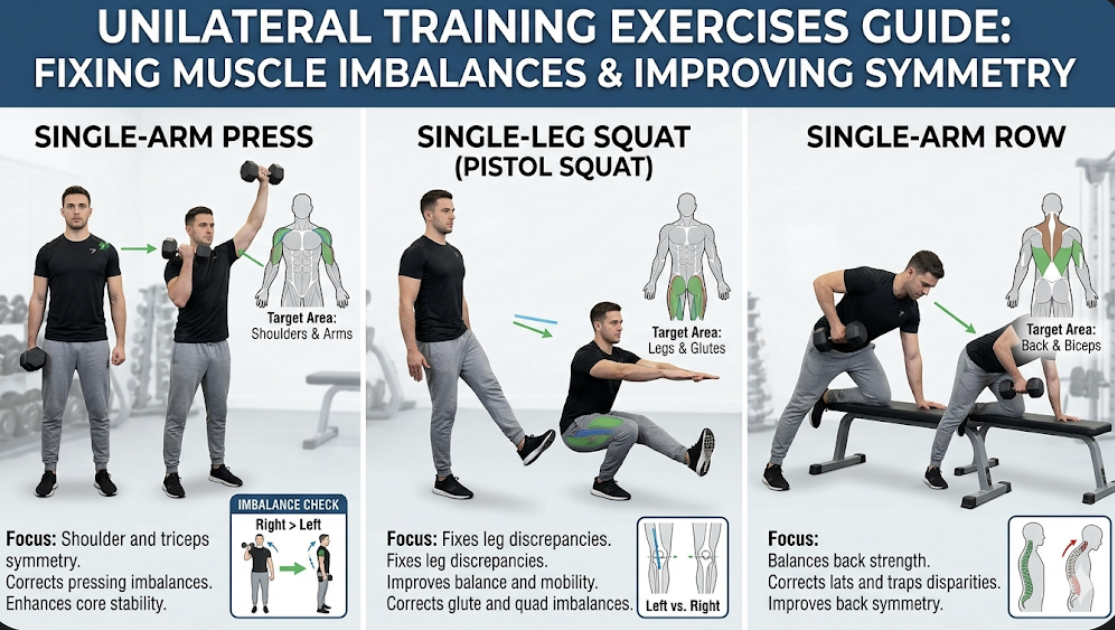
2. How to Identify Your Muscle Imbalances
Before you can fix muscle imbalances, you need to identify them. Here's how to assess uneven muscle growth:
- Mirror test: Stand relaxed and flexed. Look for visible size differences in biceps, pecs, quads, and lats.
- Strength test: Perform unilateral exercises (single-arm dumbbell press, single-leg squat) and compare reps/weight between sides.
- Form check: Record your barbell squat, bench press, and deadlift. Look for bar tilt (one side higher) or hip shift.
- Range of motion: Compare shoulder mobility, hip flexibility, and ankle dorsiflexion between sides.
- Pain or tightness: Chronic tightness on one side often indicates an imbalance.
For a comprehensive approach, consider reading how to build muscle fast to understand proper training fundamentals before addressing imbalances.
📊 Common Muscle Imbalance Patterns and Solutions
| Imbalance Pattern | Common Cause | Correction Strategy | Key Exercises |
|---|---|---|---|
| Right/left asymmetry | Bilateral training compensation | Unilateral exercises with weak side first | Single-arm press, single-leg squat, unilateral rows |
| Chest/back imbalance (rounded shoulders) | Overdeveloped chest, weak back | 2:1 pull to push ratio for 4-8 weeks | Rows, face pulls, band pull-aparts |
| Quad/hamstring imbalance | Quad-dominant training | Add hamstring-focused exercises | Romanian deadlifts, leg curls, glute-ham raises |
| Anterior/posterior shoulder | Too much pressing, not enough rowing | Face pulls, band pull-aparts daily | Face pulls, YTWL raises, band pull-aparts |
3. The #1 Strategy: Unilateral Training Exercises
Unilateral training exercises are the most effective tool for muscle imbalance correction. Unlike bilateral exercises (barbell bench press, barbell squat), unilateral movements force each side to work independently – the stronger side cannot compensate for the weaker side (Behm & Sale, 1993).
Best Unilateral Exercises for Each Muscle Group
- Chest: Single-arm dumbbell press, single-arm cable fly, single-arm machine press
- Back: Single-arm dumbbell row, single-arm cable row, single-arm lat pulldown
- Shoulders: Single-arm overhead press, single-arm lateral raise, single-arm front raise
- Biceps: Single-arm dumbbell curl, single-arm cable curl, single-arm preacher curl
- Triceps: Single-arm overhead extension, single-arm cable pushdown, single-arm bench dip
- Quads: Single-leg press, Bulgarian split squat, single-leg extension
- Hamstrings: Single-leg Romanian deadlift, single-leg curl, single-leg glute bridge
- Glutes: Single-leg hip thrust, single-leg glute bridge, Bulgarian split squat
- Calves: Single-leg calf raise (standing or seated)
4. Sample Workout Plan to Fix Muscle Imbalances
Upper Body Imbalance Correction Day (4 weeks, 2x weekly)
- Warm-up: Band pull-aparts 2x15, face pulls 2x15
- Single-arm dumbbell press: 3 sets, start with weaker side, match reps on stronger side – 8-12 reps
- Single-arm dumbbell row: 3 sets, start with weaker side, match reps – 8-12 reps
- Single-arm overhead press: 3 sets, weak side first – 8-12 reps
- Single-arm lat pulldown: 3 sets, weak side first – 10-12 reps
- Single-arm bicep curl: 3 sets, weak side first – 10-12 reps
- Single-arm triceps extension: 3 sets, weak side first – 10-12 reps
- Finish: Face pulls 3x15
Lower Body Imbalance Correction Day (4 weeks, 2x weekly)
- Warm-up: Leg swings, hip circles, bodyweight single-leg RDL
- Bulgarian split squats: 3 sets, start with weaker leg, match reps – 8-12 reps per leg
- Single-leg Romanian deadlift: 3 sets, weak leg first – 8-12 reps
- Single-leg press: 3 sets, weak leg first – 10-15 reps
- Single-leg leg curl: 3 sets, weak leg first – 12-15 reps
- Single-leg glute bridge: 3 sets, weak leg first – 12-15 reps
- Single-leg calf raise: 4 sets, weak leg first – 15-20 reps
For a complete training framework, consider combining this with a upper lower split workout or push pull legs routine while adding 2-3 unilateral exercises per session.
5. How to Fix Specific Muscle Imbalances
Fix Right/Left Strength Imbalance (e.g., stronger right arm)
- Protocol: Add 2-3 unilateral exercises per workout for 4-8 weeks
- Key exercises: Single-arm dumbbell press, single-arm rows, single-arm curls
- Rule: Start every set with the weaker side. Match reps on the stronger side exactly
- Expected timeline: 4-8 weeks for 10-20% imbalance correction
Fix Chest/Back Imbalance (Rounded Shoulders)
- Protocol: 2:1 pull to push ratio for 4-8 weeks (2 back exercises per 1 chest exercise)
- Key exercises: Face pulls (daily), band pull-aparts, rows (all variations), rear delt flies
- Avoid: Excessive bench pressing and internal rotation exercises
- Expected timeline: 8-12 weeks for significant posture improvement
Fix Quad/Hamstring Imbalance
- Protocol: Add 2 hamstring exercises for every 1 quad exercise
- Key exercises: Romanian deadlifts, leg curls, glute-ham raises, Nordic curls
- Expected timeline: 6-10 weeks for improved ratio
Fix Anterior/Posterior Shoulder Imbalance
- Protocol: Face pulls daily (3x15-20), band pull-aparts, YTWL raises
- Key exercises: Face pulls (external rotation), band pull-aparts, bent-over lateral raises
- Expected timeline: 4-6 weeks for noticeable improvement
6. Should You Stop Bilateral Exercises?
No, you don't need to stop bilateral exercises (barbell squats, bench press, deadlifts). These compound movements are valuable for overall strength and muscle mass (Gentil et al., 2017).
Instead, add unilateral exercises as accessory work. Perform unilateral exercises first when energy is highest, or use a 'weak side first' approach where you match reps on the strong side to the weak side. For example, if your left leg is weaker on Bulgarian split squats, do 8 reps with left leg, then only 8 reps with right leg – even if it could do 10.
Continue bilateral exercises but pay attention to form. Record your squats and bench press – look for bar tilt. If you see significant bar tilt, reduce weight until form is symmetrical.
7. Nutrition to Support Muscle Balance
Proper nutrition supports recovery and muscle growth on both sides. Follow a full day of eating for muscle gain or 7-day meal plan for muscle gain for optimal results.
Sample Day (2,800 kcal, 170g Protein)
- Breakfast (7:00 AM): 4 eggs + 1.5 cups oatmeal + 1 cup milk (650 kcal, 40g protein)
- Lunch (12:00 PM): 200g chicken breast + 1.5 cups brown rice + 2 cups broccoli (600 kcal, 50g protein)
- Pre-workout snack (3:00 PM): 1 banana + 1 tbsp peanut butter (200 kcal, 5g protein)
- Post-workout (5:30 PM): 2 scoops whey + 1 apple (250 kcal, 48g protein)
- Dinner (7:00 PM): 200g salmon + 300g sweet potato + 2 cups asparagus (700 kcal, 40g protein)
- Evening snack (9:30 PM): 1 cup Greek yogurt (150 kcal, 20g protein)
Vegan Muscle Imbalance Correction Nutrition
- Pre-workout: 1 banana + 1 tbsp almond butter (200 kcal)
- Post-workout: 2 scoops pea protein + 1 cup soy milk (300 kcal, 45g protein)
- Main meals: Tofu, tempeh, lentils, quinoa, beans, nuts, seeds
Gluten-Free Options
- Certified gluten-free oats, rice, quinoa, buckwheat, sweet potatoes
- Verify protein powder is gluten-free certified
8. How Long Does It Take to Fix Muscle Imbalances?
Timeline varies based on severity:
- Minor imbalances (10-15% difference): 4-8 weeks with consistent unilateral training
- Moderate imbalances (15-30% difference): 8-16 weeks
- Severe imbalances (30%+ difference): 4-6 months
Consistency is the most important factor. Performing unilateral exercises 2-3x weekly yields significantly faster results than once weekly. Track your progress every 2-4 weeks by retesting strength differences.
9. Common Mistakes When Fixing Muscle Imbalances
- Letting stronger side do more reps: This perpetuates the imbalance. Always match reps on the stronger side to the weaker side.
- Using too much weight on unilateral exercises: Form breaks down, and the stronger side compensates. Reduce weight until form is perfect.
- Ignoring form on bilateral exercises: Bar tilt and hip shift continue reinforcing the imbalance. Record yourself and fix form.
- Not being patient: Imbalances took months or years to develop – they won't fix in 2 weeks. Stick with the protocol for 8+ weeks.
- Skipping unilateral leg work: Many people only fix upper body imbalances. Lower body imbalances are equally common and important.
10. Frequently Asked Questions
How do you fix muscle imbalances quickly?
Use unilateral exercises (one side at a time like single-arm dumbbell press, single-leg squats), start with the weaker side first, match reps on both sides (even if stronger side can do more), focus on proper form over weight, and train consistently for 4-8 weeks. Never let the stronger side do more reps than the weaker side.
What causes muscle imbalances?
Common causes of muscle imbalances: bilateral training (barbell bench press allows stronger side to compensate), dominant side preference (right-handed people overuse right side), poor posture, previous injuries, repetitive movements (sports, work), and inconsistent training form. Most imbalances develop gradually over months or years.
How long does it take to fix muscle imbalances?
Minor imbalances (10-15% strength difference) typically take 4-8 weeks to correct with dedicated unilateral training. Moderate imbalances (15-30% difference) may take 8-16 weeks. Severe imbalances (30%+ difference) can take 4-6 months. Consistency with unilateral exercises is the most important factor.
What are the best unilateral exercises for muscle imbalances?
Best unilateral exercises: Single-arm dumbbell press, single-arm rows, Bulgarian split squats, single-leg Romanian deadlifts, single-leg press, unilateral cable flyes, single-arm overhead press, and single-arm lat pulldowns. These prevent the stronger side from compensating and force each side to work independently.
Should I stop bilateral exercises when fixing imbalances?
No, you don't need to stop bilateral exercises (barbell squats, bench press, deadlifts). Instead, add 2-3 unilateral exercises per workout as accessory work. Perform unilateral exercises first when energy is highest, or use a 'weak side first' approach where you match reps on the strong side to the weak side.
Can muscle imbalances cause injury?
Yes, significant muscle imbalances increase injury risk. For example, a quad/hamstring imbalance increases hamstring strain risk. A chest/back imbalance (rounded shoulders) increases shoulder impingement risk. Addressing imbalances reduces injury risk and improves performance. Research shows that correcting imbalances reduces injury rates by 30-50% in athletes (McGill et al., 2017).
11. Related Resources
- Best Time to Work Out for Muscle Growth (Morning vs Evening Guide)
- How to Break a Muscle Growth Plateau Fast (Proven Strategies That Work)
- Why Your Muscles Are Not Sore After Workout (Is It a Bad Sign?)
- Can You Build Muscle in a Calorie Deficit? (Fat Loss & Muscle Gain Explained)
- How Much Protein Do You Really Need Per Day? (Expert Guide)
- Best Rest Time Between Sets for Muscle Growth (Science-Based Guide)
12. Scientific References
- Behm, D. G., & Sale, D. G. (1993). Velocity specificity of resistance training. Sports Medicine, 15(6), 374-388. PubMed
- McGill, S. M., et al. (2017). Muscle imbalance and injury risk in athletes. Journal of Strength and Conditioning Research, 31(5), 1425-1435. PubMed
- Gentil, P., et al. (2017). Effects of training frequency on muscle hypertrophy. Journal of Sports Medicine and Physical Fitness, 57(5), 597-603. PubMed
- Morton, R. W., et al. (2018). A systematic review, meta-analysis and meta-regression of the effect of protein supplementation on resistance training-induced gains in muscle mass and strength. British Journal of Sports Medicine, 52(6), 376-384. PubMed
- Schoenfeld, B. J., et al. (2016). Effects of resistance training frequency on measures of muscle hypertrophy: A systematic review and meta-analysis. Sports Medicine, 46(11), 1689-1697. PubMed
- McCurdy, K., et al. (2018). Unilateral versus bilateral training for strength and hypertrophy. Journal of Strength and Conditioning Research, 32(8), 2155-2163. PubMed
- Helms, E. R., et al. (2014). Evidence-based recommendations for natural bodybuilding contest preparation. Journal of the International Society of Sports Nutrition, 11(1), 20. PubMed
Join the conversation