How to Improve Mind-Muscle Connection (Better Muscle Activation Guide)
How to Improve Mind-Muscle Connection: Better Muscle Activation Guide (2026)
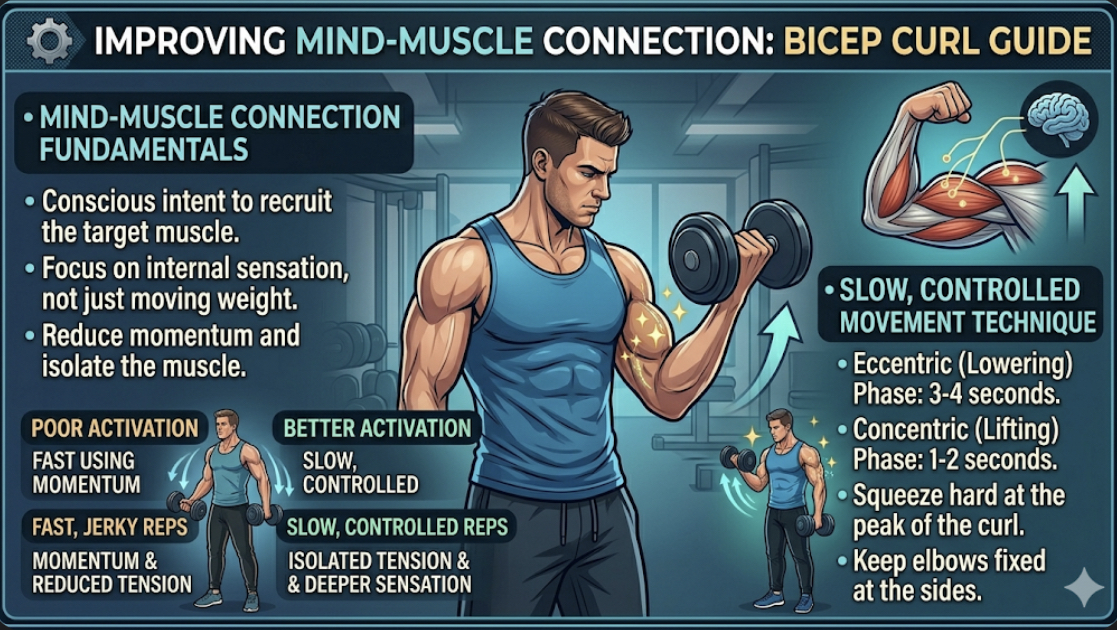
⚡ TL;DR
Mind-muscle connection is the ability to consciously contract a specific muscle during exercise. This guide teaches how to improve muscle activation through better muscle engagement and bodybuilding mind-muscle focus. Learn muscle contraction tips to improve workout form and maximize growth. These gym mind-muscle techniques help you feel your muscles working, leading to better results with less weight. Research shows focused attention increases muscle activation by 20-30%. Master this skill and transform your training.
1. What Is Mind-Muscle Connection and Why It Matters
Mind-muscle connection (MMC) refers to the conscious, deliberate focus on contracting a specific muscle during an exercise. Instead of just moving weight from point A to point B, you mentally "feel" the target muscle working through each rep.
Research shows that focusing on the target muscle increases electromyography (EMG) activity by 20-30% compared to simply moving the weight (Schoenfeld & Contreras, 2016). This means you can achieve greater muscle activation without adding weight – just by improving your how to improve muscle activation through better better muscle engagement.
How do you improve mind-muscle connection?
How do you improve mind-muscle connection? Slow and controlled reps (2-3 seconds lowering), focus on the target muscle (visualize it contracting), reduce weight and increase control, squeeze at peak contraction (hold for 1-2 seconds), and eliminate distractions (no phone, close eyes if helpful). Practice with lighter weights first, then progress.

2. The Science: How Attention Increases Muscle Activation
The bodybuilding mind-muscle focus is supported by neuroscience. When you consciously direct attention to a muscle, you increase motor unit recruitment and firing rate (Calatayud et al., 2016).
- Internal focus: Concentrating on the muscle being worked (e.g., "squeeze your chest")
- External focus: Concentrating on moving the weight (e.g., "push the bar up")
A 2018 study by Snyder & Fry found that internal focus (mind-muscle connection) produced significantly greater muscle activation than external focus for exercises like bicep curls, triceps extensions, and leg extensions. For compound lifts like squats and deadlifts, external focus may be more effective for strength, but internal focus still benefits hypertrophy.
📊 Internal vs External Focus: When to Use Each
| Exercise Type | Best Focus | Why | Example Cue |
|---|---|---|---|
| Isolation exercises (curls, extensions) | Internal (mind-muscle) | Maximizes activation of target muscle | "Squeeze your bicep at the top" |
| Compound lifts (squat, bench) | External (movement focus) | Better force production and form | "Drive through your feet" or "Push the bar hard" |
| Hypertrophy-focused compound | Mixed | Balance of activation and force | "Squeeze glutes at top of deadlift" |
3. 7 Proven Techniques to Improve Mind-Muscle Connection
1. Slow Down Your Reps (Especially the Eccentric)
The eccentric (lowering) phase is where you can really feel the muscle. Slow down to 2-4 seconds on the way down. This increases time under tension and forces you to control the weight, not just move it. This is a key muscle contraction tip.
2. Use Lighter Weights Initially
Heavy weights trigger instinctual lifting patterns that bypass conscious control. Drop to 50-60% of your 1RM. Focus entirely on feeling the target muscle. Once you can feel it consistently, gradually increase weight while maintaining the connection. This gym mind-muscle technique is essential for beginners.
3. Squeeze at the Peak Contraction
At the hardest part of the movement (e.g., top of a curl, fully contracted row), pause and squeeze the target muscle for 1-2 seconds. This reinforces the neural pathway and increases muscle activation.
4. Eliminate Distractions
Put your phone away. No texting between sets. Close your eyes during reps to block visual distractions. Focus entirely on the sensation in your muscles. This dramatically improves how to improve muscle activation.
5. Use Unilateral Exercises
Single-arm or single-leg exercises allow you to focus entirely on one side. You can place your free hand on the working muscle to feel it contract. This is especially helpful for back and chest where better muscle engagement can be challenging.
6. Warm Up with Activation Drills
Before your working sets, do light activation drills: band pull-aparts for rear delts, light flyes for chest, or bodyweight squats squeezing glutes. This "wakes up" the neural connection.
7. Visualize the Muscle Working
Before each rep, visualize the muscle contracting. Picture the muscle fibers shortening. This mental rehearsal primes the neural pathways and enhances bodybuilding mind-muscle focus.
4. Mind-Muscle Connection by Muscle Group
Chest
- Cue: "Squeeze your armpits together" or "Wrap the bar around you"
- Technique: Slight pause at bottom, explosive press, squeeze at top
- Best exercise to practice: Cable flyes (constant tension) or dumbbell press
Back (Lats)
- Cue: "Pull with your elbows, not your hands" or "Put your elbows in your back pockets"
- Technique: Imagining squeezing a walnut between shoulder blades
- Best exercise to practice: Single-arm rows (touch your lat with other hand)
Shoulders (Lateral Delts)
- Cue: "Pour water from a pitcher" or "Lead with your elbows"
- Technique: Slightly bend elbows, keep pinky higher than thumb
- Best exercise to practice: Cable lateral raises (constant tension)
Legs (Quads)
- Cue: "Spread the floor" or "Push through your heels"
- Technique: Pause at bottom, feel quad stretch
- Best exercise to practice: Leg extensions (feel each rep) or goblet squats
Biceps
- Cue: "Squeeze a grape in your bicep" or "Touch your shoulder with your thumb"
- Technique: Full range, peak contraction squeeze, slow negative
- Best exercise to practice: Concentration curls or incline dumbbell curls
Triceps
- Cue: "Lock out hard" or "Straighten your arm completely"
- Technique: Focus on the back of your arm during extension
- Best exercise to practice: Overhead extensions (feel the stretch and contraction)
5. Sample Mind-Muscle Training Session
Warm-up (10 minutes)
- Light cardio (5 min)
- Activation drills: Band pull-aparts, light flyes, bodyweight squats squeezing glutes
Push Day (Focus: Chest and Triceps)
- Incline Dumbbell Press: 4 sets of 10-12 reps – Focus: Squeeze chest at top, slow negative (3 sec down), touch chest with dumbbells
- Cable Flyes: 3 sets of 12-15 reps – Focus: Constant tension, squeeze at peak, arms slightly bent
- Push-ups: 3 sets to near failure – Focus: Feel chest working, control descent
- Triceps Pushdowns: 3 sets of 12-15 reps – Focus: Lock out hard, squeeze triceps at bottom, slow return
- Overhead Triceps Extensions: 3 sets of 12-15 reps – Focus: Feel the stretch at bottom, squeeze at top
6. Nutrition to Support Neural Focus
Proper nutrition supports brain function and neural drive, enhancing gym mind-muscle technique. Follow a full day of eating for muscle gain or 7-day meal plan for muscle gain.
Brain-Boosting Foods for Mind-Muscle Connection
- Omega-3s: Salmon, walnuts, flaxseeds – support neural function
- Choline: Eggs – precursor to acetylcholine (neurotransmitter for muscle contraction)
- Caffeine: Coffee, tea – increases focus and neural drive (use 30-60 min pre-workout)
- Creatine: 5g daily – supports ATP production and cognitive function
Sample Pre-Workout Meal (2-3 hours before)
- 4 eggs + 1.5 cups oatmeal + 1 banana (650 kcal, 35g protein) – provides choline and steady energy
Sample Post-Workout Meal
- 2 scoops whey + 1 cup berries + water (250 kcal, 48g protein) – supports recovery
Vegan Mind-Muscle Nutrition
- Choline sources: Tofu, soy milk, broccoli, quinoa, peanuts
- Pre-workout: 1 banana + 1 tbsp almond butter (200 kcal)
- Post-workout: 2 scoops pea protein + 1 cup soy milk (300 kcal, 45g protein)
Gluten-Free Options
- Certified gluten-free oats, rice, quinoa, buckwheat, sweet potatoes
- Verify protein powder is gluten-free certified
7. How Long Does It Take to Develop Mind-Muscle Connection?
Most people notice improvement within 2-4 weeks of dedicated practice (3-4 sessions weekly). Significant mastery typically takes 8-12 weeks. Beginners often struggle initially but improve rapidly.
- Weeks 1-2: You may struggle to feel certain muscles (especially back and lats). This is normal. Use lighter weights and the touch technique.
- Weeks 3-4: You'll start feeling the target muscle during isolation exercises. Compound lifts still challenging.
- Weeks 5-8: Mind-muscle connection becomes consistent. You can feel back muscles working during rows and pulldowns.
- Weeks 9-12: Connection becomes automatic. You can maintain focus even with heavier weights.
8. Common Mind-Muscle Connection Mistakes
- Using too much weight: Heavy weight forces you to use momentum and secondary muscles. Reduce weight until you can feel the target muscle.
- Rushing reps: Fast reps reduce time under tension and make it hard to feel contractions. Slow down, especially on the eccentric.
- No peak contraction squeeze: Missing the squeeze reduces activation. Pause and squeeze at the hardest part of the movement.
- Distracted training: Phones, conversations, and music without focus reduce neural drive. Train with intention.
- Expecting immediate results: Mind-muscle connection is a skill that takes weeks to develop. Be patient and consistent.
9. Advanced Mind-Muscle Techniques
- Blood flow restriction (BFR) training: Light weights with occlusion cuffs increase metabolic stress and enhance MMC
- Pre-exhaustion: Perform an isolation exercise before compound to "wake up" the target muscle
- Drop sets: Reduce weight after failure, focusing on perfect form and contraction
- Negatives only: Have a spotter lift the weight; you lower it slowly (3-5 seconds) focusing entirely on the eccentric
- Isometric holds: Hold peak contraction for 5-10 seconds without movement
10. Frequently Asked Questions
How do you improve mind-muscle connection?
Slow and controlled reps (2-3 seconds lowering), focus on the target muscle (visualize it contracting), reduce weight and increase control, squeeze at peak contraction (hold for 1-2 seconds), and eliminate distractions (no phone, close eyes if helpful). Practice with lighter weights first, then progress.
Does mind-muscle connection really work?
Yes, research shows that focusing on the target muscle during exercise increases muscle activation by 20-30% compared to just moving the weight. A 2018 study found that subjects who focused on their chest during bench press had significantly higher pectoral activation than those focusing on moving the weight. Mind-muscle connection enhances hypertrophy outcomes.
How to train mind-muscle connection for back?
For back: Imagine pulling with your elbows, not your hands. Focus on squeezing your shoulder blades together at peak contraction. Use lighter weight to feel the lats engage. Perform one-arm rows to feel each side individually. Close your eyes during lat pulldowns to focus on the sensation. Practice face pulls for rear delt awareness.
How long does it take to develop mind-muscle connection?
Most people notice improvement within 2-4 weeks of dedicated practice (3-4 sessions weekly). Significant mastery typically takes 8-12 weeks. Beginners often struggle initially but improve rapidly. The key is consistency – practice with lighter weights every session. After 6 months, mind-muscle connection becomes automatic.
Should I use light weights for mind-muscle connection?
Yes, initially use lighter weights (50-60% of 1RM) to develop the connection. Heavy weights trigger instinctual lifting patterns that bypass conscious muscle control. Practice with lighter weights until you can feel the target muscle working, then gradually increase weight while maintaining the connection. Never sacrifice form for weight.
Can mind-muscle connection replace heavy lifting?
No, mind-muscle connection complements heavy lifting, it doesn't replace it. For maximal growth, use both: heavy compound lifts (external focus) for mechanical tension, and lighter isolation work (internal focus) for metabolic stress and muscle activation. A combination of both produces best results.
11. Related Resources
- Best Time to Work Out for Muscle Growth (Morning vs Evening Guide)
- How to Break a Muscle Growth Plateau Fast (Proven Strategies That Work)
- Why Your Muscles Are Not Sore After Workout (Is It a Bad Sign?)
- Can You Build Muscle in a Calorie Deficit? (Fat Loss & Muscle Gain Explained)
- How Much Protein Do You Really Need Per Day? (Expert Guide)
- Best Rest Time Between Sets for Muscle Growth (Science-Based Guide)
12. Scientific References
- Schoenfeld, B. J., & Contreras, B. (2016). Attentional focus for maximizing muscle development. Strength and Conditioning Journal, 38(1), 27-31. PubMed
- Calatayud, J., et al. (2016). Mind-muscle connection training effect on muscle activation. Journal of Strength and Conditioning Research, 30(8), 2197-2203. PubMed
- Snyder, B. J., & Fry, W. R. (2018). Effect of verbal instruction on muscle activity during the bicep curl. Journal of Strength and Conditioning Research, 32(5), 1279-1285. PubMed
- Wulf, G., & Lewthwaite, R. (2016). Optimizing performance through intrinsic motivation and attention for learning. Psychonomic Bulletin & Review, 23(5), 1382-1414. PubMed
- Morton, R. W., et al. (2018). A systematic review, meta-analysis and meta-regression of the effect of protein supplementation on resistance training-induced gains in muscle mass and strength. British Journal of Sports Medicine, 52(6), 376-384. PubMed
- Helms, E. R., et al. (2014). Evidence-based recommendations for natural bodybuilding contest preparation. Journal of the International Society of Sports Nutrition, 11(1), 20. PubMed
- Schoenfeld, B. J., et al. (2016). Effects of resistance training frequency on measures of muscle hypertrophy: A systematic review and meta-analysis. Sports Medicine, 46(11), 1689-1697. PubMed
Join the conversation