How to Improve Squat and Deadlift (Strength & Technique Guide)
How to Improve Squat and Deadlift: Strength & Technique Guide (2026)

⚡ TL;DR
To improve squat and deadlift, you need a systematic approach. This guide provides proven squat and deadlift tips, strategies to increase squat strength, and a complete deadlift strength guide. Learn how to lift heavier weights through proper technique, programming, accessory work, and recovery. This compound lift progression and powerlifting tips guide covers everything from beginner to advanced. Stop stalling – implement these methods and watch your squat and deadlift numbers soar.
1. Why Squat and Deadlift Are the Kings of Strength
The squat and deadlift are foundational compound lifts that build total body strength, muscle mass, and athletic performance. They recruit more muscle mass than any other exercises, drive hormone response, and have direct carryover to real-life activities.
To improve squat and deadlift, you need proper technique, smart programming, and dedicated accessory work. This compound lift progression guide provides everything you need to increase squat strength and master the deadlift strength guide.
How can I improve my squat and deadlift?
How can I improve my squat and deadlift? Improve form and technique (bar position, back angle, bracing), train consistently (2-3 times per week), use progressive overload (add 5-10 lbs weekly), strengthen core and posterior chain with accessory work, and focus on mobility and recovery (hip flexors, hamstrings, sleep).
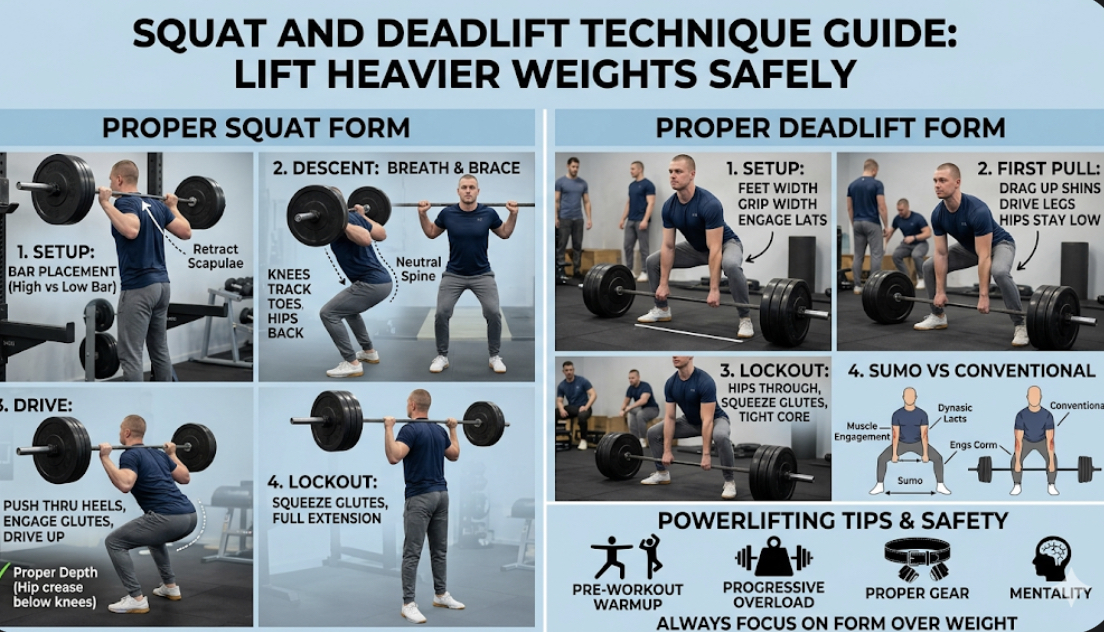
2. Squat Technique: The Foundation
Before adding weight, perfect your squat form. Proper technique can instantly add 20-30 lbs to your max.
Bar Position (Low-Bar vs High-Bar)
- Low-bar squat: Bar rests on rear delts, more hip involvement, allows heavier weight, preferred for powerlifting
- High-bar squat: Bar rests on traps, more quad involvement, more upright torso, better for Olympic lifting
- Choose based on: Your anatomy, goals, and comfort. Most beginners start with high-bar.
Setup and Bracing
- Grip: Hands slightly wider than shoulders, wrists straight, pull bar into back
- Bracing: Take a deep breath into your belly (not chest), brace core like you're about to be punched
- Back: Neutral spine (not rounded), chest up, shoulder blades squeezed
The Descent (Eccentric)
- Break at hips first: Initiate movement by pushing hips back, then bend knees
- Knee position: Knees track over toes (not caving inward)
- Depth: Hip crease below top of knee (parallel or deeper for powerlifting standards)
- Tempo: Controlled descent (2-3 seconds)
The Ascent (Concentric)
- Drive through heels/midfoot: Push the floor away, don't lift chest first
- Keep chest up: Avoid "good morning" the weight (hips rising faster than chest)
- Exhale at top: After passing sticking point
3. Deadlift Technique: The King of Pulls
The deadlift requires precision. Small form changes yield big strength increases.
Setup (The Most Critical Part)
- Bar position: Bar over midfoot (about 1 inch from shins)
- Stance: Feet hip-width apart (for conventional), or wider (sumo)
- Grip: Double overhand (light weights) or mixed/hook grip (heavy weights)
- Shins to bar: Bend knees until shins touch bar (don't move the bar)
Bracing and Tension
- Flat back: Neutral spine (no rounding). Chest up, shoulders back
- Lats engaged: "Put your armpits in your back pockets" – pull shoulders down and back
- Brace core: Deep breath into belly, hold through the lift
- Pull slack out: Lightly pull bar to feel tension before lifting
The Pull
- Push, don't pull: Imagine pushing the floor away with your feet (leg drive)
- Keep bar close: Bar should drag up shins and thighs (use long socks/pants)
- Hips and shoulders rise together: Don't let hips shoot up first
- Lockout: Squeeze glutes and push hips through at top
The Descent (Controlled)
- Don't drop: Control the bar down (hinge at hips, bend knees after bar passes them)
- Keep back flat: Don't round on the way down
4. Training Frequency and Volume for Squat and Deadlift
Research shows that training each lift 2-3x weekly produces superior strength gains (Schoenfeld et al., 2016). However, deadlifts are more systemically taxing – manage volume carefully.
📊 Optimal Squat and Deadlift Frequency by Level
| Training Level | Squat Frequency | Deadlift Frequency | Sample Schedule |
|---|---|---|---|
| Beginner | 2x weekly | 1x weekly | Mon: Squat, Thu: Squat + Deadlift |
| Intermediate | 2-3x weekly | 1-2x weekly | Mon: Heavy Squat, Wed: Light Squat, Fri: Deadlift |
| Advanced | 3-4x weekly | 2x weekly | Periodized based on program |
Weekly Volume Recommendations
- Squat: 15-30 heavy reps per week (e.g., 5x5 = 25 reps)
- Deadlift: 10-20 heavy reps per week (e.g., 3x5 = 15 reps)
- Accessory work: 30-50 total reps for supporting muscles
5. Accessory Exercises for Squat and Deadlift
Your squat and deadlift are only as strong as your weakest muscle. Strengthen these powerlifting tips accessories:
For Squat (Quad and Core Focus)
- Front squats: 3-4 sets of 5-8 reps – builds quads and upright strength
- Pause squats: 3 sets of 3-5 reps with 2-second pause – builds strength out of the hole
- Leg press: 3 sets of 8-12 reps – quad volume
- Good mornings: 3 sets of 8-10 reps – strengthens posterior chain and bracing
- Planks and ab wheel: 3 sets – core stability for bracing
For Deadlift (Posterior Chain Focus)
- Romanian deadlifts (RDLs): 3-4 sets of 8-10 reps – builds hamstrings and glutes
- Deficit deadlifts: 3 sets of 3-5 reps (standing on 1-2" plate) – builds strength off the floor
- Rack pulls: 3 sets of 3-5 reps (bar at knee level) – builds lockout strength
- Hip thrusts: 3 sets of 10-12 reps – builds glute strength for lockout
- Hyperextensions: 3 sets of 12-15 reps – erector spinae strength
For Both (General Strength)
- Pull-ups/rows: 3-4 sets – upper back stability
- Carries (farmer's walk): 3 sets of 30-50 feet – grip and core
- Box jumps/prowler pushes: 3-4 sets – explosive power
6. Sample Squat and Deadlift Program (12 Weeks)
Week 1-4: Linear Progression (Beginner/Intermediate)
- Monday (Squat Heavy): Squat 5x5, Leg Press 3x10, Good Mornings 3x8, Planks 3x30 sec
- Wednesday (Deadlift Focus): Deadlift 3x5, RDL 3x8, Pull-ups 3x8, Hyperextensions 3x12
- Friday (Squat Light/Technique): Pause Squats 3x5, Front Squats 3x8, Lunges 3x10, Ab Wheel 3x10
- Progression: Add 5-10 lbs to squat and deadlift each week
Week 5-8: Periodized (Intermediate)
- Monday (Squat Volume): Squat 4x8 (70-75%), Leg Press 3x12, Good Mornings 3x10
- Wednesday (Deadlift Heavy): Deadlift 4x3 (85-90%), Deficit Deadlifts 3x3, RDL 3x8
- Friday (Squat Heavy): Squat 5x3 (85-90%), Front Squats 3x5, Box Jumps 4x5
- Progression: Add 2.5-5 lbs to heavy days weekly
Week 9-12: Peaking (Intermediate/Advanced)
- Monday (Squat Strength): Squat 5x3 (85-90%), Good Mornings 3x5
- Wednesday (Deadlift Strength): Deadlift 3x3 (85-90%), Rack Pulls 3x3
- Friday (Overload): Squat 3x2 (90-95%), Deadlift 2x2 (90-95%)
- Deload Week 12: Reduce weight by 40-50% for 1 week, then test 1RM
For a complete training framework, combine with a upper lower split workout or push pull legs routine.
7. Mobility and Recovery for Squat and Deadlift
Poor mobility limits depth and technique. Prioritize these areas:
- Ankle mobility (for squat depth): Knee-to-wall stretches, banded ankle mobilizations
- Hip mobility (for both): Hip flexor stretches, 90/90 stretches, pigeon pose
- Hamstring flexibility (for deadlift setup): RDLs with light weight, good mornings
- Thoracic mobility (for squat bar position): T-spine rotations, foam rolling upper back
- Sleep: 7-9 hours nightly – critical for CNS recovery from heavy compound lifts
- Deload weeks: Every 4-6 weeks, reduce intensity/volume by 40-50%
8. Common Squat and Deadlift Mistakes
Squat Mistakes
- Knee cave (valgus): Knees collapsing inward. Fix: Glute activation, "spread floor" cue, banded squats
- Butt wink: Lower back rounding at bottom. Fix: Improve ankle/hip mobility, stop going too deep
- Good morning squat: Hips rise faster than chest. Fix: Strengthen quads, keep chest up cue
- Shallow depth: Not reaching parallel. Fix: Box squats, pause squats, mobility work
Deadlift Mistakes
- Rounded back: Spinal flexion during pull. Fix: Lower weight, engage lats, "show chest" cue
- Hips rising too fast: Legs straighten before back. Fix: Push through floor, hips and shoulders rise together
- Bar away from body: Bar drifts forward. Fix: Keep bar against shins/thighs, engage lats
- Soft lockout: Not squeezing glutes at top. Fix: Hip thrust at top, hold lockout for 1 second
9. Nutrition for Squat and Deadlift Strength
To increase squat strength and deadlift numbers, you need adequate calories and protein. Follow a full day of eating for muscle gain or 7-day meal plan for muscle gain.
Calorie and Protein Requirements
- Calories: Maintenance to +200 surplus for strength gains (avoid excessive fat gain)
- Protein: 1.8-2.2 g/kg body weight (150-170g for 75kg person)
- Carbs: 4-5 g/kg – fuel for heavy squat and deadlift sessions
Sample Squat/Deadlift Training Day (2,800 kcal, 170g Protein)
- Breakfast (7:00 AM): 4 eggs + 1.5 cups oatmeal + 1 cup milk (650 kcal, 40g protein)
- Lunch (12:00 PM): 200g chicken breast + 1.5 cups brown rice + 2 cups broccoli (600 kcal, 50g protein)
- Pre-workout snack (3:00 PM): 1 banana + 1 tbsp peanut butter (200 kcal, 5g protein)
- Post-workout (5:30 PM): 2 scoops whey + 1 apple (250 kcal, 48g protein)
- Dinner (7:00 PM): 200g salmon + 300g sweet potato + 2 cups asparagus (700 kcal, 40g protein)
- Evening snack (9:30 PM): 1 cup Greek yogurt (150 kcal, 20g protein)
Vegan Powerlifting Nutrition
- Pre-workout: 1 banana + 1 tbsp almond butter (200 kcal)
- Post-workout: 2 scoops pea protein + 1 cup soy milk (300 kcal, 45g protein)
- Main meals: Tofu, tempeh, lentils, quinoa, beans, nuts, seeds
Gluten-Free Options
- Certified gluten-free oats, rice, quinoa, buckwheat, sweet potatoes
- Verify protein powder is gluten-free certified
10. Frequently Asked Questions
How can I improve my squat and deadlift?
Improve form and technique (bar position, back angle, bracing), train consistently (2-3 times per week), use progressive overload (add 5-10 lbs weekly), strengthen core and posterior chain with accessory work, and focus on mobility and recovery (hip flexors, hamstrings, sleep).
How often should I squat and deadlift?
For optimal strength gains, squat 2-3 times per week and deadlift 1-2 times per week. Beginners can squat 2x weekly and deadlift 1x weekly. Intermediates can squat 3x weekly and deadlift 2x weekly (alternating heavy and light days). Deadlifts are more systemically taxing – manage volume carefully.
What accessory exercises help squat and deadlift?
Best accessory exercises: For squats: front squats, leg press, lunges, good mornings, pause squats. For deadlifts: Romanian deadlifts, deficit deadlifts, rack pulls, good mornings, glute bridges, hip thrusts. Core: planks, leg raises, ab wheel. Posterior chain: hyperextensions, reverse hyperextensions.
How can I fix my squat form?
Fix squat form by: proper bar placement (low-bar or high-bar), chest up, back tight, brace core before each rep, break at hips first, knees track over toes, depth (hip crease below knee), drive through heels/midfoot. Record yourself to identify form breakdowns. Improve ankle and hip mobility if depth is limited.
How can I fix my deadlift form?
Fix deadlift form by: bar over midfoot, shins against bar, flat back (no rounding), lats engaged (armpits pulled down), brace core, pull slack out of bar, push feet through floor, keep bar close to shins/thighs, lock out glutes at top, controlled descent. Use light weights to practice form.
How much can the average person squat and deadlift?
Average lifts by body weight (intermediate): Squat: 165 lb male: 225-275 lbs, 200 lb male: 275-335 lbs. Deadlift: 165 lb male: 275-335 lbs, 200 lb male: 335-405 lbs. For women, approximately 60-70% of male numbers. Focus on your own progress, not comparison.
11. Related Resources
- Best Time to Work Out for Muscle Growth (Morning vs Evening Guide)
- How to Break a Muscle Growth Plateau Fast (Proven Strategies That Work)
- Why Your Muscles Are Not Sore After Workout (Is It a Bad Sign?)
- Can You Build Muscle in a Calorie Deficit? (Fat Loss & Muscle Gain Explained)
- How Much Protein Do You Really Need Per Day? (Expert Guide)
- Best Rest Time Between Sets for Muscle Growth (Science-Based Guide)
12. Scientific References
- Schoenfeld, B. J., et al. (2016). Effects of resistance training frequency on measures of muscle hypertrophy: A systematic review and meta-analysis. Sports Medicine, 46(11), 1689-1697. PubMed
- Grgic, J., et al. (2018). Effects of resistance training frequency on skeletal muscle hypertrophy: A systematic review and meta-analysis. Sports Medicine, 48(9), 2145-2158. PubMed
- Morton, R. W., et al. (2018). A systematic review, meta-analysis and meta-regression of the effect of protein supplementation on resistance training-induced gains in muscle mass and strength. British Journal of Sports Medicine, 52(6), 376-384. PubMed
- Helms, E. R., et al. (2014). Evidence-based recommendations for natural bodybuilding contest preparation. Journal of the International Society of Sports Nutrition, 11(1), 20. PubMed
- Gentil, P., et al. (2017). Effects of training frequency on muscle hypertrophy. Journal of Sports Medicine and Physical Fitness, 57(5), 597-603. PubMed
- McGill, S. M. (2015). Low back disorders: evidence-based prevention and rehabilitation. Human Kinetics.
- Wendler, J. (2017). 5/3/1: The simplest and most effective training system. Powerlifting USA.
Join the conversation