How to Increase Strength Without Gaining Fat (Lean Strength Guide)
How to Increase Strength Without Gaining Fat: Lean Strength Guide (2026)

⚡ TL;DR
You can increase strength without gaining fat by focusing on neurological adaptations rather than muscle size. This lean strength training approach teaches how to get stronger without weight gain through maintenance calories, high protein, and compound lifts. Learn strength training without bulking and build strength without fat gain using proven methods. This body recomposition strength guide provides everything for clean strength gains – no dirty bulking required. Stop accepting unwanted fat gain – build lean, functional strength today.
1. The Myth: You Must Bulk to Get Stronger
For decades, lifters believed you needed a calorie surplus ("bulk") to gain strength. While a surplus helps, it's not necessary – especially for beginners and intermediates. Most strength gains come from neurological adaptations, not muscle growth (Carroll et al., 2001).
This guide teaches you how to increase strength without gaining fat using lean strength training principles. Whether you want strength training without bulking or clean strength gains, these methods work for anyone who wants to build strength without fat gain.
How can I increase strength without gaining fat?
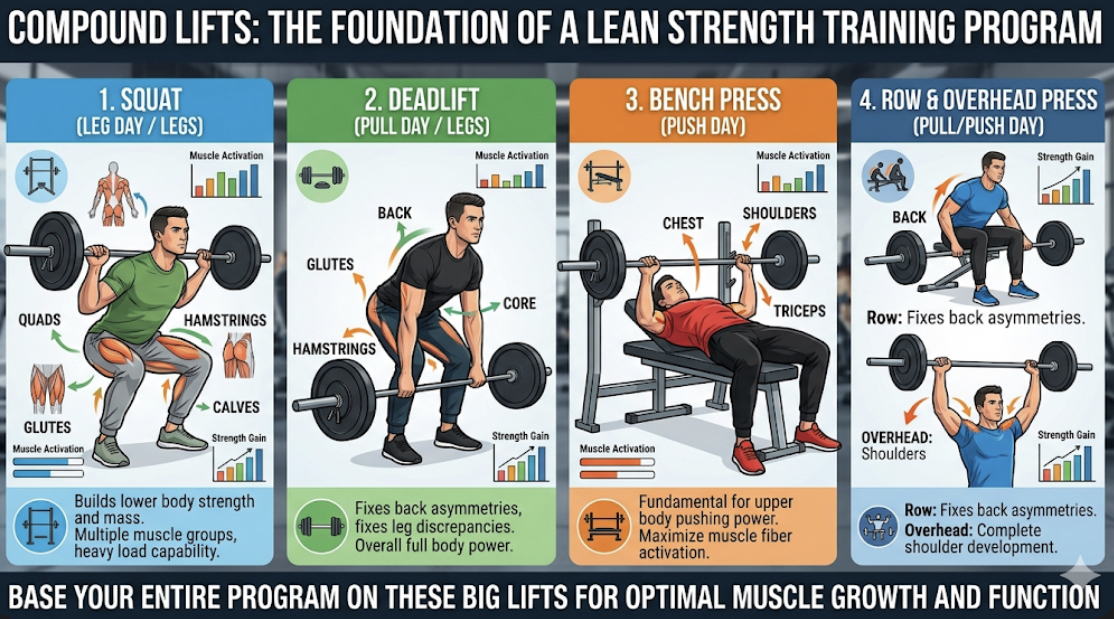
How can I increase strength without gaining fat? Eat at maintenance calories (not surplus), high protein intake (1.8-2.2 g/kg body weight), focus on compound lifts (squat, deadlift, bench press, overhead press, rows), apply progressive overload (add weight or reps weekly), and avoid dirty bulking. This approach allows neurological adaptations to drive strength gains without excess fat.
2. The Science: Neurological Adaptations Drive Strength
Lean strength training relies on understanding how strength increases occur:
- Neurological adaptations (60-80% of early strength gains): Improved motor unit recruitment, rate coding, and intermuscular coordination (Carroll et al., 2001).
- Muscle hypertrophy (20-40% of strength gains): Actual muscle growth – slower to develop.
- Technique improvements: Better leverage and movement efficiency.
- Connective tissue adaptations: Increased tendon stiffness improves force transmission.
Research shows that beginners can increase strength by 20-40% in 8-12 weeks without any muscle growth – purely through neurological adaptations. This means you can get stronger without weight gain for months or even years.
📊 Strength Gains Without Weight Gain: What's Possible?
| Training Experience | Potential Strength Gain (12 weeks) | Muscle Gain Needed? | Best Approach |
|---|---|---|---|
| Beginner (0-6 months) | 30-50% increase | Little to none | Maintenance calories + compound lifts |
| Intermediate (6-18 months) | 15-25% increase | Some (5-10 lbs muscle) | Slight surplus (+100-200 calories) or maintenance |
| Advanced (2+ years) | 5-10% increase | Significant (10+ lbs muscle) | Moderate surplus (+200-300 calories) or periodized bulking |
3. The Lean Strength Nutrition Protocol
To increase strength without gaining fat, nutrition is critical. Here's the body recomposition strength nutrition approach:
Calories: Eat at Maintenance
Calculate your TDEE (Total Daily Energy Expenditure). Eat at maintenance calories – not a surplus, not a deficit. This provides enough energy for performance without fat gain. Adjust based on weekly scale weight – if gaining weight, reduce calories by 100-200; if losing weight and strength stalls, increase by 100-200.
Protein: High Intake (1.8-2.2 g/kg)
High protein preserves muscle and supports recovery. A 75 kg person needs 135-165g protein daily. Spread across 4-5 meals (30-40g per meal) to maximize muscle protein synthesis (Schoenfeld & Aragon, 2018).
Carbohydrates: Moderate (3-5 g/kg)
Carbs fuel training intensity. On training days, eat more carbs (4-5 g/kg). On rest days, reduce slightly (3 g/kg). Prioritize carbs around workouts.
Fats: Moderate (0.8-1 g/kg)
Fats support hormone production. Don't drop below 0.6 g/kg – hormone function suffers. Focus on healthy fats: olive oil, avocado, nuts, seeds, fatty fish.
4. Sample Lean Strength Meal Plan (2,500 kcal, 165g Protein)
Full Day at Maintenance (75 kg person)
- Breakfast (7:00 AM): 4 eggs + 1.5 cups oatmeal + 1 cup milk (650 kcal, 40g protein)
- Lunch (12:00 PM): 200g chicken breast + 1.5 cups brown rice + 2 cups broccoli (600 kcal, 50g protein)
- Pre-workout snack (3:00 PM): 1 banana + 1 tbsp peanut butter (200 kcal, 5g protein)
- Post-workout (5:30 PM): 2 scoops whey + 1 apple (250 kcal, 48g protein)
- Dinner (7:00 PM): 200g salmon + 250g sweet potato + 2 cups asparagus (650 kcal, 40g protein)
- Evening snack (9:30 PM – optional): 1 cup Greek yogurt (150 kcal, 20g protein)
- Total: ~2,500 kcal, ~163g protein
For more meal ideas, check out full day of eating for muscle gain and adjust portions to maintenance calories.
Vegan Lean Strength Meal Plan
- Breakfast: 1.5 cups tofu scramble + 1.5 cups oats + 2 cups soy milk (650 kcal, 45g protein)
- Lunch: 200g tempeh + 1.5 cups quinoa + 2 cups mixed vegetables (600 kcal, 45g protein)
- Post-workout: 2 scoops pea protein + 1 banana (300 kcal, 45g protein)
- Dinner: 250g lentils + 2 cups brown rice + 2 cups broccoli + 1 tbsp olive oil (700 kcal, 35g protein)
Gluten-Free Lean Strength Options
- Certified gluten-free oats, rice, quinoa, buckwheat, sweet potatoes
- Verify protein powder is gluten-free certified
5. Lean Strength Training Program
This program focuses on strength training without bulking – maximizing neurological adaptations and technique.
Weekly Schedule (4 days)
- Monday: Lower Body Strength (squat focus)
- Tuesday: Upper Body Strength (bench press focus)
- Wednesday: Rest or light cardio
- Thursday: Lower Body Power (deadlift focus)
- Friday: Upper Body Power (overhead press focus)
- Saturday: Accessory work / weak point training
- Sunday: Rest
Lower Body Strength Day (Squat Focus)
- Squat: 5 sets of 5 reps (heavy, 80-85% 1RM)
- Romanian Deadlift: 3 sets of 8-10 reps
- Leg Press: 3 sets of 10-12 reps
- Calf Raises: 4 sets of 15-20 reps
- Core: Planks 3x45 sec
Upper Body Strength Day (Bench Press Focus)
- Bench Press: 5 sets of 5 reps (heavy, 80-85% 1RM)
- Barbell Rows: 4 sets of 6-8 reps
- Overhead Press: 3 sets of 8-10 reps
- Pull-ups: 3 sets to failure
- Triceps Extensions: 3 sets of 10-12 reps
- Face Pulls: 3 sets of 15-20 reps
Lower Body Power Day (Deadlift Focus)
- Deadlift: 5 sets of 3-5 reps (heavy, 80-85% 1RM)
- Front Squat or Goblet Squat: 3 sets of 8-10 reps
- Walking Lunges: 3 sets of 10-12 per leg
- Leg Curls: 3 sets of 12-15 reps
- Core: Hanging leg raises 3x12
Upper Body Power Day (Overhead Press Focus)
- Overhead Press: 5 sets of 5 reps (heavy, 80-85% 1RM)
- Pull-ups or Lat Pulldowns: 4 sets of 8-10 reps
- Incline Dumbbell Press: 3 sets of 8-12 reps
- Seated Cable Rows: 3 sets of 10-12 reps
- Dumbbell Curls: 3 sets of 10-12 reps
- Lateral Raises: 3 sets of 12-15 reps
For a complete training framework, consider following a upper lower split workout or push pull legs routine adapted for strength.
6. Progressive Overload for Lean Strength
To build strength without fat gain, apply progressive overload systematically:
- Add weight: When you complete all reps for all sets with good form, add 2.5-5 lbs (1-2 kg) to the bar for main lifts.
- Add reps: Before adding weight, increase reps (e.g., 5 reps → 6 reps → 7 reps → add weight).
- Add sets: After 4-6 weeks, add a 4th set to your main lifts.
- Decrease rest: Reduce rest between sets from 90-120 sec to 60-90 sec over time.
- Wave periodization: Rotate between heavy (85% 1RM, 3-5 reps), medium (75-80%, 6-8 reps), and light (65-70%, 10-12 reps) weeks.
7. Tracking Progress Without the Scale
When trying to increase strength without gaining fat, the scale can be misleading. Track these metrics instead:
- Strength numbers: Record weights, reps, and sets for squat, bench press, deadlift, overhead press, rows.
- Waist measurement: Measure weekly at navel. Stable or decreasing waist = no fat gain.
- Progress photos: Every 4 weeks, same lighting, clothing, poses.
- Performance metrics: Rest heart rate, workout duration, recovery between sets.
- How clothes fit: Looser waist? Tighter shoulders/chest? That's lean strength progress.
8. Common Lean Strength Mistakes
- Dirty bulking: Eating excessive calories (500+ surplus) leads to mostly fat gain. Maintenance or small surplus is sufficient.
- Insufficient protein: Low protein during maintenance calories can lead to muscle loss. Prioritize 1.8-2.2 g/kg.
- Too much volume: More isn't better for strength. Focus on intensity (weight on bar), not volume (total reps).
- Neglecting technique: Poor form limits strength gains and increases injury risk. Record your lifts and fix form.
- Not deloading: Strength plateaus require deload weeks (reduce intensity/volume by 40-50% for 1 week).
- Comparing to bulking lifters: Don't compare your strength to someone 20 lbs heavier. Focus on relative strength (strength-to-bodyweight ratio).
9. Body Recomposition: The Ultimate Lean Strength Approach
Body recomposition strength – simultaneously losing fat while gaining strength (and potentially muscle) – is possible, especially for beginners and intermediates. Research shows that maintenance calories with high protein (2.2-2.6 g/kg) can produce body recomposition in trained individuals (Barakat et al., 2020).
Body recomposition is ideal for those wanting clean strength gains without bulking and cutting cycles. Results are slower than bulking but sustainable and produce a leaner physique.
10. Frequently Asked Questions
How can I increase strength without gaining fat?
Eat at maintenance calories (not surplus), high protein intake (1.8-2.2 g/kg body weight), focus on compound lifts (squat, deadlift, bench press, overhead press, rows), apply progressive overload (add weight or reps weekly), and avoid dirty bulking. This approach allows neurological adaptations to drive strength gains without excess fat.
Can you get stronger without gaining weight?
Yes, you can get significantly stronger without gaining weight, especially as a beginner or intermediate. Strength gains come from neurological adaptations (better motor unit recruitment, improved coordination) and muscle fiber efficiency, not just muscle size. Research shows strength can increase 20-40% in 8-12 weeks without muscle growth.
What is body recomposition?
Body recomposition is simultaneously losing fat and gaining muscle (or increasing strength) while staying at the same body weight. This occurs when you eat at maintenance calories with high protein and train consistently. Body recomposition is ideal for lean strength gains without bulking and cutting cycles.
How much protein for lean strength gains?
For lean strength gains, consume 1.8-2.2 g protein per kg body weight daily. A 75 kg (165 lb) person needs 135-165g protein daily. Higher protein preserves muscle during maintenance calories and supports recovery. Spread across 4-5 meals (30-40g per meal) to maximize muscle protein synthesis.
Should I bulk to get stronger?
No, you don't need to bulk to get stronger, especially as a beginner or intermediate. Most strength gains come from neurological adaptations, not muscle size. Eating at maintenance calories with high protein allows you to increase strength without gaining fat. Bulking (calorie surplus) is only necessary when neurological adaptations plateau after 1-2 years of consistent training.
How long can I gain strength without gaining weight?
Beginners can gain strength for 6-12 months without gaining weight (or with minimal weight gain). Intermediates can continue for 1-2 years, though progress slows. Advanced lifters eventually need small surpluses (+100-200 calories) to continue strength progress. Most people never reach the level where a surplus is truly necessary for strength gains.
11. Related Resources
- Best Time to Work Out for Muscle Growth (Morning vs Evening Guide)
- How to Break a Muscle Growth Plateau Fast (Proven Strategies That Work)
- Why Your Muscles Are Not Sore After Workout (Is It a Bad Sign?)
- Can You Build Muscle in a Calorie Deficit? (Fat Loss & Muscle Gain Explained)
- How Much Protein Do You Really Need Per Day? (Expert Guide)
- Best Rest Time Between Sets for Muscle Growth (Science-Based Guide)
12. Scientific References
- Carroll, T. J., et al. (2001). Neural adaptations to resistance training. Journal of Applied Physiology, 91(6), 2451-2458. PubMed
- Schoenfeld, B. J., & Aragon, A. A. (2018). How much protein can the body use in a single meal for muscle-building? Journal of the International Society of Sports Nutrition, 15(1), 10. PubMed
- Barakat, C., et al. (2020). Body recomposition: can trained individuals build muscle and lose fat at the same time? Strength and Conditioning Journal, 42(5), 7-21. PubMed
- Morton, R. W., et al. (2018). A systematic review, meta-analysis and meta-regression of the effect of protein supplementation on resistance training-induced gains in muscle mass and strength. British Journal of Sports Medicine, 52(6), 376-384. PubMed
- Helms, E. R., et al. (2014). Evidence-based recommendations for natural bodybuilding contest preparation. Journal of the International Society of Sports Nutrition, 11(1), 20. PubMed
- Slater, G. J., et al. (2019). Is an energy surplus required to maximize skeletal muscle hypertrophy associated with resistance training? Frontiers in Nutrition, 6, 131. PubMed
- Grgic, J., et al. (2018). Effects of resistance training frequency on skeletal muscle hypertrophy: A systematic review and meta-analysis. Sports Medicine, 48(9), 2145-2158. PubMed
Join the conversation