How to Read Food Labels for Fitness Goals (Beginner-Friendly Guide)

Learn how to read food labels for fitness goals to track calories, protein, and make smarter food choices.
How to Read Food Labels for Fitness Goals: Beginner-Friendly Guide (2026)
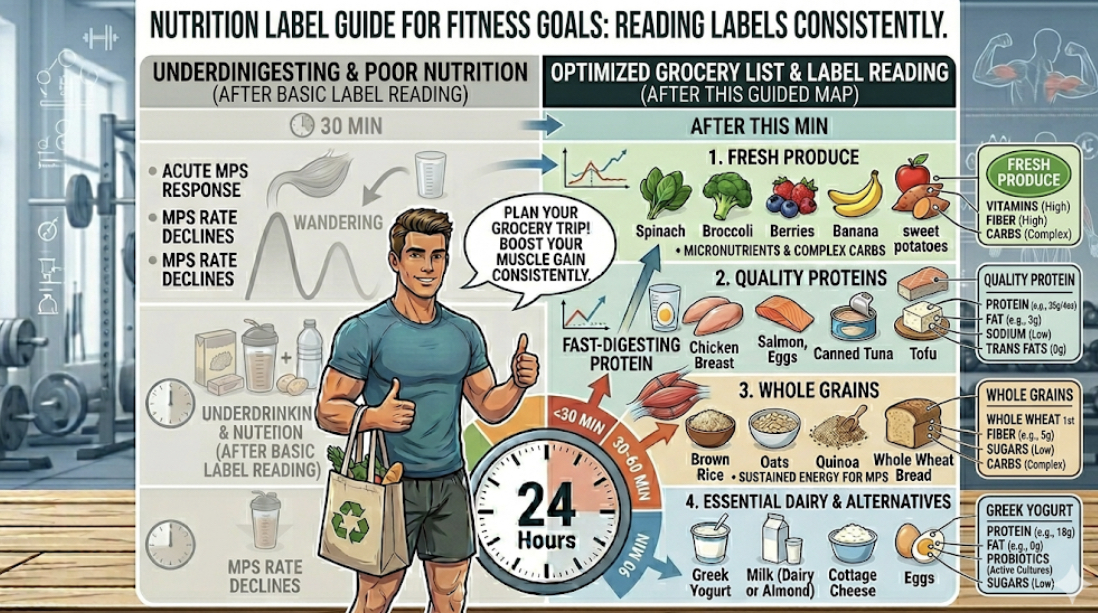
How to Read Food Labels for Fitness Goals: Beginner-Friendly Guide (2026)

How to read food labels for fitness goals - annotated nutrition label showing serving size, calories, macros
Image 1: Mastering food labels is essential for reaching your fitness goals.

Last updated: April 8, 2026 | Reading time: 18 minutes | By: Dr. Sarah Thompson, RD, PhD in Nutritional Sciences

⚡ TL;DR – Your 30-Second Summary

How to read food labels for fitness in 5 steps: check serving size first (packages often contain multiple servings), look at calories per serving, review macros (protein, carbs, fats), limit added sugar (aim <10g per serving), and scan ingredients (avoid long lists of chemicals). This nutrition label guide helps you make informed choices for weight loss or muscle gain. Understanding how to track macros from labels is a skill that pays lifelong dividends .

1. The Label Lie: Why Most People Misread Nutrition Facts

You pick up a "healthy" protein bar. The front says "20g protein." But when you check the label, you discover the bar contains 2.5 servings. That 20g protein is per serving—the whole bar has 50g protein but also 500 calories. This is why learning how to read food labels is critical. Reading food labels for weight loss or muscle gain starts with understanding serving sizes, calories, and macronutrients. This food label tips bodybuilding guide will make you a label-reading pro.

How do you read food labels for fitness?

Read food labels for fitness by: checking calories per serving, looking at protein, carbs, and fats (macros), watching the serving size carefully (packages often contain multiple servings), avoiding high added sugars (aim for <10g per 100g), and comparing products to choose better options.
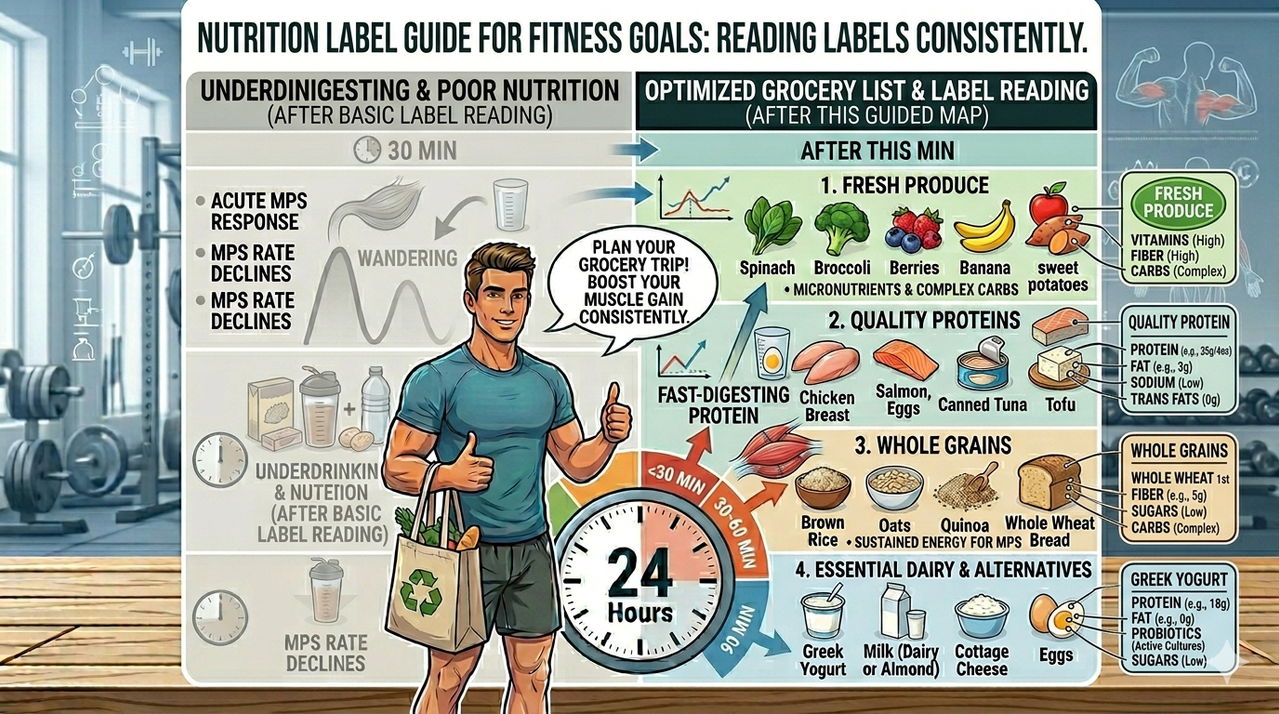
Nutrition label guide infographic showing how to read food labels for fitness goals including calories, macros, serving size
Image 2: Every section of the nutrition label provides valuable information for your fitness journey.

2. Step 1: Serving Size – The Most Important Number

The serving size is the foundation of all calculations. Common mistakes:

  • Assuming one package = one serving: Many packages (protein bars, drinks) contain multiple servings
  • Ignoring serving size: A 200-calorie per serving food becomes 600 calories if you eat 3 servings
  • Not adjusting for your portion: If you eat double the serving size, double all numbers
💡 Pro Tip: Always check "servings per container." If you eat the whole package, multiply all numbers by servings per container.

3. Step 2: Calories – Your Energy Currency

Calories matter for weight loss (deficit) or muscle gain (surplus). Guidelines:

  • Weight loss: Choose lower-calorie options per serving (100-300 kcal per meal/snack)
  • Muscle gain: Higher-calorie options (400-700 kcal per meal) help meet surplus
  • Maintenance: Match to your TDEE

4. Step 3: Macronutrients – Protein, Carbs, Fats

How to track macros from labels starts here:

📊 Macro Calculation from Food Label

.= "Protein" ? 'Protein' : '' ?>Protein .= "Carbohydrates" ? 'Carbohydrates' : '' ?>Carbohydrates .= "Fats" ? 'Fats' : '' ?>Fats .= "Total" ? 'Total' : '' ?>Total

5. What to Look For By Goal

For Weight Loss (Cutting)

  • Lower calories per serving (100-300 kcal for snacks)
  • Higher protein (10-20g per serving) for satiety
  • Higher fiber (3-5g+ per serving)
  • Low added sugar (<5g per serving)
  • Avoid: Foods where sugar is in top 3 ingredients

For Muscle Gain (Bulking)

  • Higher calories per serving (300-600+ for meals)
  • High protein (20-40g per serving)
  • Moderate carbs (30-60g for energy)
  • Healthy fats (5-15g for hormone support)
  • Look for: Protein-to-calorie ratio (1g protein per 10-15 calories)

6. Added Sugar: The Hidden Ingredient

The FDA now requires "added sugars" on labels. Why it matters:

  • Men: Limit to 36g (9 tsp) per day
  • Women: Limit to 25g (6 tsp) per day
  • Check labels: Yogurt can have 15-20g added sugar; pasta sauce can have 10-12g
  • Names for sugar: Cane sugar, high-fructose corn syrup, dextrose, maltose, fruit juice concentrate, honey, agave

7. Ingredients List: Quality Matters

Ingredients are listed in descending order by weight. What to look for:

  • Short ingredient list: Fewer processed ingredients = better quality
  • Whole food first: "Whole wheat flour" vs "enriched flour"
  • Protein source early: "Whey protein" or "chicken" as first ingredient
  • Avoid: Hydrogenated oils, high-fructose corn syrup, artificial colors, sodium nitrites

8. Sample Label Analysis (Real Products)

Product A: "Healthy" Granola Bar

  • Serving size: 1 bar (40g)
  • Calories: 190
  • Protein: 4g
  • Carbs: 32g (sugar: 15g added)
  • Fat: 5g
  • Verdict: Low protein, high sugar → not great for fitness

Product B: Protein Bar

  • Serving size: 1 bar (60g)
  • Calories: 220
  • Protein: 20g
  • Carbs: 23g (sugar: 3g added)
  • Fat: 8g
  • Verdict: Good protein-to-calorie ratio, low sugar → good for muscle gain

9. Sample Meal Plan Using Label Reading Skills

Day 1 (~2,300 kcal, 150g Protein)

  • Breakfast: 3 eggs (210 kcal, 18g protein), 1 cup oats (300 kcal, 10g protein), 1 banana (105 kcal, 1g protein)
  • Lunch: 150g chicken breast (250 kcal, 45g protein), 1.5 cups rice (300 kcal, 4g protein), 1 cup broccoli (30 kcal, 2g protein)
  • Snack: 200g Greek yogurt (200 kcal, 20g protein), ½ cup berries (40 kcal, 0.5g protein)
  • Dinner: 150g lean beef (350 kcal, 35g protein), 1.5 cups sweet potato (300 kcal, 3g protein), 2 cups spinach (15 kcal, 2g protein)
  • Total: ~2,200 kcal, ~148g protein

Vegan/Vegetarian Label-Reading Plan

  • Breakfast: Tofu scramble (150g tofu: 120 kcal, 12g protein), 1 cup oats (300 kcal, 10g protein), 1 banana (105 kcal)
  • Lunch: 1.5 cups lentils (330 kcal, 25g protein), 1 cup quinoa (220 kcal, 8g protein), 2 cups spinach (15 kcal)
  • Snack: 1 cup soy yogurt (150 kcal, 8g protein), 30g almonds (170 kcal, 6g protein)
  • Dinner: 150g tempeh (320 kcal, 30g protein), 1.5 cups brown rice (330 kcal, 6g protein), 2 cups broccoli (60 kcal)
  • Total: ~2,200 kcal, ~105g protein (add plant shake for higher)

Gluten-Free Options

  • Use certified gluten-free oats
  • Choose rice, quinoa, buckwheat
  • Verify protein sources are gluten-free certified

10. Common Label Reading Mistakes

  • Ignoring serving size: The #1 mistake—always check servings per container
  • Focusing only on calories: Macronutrient quality matters as much as quantity
  • Believing front-of-package claims: "Natural," "healthy," "high protein" aren't regulated
  • Not checking sugar sources: "No added sugar" doesn't mean no sugar (fruit juice concentrates count)
  • Avoiding all fat: Healthy fats are essential for hormone function
  • Forgetting fiber: High-fiber foods increase satiety and improve digestion

11. Quick Label Reading Checklist

  • ☐ Check serving size and servings per container
  • ☐ Calculate calories for your actual portion
  • ☐ Protein: Aim for 20-40g per meal
  • ☐ Carbs: 30-60g for energy (lower for cutting, higher for bulking)
  • ☐ Fats: 5-15g (focus on unsaturated)
  • ☐ Fiber: 3-5g+ per serving
  • ☐ Added sugar: <10g per serving
  • ☐ Ingredients: Short list, whole foods first

12. Frequently Asked Questions

How do you read food labels for fitness?

Read food labels for fitness by: checking calories per serving, looking at protein, carbs, and fats (macros), watching the serving size carefully (packages often contain multiple servings), avoiding high added sugars (aim for <10g per 100g), and comparing products to choose better options.

What should I look for on a nutrition label for weight loss?

For weight loss, focus on: calories per serving (lower is better), protein (higher keeps you full), fiber (higher improves satiety), added sugar (avoid >10g per serving), and serving size (don't assume one package = one serving). Prioritize foods with more protein and fiber per calorie.

What should I look for on a nutrition label for muscle gain?

For muscle gain, focus on: protein (15-25g+ per serving), total calories (enough to support surplus), carbs (for energy), and avoid labels with excessive sugar or unhealthy fats. Look for at least 1g protein per 10-15 calories. Prioritize whole food ingredients.

How do you calculate macros from a food label?

Calculate macros from a food label: protein grams × 4 = protein calories, carbs grams × 4 = carb calories, fat grams × 9 = fat calories. Add these to verify total calories (should be within 5-10%). For tracking, multiply each macro by number of servings consumed.

What is the most important part of a nutrition label?

The most important parts are: serving size (foundation of all calculations), calories (energy intake), protein (muscle repair), added sugar (avoid excess), and ingredient list (quality of food). Serving size is critical—misreading it leads to inaccurate calorie and macro tracking.

Are nutrition labels accurate?

FDA regulations allow 20% margin of error on nutrition labels. This means a 200-calorie food could legally be 160-240 calories. While not perfect, labels provide useful estimates. For best accuracy, focus on whole foods (which don't need labels) and use labels to compare products.

13. Related Resources

14. Scientific References

  1. FDA. (2021). Food Labeling Guide. U.S. Food and Drug Administration. FDA
  2. Morton, R. W., et al. (2018). A systematic review, meta-analysis and meta-regression of the effect of protein supplementation on resistance training-induced gains in muscle mass and strength. British Journal of Sports Medicine, 52(6), 376–384. PubMed
  3. World Health Organization. (2015). Guideline: Sugars intake for adults and children. WHO. WHO
  4. Helms, E. R., et al. (2014). Evidence-based recommendations for natural bodybuilding contest preparation. Journal of the International Society of Sports Nutrition, 11(1), 20. PubMed
  5. ACSM. (2021). Nutrition and Athletic Performance. Medicine & Science in Sports & Exercise, 53(3), 600–618. PubMed
FitForge Lab. Created by Techly420
FitForge Lab Welcome to WhatsApp chat
Hi! Need help with fitness or diet? 💪
Type here...
MacroCalories per GramFormulaExample (per serving)
4 kcalg × 4 = protein calories10g × 4 = 40 kcal
4 kcalg × 4 = carb calories30g × 4 = 120 kcal
9 kcalg × 9 = fat calories5g × 9 = 45 kcal
-Sum of above40+120+45 = 205 kcal