How to Train Each Muscle Group Effectively (Complete Training Guide)
How to Train Each Muscle Group Effectively: Complete Training Guide (2026)

⚡ TL;DR
To train each muscle group effectively, you need to understand the best exercises, rep ranges, and volume for each. This muscle group training guide covers how to train chest, back, legs, shoulders, arms, and core. Learn the best muscle group split and effective workout routine for balanced development. This bodybuilding muscle groups guide teaches you how to target each muscle with compound and isolation exercises. Master the principles of volume, frequency, and progressive overload to maximize your results.
1. The Fundamentals of Training Each Muscle Group
To train each muscle group effectively, you must understand three key variables: exercise selection, volume (sets and reps), and frequency (how often to train). Research shows that 10-20 sets per muscle group weekly, split across 2 sessions, produces optimal growth (Schoenfeld et al., 2016).
This muscle group training guide provides everything you need for how to train chest, back, legs, shoulders, arms, and core. Whether you're looking for the best muscle group split or an effective workout routine, this guide covers all bodybuilding muscle groups and teaches how to target each muscle for maximum development.
How do you train each muscle group effectively?
How do you train each muscle group effectively? Chest: push exercises (bench press, push-ups, flyes). Back: pull exercises (rows, pull-ups, pulldowns). Legs: squats, lunges, deadlifts, leg press. Shoulders: overhead press, lateral raises, face pulls. Arms: bicep curls + triceps extensions. Core: planks, leg raises, crunches. Focus on compound lifts first, then isolation. Progressive overload is key for all muscle groups.
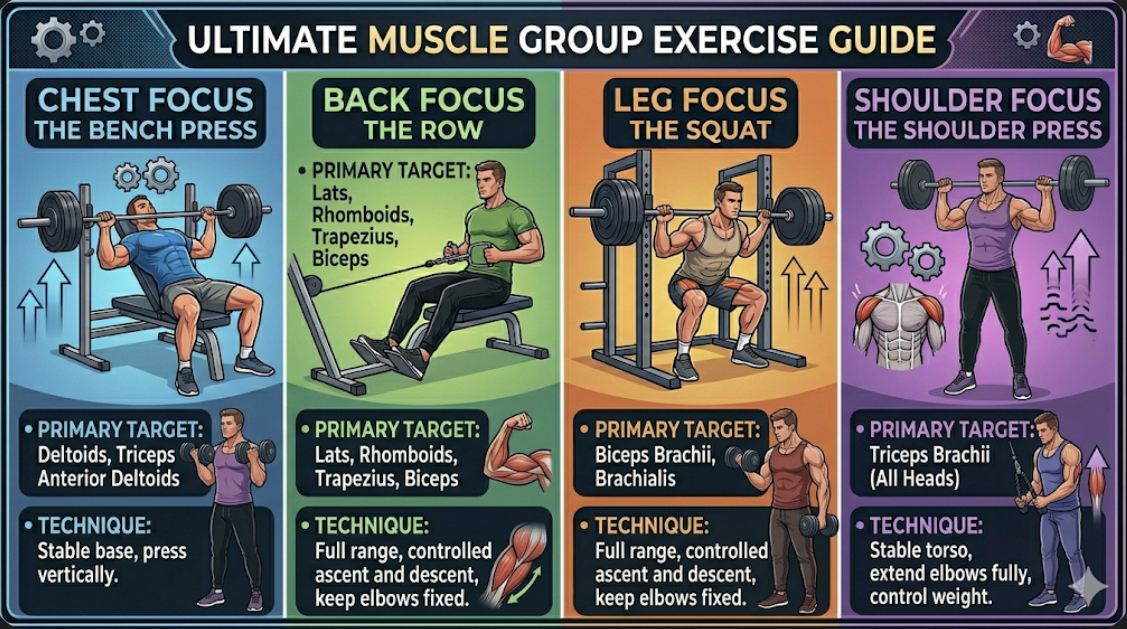
2. Chest Training Guide (Pectorals)
The chest (pectoralis major and minor) is responsible for horizontal adduction and internal rotation of the arms. To train each muscle group effectively for chest growth:
- Primary functions: Horizontal pressing movements, arm adduction
- Best compound exercises: Barbell bench press, dumbbell bench press, incline press, decline press
- Best isolation exercises: Cable flyes, dumbbell flyes, pec deck machine
- Optimal rep range: 6-12 reps for hypertrophy, 1-5 for strength
- Weekly volume: 10-20 sets total (split across 2 sessions)
- Frequency: 2x weekly for optimal growth
Sample Chest Workout
- Barbell Bench Press: 4 sets of 6-10 reps
- Incline Dumbbell Press: 3 sets of 8-12 reps
- Cable Flyes: 3 sets of 12-15 reps
- Push-ups: 3 sets to failure
3. Back Training Guide (Lats, Rhomboids, Traps)
The back is the largest upper body muscle group, comprising the lats, rhomboids, traps, and erector spinae. For how to train chest, back, legs effectively:
- Primary functions: Pulling movements (vertical and horizontal), scapular retraction, extension
- Best compound exercises: Pull-ups, lat pulldowns, barbell rows, seated cable rows, T-bar rows
- Best isolation exercises: Straight-arm pulldowns, face pulls, rear delt flyes
- Optimal rep range: 6-12 reps for hypertrophy, 8-15 for back thickness
- Weekly volume: 12-20 sets total (back responds well to higher volume)
- Frequency: 2x weekly for optimal growth
Sample Back Workout
- Pull-ups or Lat Pulldowns: 4 sets of 8-12 reps
- Barbell Rows: 4 sets of 8-10 reps
- Seated Cable Rows: 3 sets of 10-12 reps
- Face Pulls: 3 sets of 15-20 reps
4. Legs Training Guide (Quads, Hamstrings, Glutes, Calves)
The legs are the largest muscle group in the body. Training legs boosts overall muscle growth and hormone response. For how to train each muscle group effectively for legs:
- Primary functions: Knee extension (quads), knee flexion (hamstrings), hip extension (glutes), ankle plantarflexion (calves)
- Best compound exercises: Squats, deadlifts, leg press, lunges, Bulgarian split squats
- Best isolation exercises: Leg extensions, leg curls, calf raises, glute bridges
- Optimal rep range: 8-15 reps for hypertrophy (legs respond well to higher reps)
- Weekly volume: 12-20 sets total (legs can handle high volume)
- Frequency: 2x weekly for optimal growth
Sample Legs Workout
- Squats: 4 sets of 6-10 reps
- Romanian Deadlifts: 3 sets of 8-12 reps
- Leg Press: 3 sets of 10-15 reps
- Leg Curls: 3 sets of 12-15 reps
- Calf Raises: 4 sets of 15-20 reps
5. Shoulders Training Guide (Deltoids)
The shoulders (deltoids) have three heads: anterior (front), lateral (side), and posterior (rear). For bodybuilding muscle groups and how to target each muscle effectively:
- Primary functions: Shoulder flexion/abduction (anterior), abduction (lateral), extension/transverse abduction (posterior)
- Best compound exercises: Overhead press (barbell or dumbbell), push press
- Best isolation exercises: Lateral raises, front raises, rear delt flyes, face pulls
- Optimal rep range: 8-15 reps for hypertrophy (shoulders respond well to moderate reps)
- Weekly volume: 8-16 sets total (shoulders recover quickly)
- Frequency: 2x weekly for optimal growth
Sample Shoulders Workout
- Overhead Press: 4 sets of 8-10 reps
- Lateral Raises: 3 sets of 12-15 reps
- Rear Delt Flyes: 3 sets of 12-15 reps
- Face Pulls: 3 sets of 15-20 reps
6. Arms Training Guide (Biceps & Triceps)
The arms consist of biceps (front) and triceps (back – 2/3 of arm mass). For effective workout routine development:
- Primary functions: Elbow flexion (biceps), elbow extension (triceps)
- Best compound exercises: Close-grip bench press (triceps), chin-ups (biceps)
- Best isolation exercises (biceps): Barbell curls, dumbbell curls, hammer curls, preacher curls
- Best isolation exercises (triceps): Triceps pushdowns, overhead extensions, dips, skull crushers
- Optimal rep range: 8-15 reps for hypertrophy
- Weekly volume: 8-12 sets per muscle group (arms are smaller, recover faster)
- Frequency: 2x weekly for optimal growth
Sample Arms Workout
- Barbell Curls: 3 sets of 8-12 reps
- Triceps Pushdowns: 3 sets of 10-12 reps
- Dumbbell Hammer Curls: 3 sets of 10-12 reps
- Overhead Triceps Extensions: 3 sets of 10-12 reps
- Preacher Curls: 3 sets of 10-12 reps (optional)
- Dips (triceps focus): 3 sets to failure
7. Core Training Guide (Abs, Obliques, Lower Back)
The core includes rectus abdominis (six-pack), obliques, transverse abdominis, and lower back. For how to train each muscle group effectively:
- Primary functions: Spinal flexion (abs), rotation (obliques), stabilization (transverse abdominis), extension (lower back)
- Best exercises: Planks, leg raises, crunches, Russian twists, back extensions, hanging leg raises
- Optimal rep range: 10-20 reps or timed holds (30-60 seconds)
- Weekly volume: 6-10 sets total (core recovers quickly, can train more frequently)
- Frequency: 2-4x weekly (core can handle higher frequency)
Sample Core Workout
- Planks: 3 sets of 30-60 seconds
- Hanging Leg Raises: 3 sets of 10-15 reps
- Russian Twists: 3 sets of 15-20 reps per side
- Crunches: 3 sets of 15-20 reps
8. Best Muscle Group Split for Balanced Development
Choosing the right best muscle group split is crucial for recovery and growth. Here are the most effective options:
Push/Pull/Legs (PPL) Split – Recommended for most
- Push Day: Chest, shoulders, triceps
- Pull Day: Back, biceps
- Legs Day: Quads, hamstrings, glutes, calves
- Schedule: Push, Pull, Legs, Rest, Repeat (6 days/week) or 3 days/week
- Best for: Intermediate to advanced lifters
Upper/Lower Split – Time-efficient
- Upper Day: Chest, back, shoulders, biceps, triceps
- Lower Day: Quads, hamstrings, glutes, calves
- Schedule: Upper, Lower, Rest, Upper, Lower (4 days/week)
- Best for: Most lifters (best balance of frequency and time)
Full Body Split – Best for beginners
- Each session: All major muscle groups
- Schedule: 3 days/week (Monday, Wednesday, Friday)
- Best for: Beginners, time-pressed lifters
For detailed programs, check out our upper lower split workout and push pull legs routine guides.
9. Weekly Volume Recommendations by Muscle Group
How many sets per muscle group per week? Research shows 10-20 sets weekly is optimal for muscle growth (Schoenfeld et al., 2016). Here's a breakdown:
📊 Optimal Weekly Sets by Muscle Group
| Muscle Group | Beginner (sets/week) | Intermediate (sets/week) | Advanced (sets/week) | Frequency |
|---|---|---|---|---|
| Chest | 8-12 | 12-16 | 16-20 | 2x weekly |
| Back | 10-14 | 14-18 | 18-22 | 2x weekly |
| Legs | 10-14 | 14-18 | 18-22 | 2x weekly |
| Shoulders | 6-10 | 10-14 | 14-18 | 2x weekly |
| Biceps | 4-8 | 8-12 | 12-16 | 2x weekly |
| Triceps | 4-8 | 8-12 | 12-16 | 2x weekly |
10. Nutrition to Support Muscle Group Training
Proper nutrition is essential for recovery and growth. Follow a full day of eating for muscle gain or 7-day meal plan for muscle gain.
Sample Day (2,800 kcal, 170g Protein)
- Breakfast (7:00 AM): 4 eggs + 1.5 cups oatmeal + 1 cup milk (650 kcal, 40g protein)
- Lunch (12:00 PM): 200g chicken breast + 1.5 cups brown rice + 2 cups broccoli (600 kcal, 50g protein)
- Pre-workout snack (3:00 PM): 1 banana + 1 tbsp peanut butter (200 kcal, 5g protein)
- Post-workout (5:30 PM): 2 scoops whey + 1 apple (250 kcal, 48g protein)
- Dinner (7:00 PM): 200g salmon + 300g sweet potato + 2 cups asparagus (700 kcal, 40g protein)
- Evening snack (9:30 PM): 1 cup Greek yogurt (150 kcal, 20g protein)
Vegan Muscle Building Nutrition
- Breakfast: 1.5 cups tofu scramble + 1.5 cups oats + 2 cups soy milk (650 kcal, 45g protein)
- Lunch: 200g tempeh + 1.5 cups quinoa + 2 cups mixed vegetables (600 kcal, 45g protein)
- Post-workout: 2 scoops pea protein + 1 banana (300 kcal, 45g protein)
Gluten-Free Options
- Certified gluten-free oats, rice, quinoa, buckwheat, sweet potatoes
- Verify protein powder is gluten-free certified
11. Common Mistakes When Training Muscle Groups
- Imbalanced volume: Training chest 3x more than back leads to poor posture and injury risk. Maintain balance.
- Insufficient leg training: Skipping legs limits overall growth and hormone response. Train legs 2x weekly.
- Too much isolation, not enough compound: Compounds should form the foundation. Isolations are accessories.
- Inconsistent frequency: Training each muscle group 1x weekly is suboptimal. Aim for 2x weekly.
- Not progressing overload: Using the same weight for months leads to plateaus. Add weight or reps weekly.
- Ignoring form for weight: Ego lifting increases injury risk and reduces muscle activation.
12. Frequently Asked Questions
How do you train each muscle group effectively?
Chest: push exercises (bench press, push-ups, flyes). Back: pull exercises (rows, pull-ups, pulldowns). Legs: squats, lunges, deadlifts, leg press. Shoulders: overhead press, lateral raises, face pulls. Arms: bicep curls + triceps extensions. Core: planks, leg raises, crunches. Focus on compound lifts first, then isolation. Progressive overload is key for all muscle groups.
What is the best exercise for each muscle group?
Chest: Barbell bench press. Back: Pull-ups or barbell rows. Legs: Squats or deadlifts. Shoulders: Overhead press. Biceps: Barbell or dumbbell curls. Triceps: Close-grip bench press or triceps pushdowns. Core: Planks or hanging leg raises. These compound movements provide the most muscle activation and strength gains.
How many exercises per muscle group?
For most lifters: Large muscle groups (chest, back, legs): 3-5 exercises per session. Small muscle groups (shoulders, biceps, triceps): 2-4 exercises per session. Total weekly sets: 10-20 sets per muscle group per week for optimal growth. Beginners start at 8-12 sets, intermediates 12-16 sets, advanced 16-20+ sets.
What is the best split to train all muscle groups?
Best splits: Push/Pull/Legs (PPL) – Push: chest, shoulders, triceps; Pull: back, biceps; Legs: lower body. Upper/Lower – Upper: chest, back, shoulders, arms; Lower: legs, glutes. Full Body – all muscles each session. PPL and Upper/Lower are best for most people, providing 2x weekly frequency per muscle group.
How many sets per muscle group per week?
Research shows 10-20 sets per muscle group weekly is optimal for muscle growth. Beginners: 8-12 sets weekly. Intermediates: 12-16 sets weekly. Advanced: 16-20+ sets weekly. Volume should be split across 2 sessions per muscle group weekly (e.g., 4 sets per muscle group × 2 sessions weekly = 8 sets).
How often should I train each muscle group?
Research shows training each muscle group 2x weekly produces superior hypertrophy compared to 1x weekly. For most lifters: train each muscle group 2x weekly. Example: Upper/Lower split (Upper Monday/Thursday, Lower Tuesday/Friday) or PPL 6-day schedule (Push/Pull/Legs twice weekly).
13. Related Resources
- Best Time to Work Out for Muscle Growth (Morning vs Evening Guide)
- How to Break a Muscle Growth Plateau Fast (Proven Strategies That Work)
- Why Your Muscles Are Not Sore After Workout (Is It a Bad Sign?)
- Can You Build Muscle in a Calorie Deficit? (Fat Loss & Muscle Gain Explained)
- How Much Protein Do You Really Need Per Day? (Expert Guide)
- Best Rest Time Between Sets for Muscle Growth (Science-Based Guide)
14. Scientific References
- Schoenfeld, B. J., et al. (2016). Effects of resistance training frequency on measures of muscle hypertrophy: A systematic review and meta-analysis. Sports Medicine, 46(11), 1689-1697. PubMed
- Schoenfeld, B. J., & Grgic, J. (2019). Does training to failure maximize muscle hypertrophy? Strength and Conditioning Journal, 41(5), 101-108. PubMed
- Grgic, J., et al. (2018). Effects of resistance training frequency on skeletal muscle hypertrophy: A systematic review and meta-analysis. Sports Medicine, 48(9), 2145-2158. PubMed
- Morton, R. W., et al. (2018). A systematic review, meta-analysis and meta-regression of the effect of protein supplementation on resistance training-induced gains in muscle mass and strength. British Journal of Sports Medicine, 52(6), 376-384. PubMed
- Helms, E. R., et al. (2014). Evidence-based recommendations for natural bodybuilding contest preparation. Journal of the International Society of Sports Nutrition, 11(1), 20. PubMed
- Schoenfeld, B. J. (2010). The mechanisms of muscle hypertrophy and their application to resistance training. Journal of Strength and Conditioning Research, 24(10), 2857-2872. PubMed
- Gentil, P., et al. (2017). Effects of training frequency on muscle hypertrophy. Journal of Sports Medicine and Physical Fitness, 57(5), 597-603. PubMed
Join the conversation