Upper Lower Split Workout Guide (Best Routine for Muscle Growth)
Upper Lower Split Workout Guide: Best Routine for Muscle Growth (2026)

⚡ TL;DR
The upper lower split workout is one of the most effective gym split routines for building muscle. This upper lower routine trains all upper body muscles on one day and lower body on another, allowing each muscle group to be trained 2x weekly. This upper lower workout plan is a proven best workout split for muscle growth for beginners and advanced lifters alike. Follow this beginner upper lower split as your primary gym split routine for balanced, sustainable results. This upper body lower body workout guide includes complete workouts, schedules, and nutrition advice.
1. What Is an Upper Lower Split Workout?
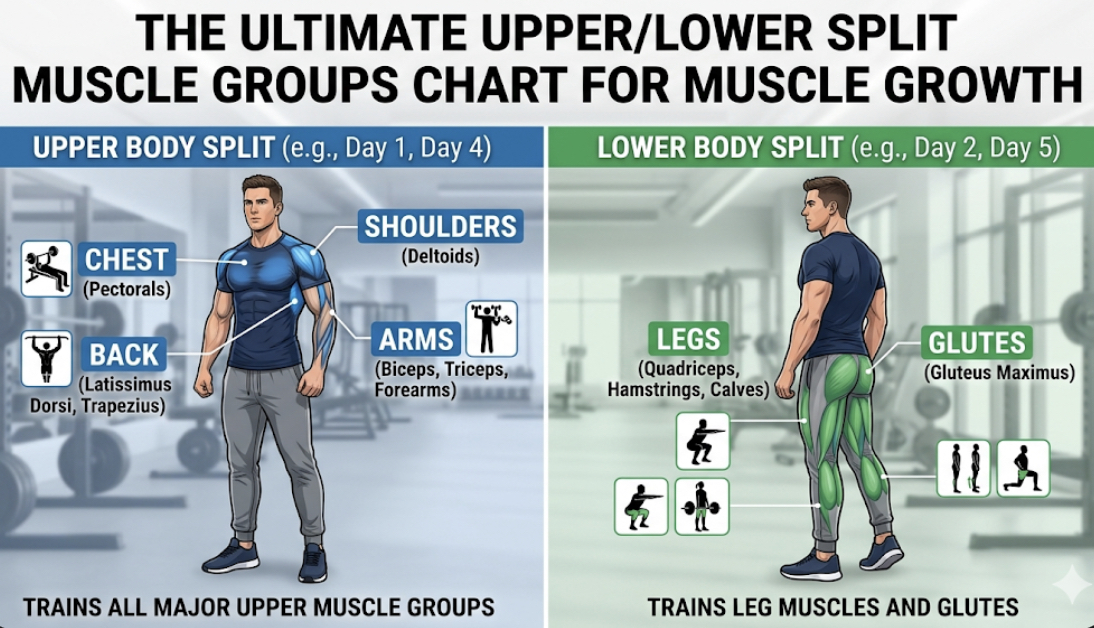
The upper lower split workout divides your training into two categories: upper body (chest, back, shoulders, arms) and lower body (quadriceps, hamstrings, glutes, calves). This upper lower routine is one of the most time-efficient and effective gym split routines available (Schoenfeld et al., 2016).
Unlike push pull legs routines that require 6 days weekly, the upper lower workout plan typically runs 4 days weekly while still training each muscle group 2x weekly – the optimal frequency for muscle growth.
What is an upper lower split workout?
What is an upper lower split workout? Upper: chest, back, shoulders, arms (all upper body muscles). Lower: quadriceps, hamstrings, glutes, calves (all lower body muscles). Weekly schedule example: Day 1 Upper, Day 2 Lower, Day 3 Rest, Day 4 Upper, Day 5 Lower, Day 6 Rest, Day 7 Rest. This trains each muscle group 2x weekly for optimal growth.
2. Why Upper Lower Split Is the Best Workout Split for Muscle Growth
Research consistently shows that training each muscle group twice weekly produces superior hypertrophy compared to once weekly (Schoenfeld et al., 2016; Grgic et al., 2018). The upper lower routine achieves this 2x frequency in just 4 days per week.
- Optimal frequency: Each muscle trained 2x weekly – proven superior for growth
- Time efficiency: Only 4 gym days weekly vs 6 days for PPL
- Recovery management: 48-72 hours between same muscle groups
- Volume distribution: Manageable per-session volume (45-60 minutes)
- Flexibility: Easy to adjust for 3, 4, or 5-day schedules
If you're looking for a gym split for muscle growth, the upper lower split is arguably the best balance of frequency, volume, and time commitment.
📊 Upper Lower Split vs Other Training Splits
| Split Type | Days/Week | Frequency per Muscle | Session Length | Best For |
|---|---|---|---|---|
| Upper Lower | 3-4 days | 1.5-2x weekly | 45-60 min | Most people (best balance) |
| Push Pull Legs (PPL) | 6 days | 2x weekly | 45-60 min | Advanced/enthusiasts |
| Full Body | 3 days | 3x weekly | 60-75 min | Beginners, time-pressed |
| Bro Split (1 muscle/day) | 5 days | 1x weekly | 45 min | Not optimal for naturals |
3. Complete Upper Day Workout (Chest, Back, Shoulders, Arms)
This upper body lower body workout upper day targets all pushing and pulling muscles of the upper body.
Warm-up (5-10 minutes)
- Arm circles, shoulder rotations, band pull-aparts, light rows, light push-ups
Upper Day A (Horizontal Push/Pull Focus)
- Barbell Bench Press (horizontal push): 3-4 sets of 6-10 reps – rest 90-120 sec
- Barbell Rows (horizontal pull): 3-4 sets of 8-12 reps – rest 90 sec
- Overhead Press (vertical push): 3 sets of 8-12 reps – rest 90 sec
- Pull-ups or Lat Pulldowns (vertical pull): 3 sets of 6-10 reps – rest 90 sec
- Dumbbell Curls (biceps): 3 sets of 10-12 reps – rest 60 sec
- Triceps Pushdowns (triceps): 3 sets of 10-12 reps – rest 60 sec
- Optional – Lateral Raises (side delts): 3 sets of 12-15 reps – rest 60 sec
Upper Day B (Vertical Push/Pull Focus – alternate with Day A)
- Pull-ups or Lat Pulldowns (vertical pull): 3-4 sets of 6-10 reps – rest 90 sec
- Overhead Press (vertical push): 3-4 sets of 8-12 reps – rest 90 sec
- Incline Dumbbell Press (horizontal push variation): 3 sets of 10-12 reps – rest 90 sec
- Seated Cable Rows (horizontal pull variation): 3 sets of 10-12 reps – rest 90 sec
- Hammer Curls (brachialis): 3 sets of 10-12 reps – rest 60 sec
- Overhead Triceps Extensions: 3 sets of 10-12 reps – rest 60 sec
- Optional – Face Pulls (rear delts): 3 sets of 15-20 reps – rest 60 sec
Beginner Upper Day Modifications
- Use dumbbells instead of barbell (easier to learn)
- Do assisted pull-ups or lat pulldowns instead of pull-ups
- Start with 3 sets of 8 reps instead of 4 sets of 12
- Reduce to 5 exercises per day initially
4. Complete Lower Day Workout (Quads, Hamstrings, Glutes, Calves)
This upper lower routine lower day builds lower body strength and size – often neglected but critical for overall development.
Warm-up (5-10 minutes)
- Leg swings, hip circles, bodyweight squats, walking lunges, glute activations
Lower Day A (Quadriceps Focus)
- Barbell Squats (quadriceps dominant): 3-4 sets of 6-10 reps – rest 120 sec
- Romanian Deadlifts (hamstring focus): 3-4 sets of 8-12 reps – rest 90 sec
- Leg Press (quadriceps): 3 sets of 10-15 reps – rest 90 sec
- Walking Lunges (glutes/quads): 3 sets of 10-12 per leg – rest 90 sec
- Leg Curls (hamstrings): 3 sets of 12-15 reps – rest 60 sec
- Standing Calf Raises (calves): 4 sets of 15-20 reps – rest 45 sec
Lower Day B (Posterior Chain Focus – alternate with Day A)
- Deadlifts or Trap Bar Deadlifts (posterior chain): 3-4 sets of 5-8 reps – rest 120 sec
- Front Squats or Goblet Squats (quadriceps): 3-4 sets of 8-12 reps – rest 90 sec
- Hip Thrusts (glute focus): 3 sets of 10-15 reps – rest 90 sec
- Reverse Lunges (stability): 3 sets of 10-12 per leg – rest 90 sec
- Leg Extensions (quadriceps isolation): 3 sets of 12-15 reps – rest 60 sec
- Seated Calf Raises (calves): 4 sets of 15-20 reps – rest 45 sec
Beginner Lower Day Modifications
- Start with goblet squats (dumbbell) instead of barbell squats
- Do bodyweight lunges before adding weight
- Use leg press machine – it's safer and easier to learn
- Skip deadlifts initially – add Romanian deadlifts with light weight after 4 weeks
5. Sample Upper Lower Split Weekly Schedule
Option 1: 4-Day Upper Lower Split (Recommended for most)
- Monday: Upper Day A
- Tuesday: Lower Day A
- Wednesday: Rest
- Thursday: Upper Day B
- Friday: Lower Day B
- Saturday: Rest or light cardio (20-30 min walking)
- Sunday: Rest
Option 2: 3-Day Upper Lower Split (For beginners or time-pressed)
- Monday: Upper Day A
- Tuesday: Lower Day A
- Wednesday: Rest
- Thursday: Upper Day B OR Full Body
- Friday: Rest
- Saturday: Lower Day B
- Sunday: Rest
Option 3: 5-Day Upper Lower Split (For advanced lifters)
- Monday: Upper Day A
- Tuesday: Lower Day A
- Wednesday: Upper Day B (lighter, higher reps)
- Thursday: Rest
- Friday: Lower Day B
- Saturday: Upper Day C or Arms/Shoulders focus
- Sunday: Rest
6. Nutrition to Support Your Upper Lower Split
Pre-Workout Nutrition (1-2 hours before training)
- Sample meal: 1 banana + 1 tbsp peanut butter (200 kcal) or 1 cup oatmeal + 1 scoop protein (350 kcal)
Post-Workout Recovery (within 60 minutes)
- Sample meal: 2 scoops whey + 1 cup berries + water (250 kcal, 45g protein)
- Whole food option: 200g chicken breast + 1.5 cups rice (550 kcal, 50g protein)
Full Day Meal Plan for Upper Lower Training (2,800 kcal, 170g Protein)
- Breakfast (7:00 AM): 4 eggs + 1.5 cups oatmeal + 1 cup milk (650 kcal, 40g protein)
- Lunch (12:00 PM): 200g chicken breast + 1.5 cups brown rice + 2 cups broccoli (600 kcal, 50g protein)
- Pre-workout snack (3:00 PM): 1 banana + 1 tbsp peanut butter (200 kcal, 5g protein)
- Post-workout (5:30 PM): 2 scoops whey + 1 apple (250 kcal, 48g protein)
- Dinner (7:00 PM): 200g salmon + 300g sweet potato + 2 cups asparagus (700 kcal, 40g protein)
- Evening snack (9:30 PM): 1 cup Greek yogurt (150 kcal, 20g protein)
For more meal ideas, check out full day of eating for muscle gain and 7-day meal plan for muscle gain.
Vegan Upper Lower Split Nutrition
- Pre-workout: 1 banana + 1 tbsp almond butter (200 kcal)
- Post-workout: 2 scoops pea protein + 1 cup soy milk (300 kcal, 45g protein)
- Main meals: Tofu, tempeh, lentils, quinoa, beans, nuts, seeds
Gluten-Free Upper Lower Options
- Certified gluten-free oats, rice, quinoa, buckwheat, sweet potatoes
- Verify protein powder is gluten-free certified
7. Progressive Overload in Upper Lower Split
To make this best workout split for muscle growth effective long-term, you must apply progressive overload:
- Add weight: When you can complete all reps for all sets with good form, add 2.5-5 lbs (1-2 kg) to the bar.
- Add reps: Increase reps before increasing weight (e.g., 8 reps → 9 reps → 10 reps → add weight).
- Add sets: After 4-6 weeks, add a 4th set to your main lifts.
- Decrease rest: Reduce rest between sets from 90 sec to 60 sec over time.
- Track everything: Use a training log or app to record weights, reps, and sets.
8. Common Upper Lower Split Mistakes Beginners Make
- Neglecting legs: Many beginners skip or half-ass lower days. Leg training drives overall growth and hormone response.
- Poor exercise order: Do compound lifts first (bench, rows, squats) when energy is highest, isolation exercises last.
- Insufficient rest between sets: 60-90 sec for hypertrophy, 90-120 sec for heavy compounds. Don't rush.
- Not alternating Upper A and Upper B: Doing the same upper day twice weekly leads to imbalances. Alternate horizontal/vertical emphasis.
- Overtraining on 5-day split too soon: Beginners need recovery. Start with 4 days weekly for the first 8-12 weeks.
- Not tracking progress: Without tracking, you can't apply progressive overload. Use a logbook or app every session.
9. Frequently Asked Questions
What is an upper lower split workout?
Upper: chest, back, shoulders, arms (all upper body muscles). Lower: quadriceps, hamstrings, glutes, calves (all lower body muscles). Weekly schedule example: Day 1 Upper, Day 2 Lower, Day 3 Rest, Day 4 Upper, Day 5 Lower, Day 6 Rest, Day 7 Rest. This trains each muscle group 2x weekly for optimal growth.
Is upper lower split good for beginners?
Yes, the upper lower split is excellent for beginners. It provides 2x weekly frequency for all muscles, manageable volume per session (45-60 minutes), and clear organization. Beginners should start with the 4-day version (Upper, Lower, Rest, Upper, Lower) for 4-6 weeks before adding intensity or volume.
How many days a week should I do upper lower split?
Most people run upper lower as a 4-day split (Upper, Lower, Rest, Upper, Lower) or 3-day split (Upper, Lower, Upper or Lower, Upper, Lower). The 4-day split provides 2x weekly frequency for all muscles with adequate recovery. Beginners should start with 3-4 days weekly, intermediates can handle 4 days.
What exercises are in an upper lower split?
Upper Day: Bench press, rows, overhead press, pull-ups/lat pulldowns, bicep curls, triceps extensions. Lower Day: Squats, deadlifts, leg press, lunges, leg curls, calf raises. Choose 5-7 exercises per day, 3-4 sets of 8-12 reps. Alternate upper days between horizontal/vertical push/pull emphasis.
What is better: PPL or upper lower split?
Both are effective. Upper lower split trains each muscle 2x weekly with less gym time (4 days vs 6 days for PPL). PPL allows more specialization and volume per muscle group but requires more days. For most people, upper lower split is more sustainable and time-efficient while providing excellent results.
Can I build muscle with upper lower split?
Yes, the upper lower split is one of the most effective splits for natural muscle growth. Research shows training each muscle 2x weekly produces superior hypertrophy to 1x weekly. The upper lower split achieves this optimal frequency in just 4 days per week, making it highly effective and sustainable.
10. Related Resources
- Best Evening Habits for Fat Loss (Simple Night Routine That Works)
- How to Burn More Calories Without Cardio (Simple Fat Loss Strategies)
- Why You Lose Weight Then Gain It Back Quickly (Yo-Yo Dieting Explained)
- How to Avoid Binge Eating During Fat Loss (Control Cravings & Stay on Track)
- Does Drinking Water Help You Lose Fat Faster? (Science-Based Answer)
- How to Reduce Cravings While Dieting (Control Hunger & Stay Consistent)
11. Scientific References
- Schoenfeld, B. J., et al. (2016). Effects of resistance training frequency on measures of muscle hypertrophy: A systematic review and meta-analysis. Sports Medicine, 46(11), 1689-1697. PubMed
- Grgic, J., et al. (2018). Effects of resistance training frequency on skeletal muscle hypertrophy: A systematic review and meta-analysis. Sports Medicine, 48(9), 2145-2158. PubMed
- Morton, R. W., et al. (2018). A systematic review, meta-analysis and meta-regression of the effect of protein supplementation on resistance training-induced gains in muscle mass and strength. British Journal of Sports Medicine, 52(6), 376-384. PubMed
- Gentil, P., et al. (2017). Effects of training frequency on muscle hypertrophy. Journal of Sports Medicine and Physical Fitness, 57(5), 597-603. PubMed
- Helms, E. R., et al. (2014). Evidence-based recommendations for natural bodybuilding contest preparation. Journal of the International Society of Sports Nutrition, 11(1), 20. PubMed
- Schoenfeld, B. J., & Grgic, J. (2020). Effects of resistance training frequency on muscular strength and hypertrophy. Strength and Conditioning Journal, 42(2), 50-58. PubMed
- Suchomel, T. J., et al. (2016). The importance of muscular strength in athletic performance. Sports Medicine, 46(10), 1419-1449. PubMed
Join the conversation