Why Most People Quit the Gym (And How to Avoid It for Long-Term Success)
Why Most People Quit the Gym (And How to Avoid It for Long-Term Success) 2026

⚡ TL;DR
Most people quit the gym within 3-6 months. Understanding why people quit the gym – unrealistic expectations, lack of visible results, no clear plan, overtraining, and intimidation – is key to avoiding the same fate. This guide reveals why most people stop working out and provides evidence-based strategies for how to stay consistent in gym. Learn to avoid quitting fitness by addressing common gym motivation problems and applying proven fitness consistency tips that work for beginners and experienced gym-goers alike. Discover why beginners quit gym and how to build habits that last.
1. The Shocking Statistics: How Many People Actually Quit?
You sign up for a gym membership in January, full of motivation. By March, you've stopped going. You're not alone – this is the norm, not the exception.
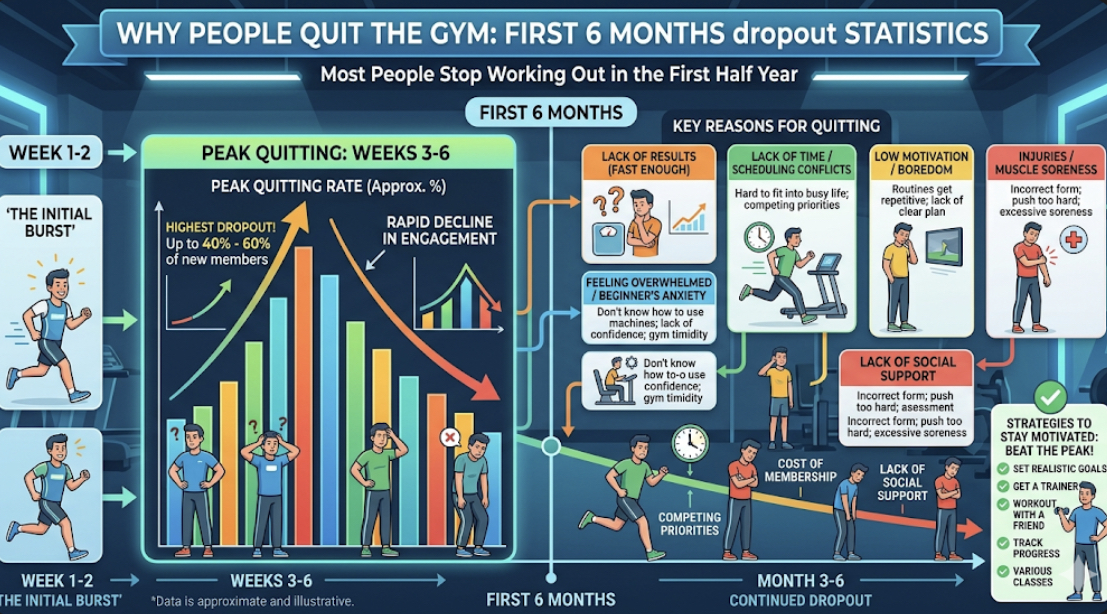
According to IHRSA (International Health Racquet & Sportsclub Association), approximately 50% of new gym members quit within the first 6 months, and 67% of all gym members never use their membership regularly. January has the highest sign-ups but also the highest dropout rate by March. Understanding why people quit the gym is essential to becoming part of the successful minority.
Why do most people quit the gym?
Why do most people quit the gym? Most people quit the gym due to: unrealistic expectations (expecting too fast results), lack of visible progress quickly, no clear structured plan, overtraining or burnout, and lack of consistency. Research shows 50% of new gym members quit within the first 6 months, with peak dropout occurring at weeks 3-6.
2. Top 7 Reasons Why People Quit the Gym
Reason #1: Unrealistic Expectations
Social media shows dramatic "6-week transformations" that are often misleading. Research by Holland et al. (2019) found that new gym-goers who expected visible results in under 4 weeks were 3x more likely to quit than those with realistic timelines. Muscle growth takes 8-12 weeks to become visible. Fat loss of 1-2 lbs weekly is excellent progress.
Reason #2: No Visible Results Quickly
When scale weight doesn't drop or muscles don't appear after 2-3 weeks, discouragement sets in. This is a primary gym motivation problem. The solution is tracking non-scale victories: strength increases, better sleep, more energy, looser clothes, improved mood.
Reason #3: No Clear, Structured Plan
Walking into the gym without a plan leads to wandering, ineffective workouts, and eventual quitting. A 2021 study by Bennie et al. found that individuals with a written exercise plan were 2.5x more likely to maintain gym attendance at 6 months.
Reason #4: Overtraining and Burnout
Beginners often start training 5-6 days weekly, leading to extreme soreness, fatigue, and quitting by week 2-3. Starting with 3 days weekly is optimal for adherence. More is not better – consistent is better.
Reason #5: Intimidation and Gym Anxiety
Feeling judged by other gym-goers, not knowing proper form, or not understanding equipment usage causes many to quit. This is especially common among why beginners quit gym statistics. Solution: off-peak hours, gym orientation session, or following a simple machine-based routine.
Reason #6: Lack of Accountability
No one notices when you skip. Without external accountability, it's easy to abandon workouts. Research shows that accountability partners increase adherence by 65-95% (ASTD).
Reason #7: All-or-Nothing Thinking
Missing one workout leads to "I've ruined everything" mentality, then quitting entirely. Perfectionism is the enemy of consistency. The 2-day rule (never skip two in a row) solves this.
📊 Gym Dropout Timeline: When Quitting Happens
| Time Period | Dropout Rate | Primary Reason | Prevention Strategy |
|---|---|---|---|
| Weeks 1-2 | 15-20% | Overtraining, extreme soreness | Start with 3 days/week, low volume |
| Weeks 3-6 | 30-40% (peak) | No visible results, unrealistic expectations | Track strength, not just weight; set 8-12 week expectations |
| Weeks 7-12 | 15-20% | Boredom, lack of variety | Change routine every 4-6 weeks, try new exercises |
| Months 4-6 | 10-15% | Life disruptions (vacation, illness, work) | Have backup home routine; use 2-day rule |
3. How to Avoid Quitting the Gym: 10 Science-Backed Strategies
How can I avoid quitting the gym?
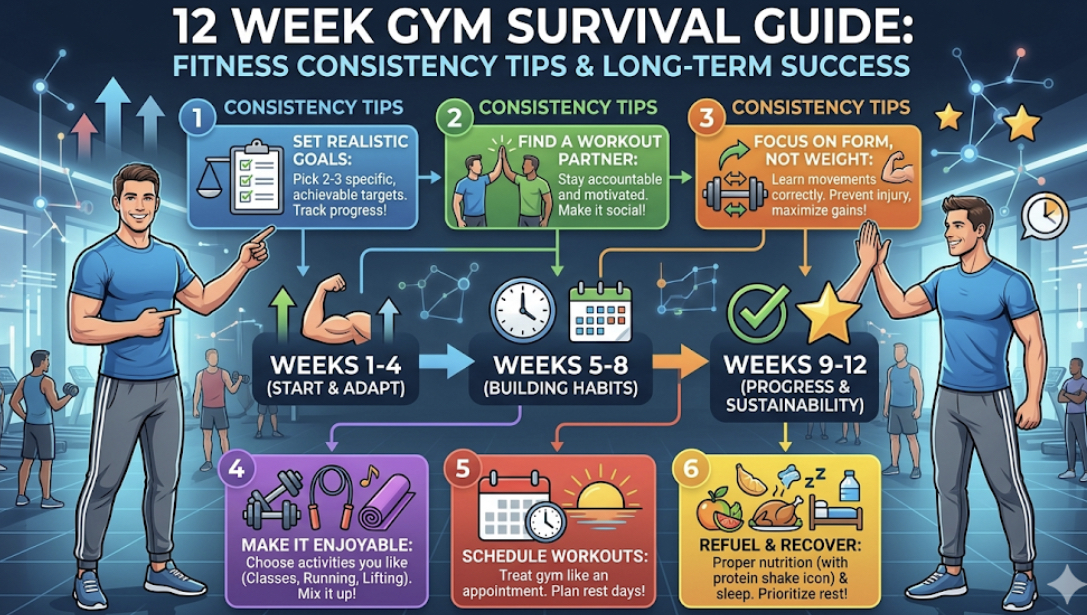
How can I avoid quitting the gym? Set realistic goals (expect 1-2 lbs fat loss weekly or 8-12 weeks for visible muscle growth), follow a simple structured plan, track progress (strength, measurements, photos), focus on long-term habits not short-term intensity, start with 3 days weekly, and use the 2-day rule (never skip two workouts in a row).
Strategy #1: Set Realistic Timeline Expectations
Understand realistic progress: visible muscle definition takes 8-12 weeks of consistent training. Fat loss of 1-2 lbs weekly is excellent. Strength increases of 5-10% monthly are great progress. Write these expectations down and revisit them when discouraged.
Strategy #2: Follow a Simple, Written Plan
Use a structured routine (e.g., 3-day full-body or 4-day upper/lower split). Write down exercises, sets, reps, and weights before entering the gym. This eliminates decision fatigue and ensures productive workouts.
Strategy #3: Start with 3 Days Weekly
Research shows that beginners who start with 3 training days weekly have 80% adherence at 6 months versus 40% for those starting with 5+ days. Build the habit first, then add volume.
Strategy #4: Track Non-Scale Victories
Record: strength on key lifts (squat, bench, deadlift), waist measurement, energy levels (1-10 scale), sleep quality, how clothes fit, and progress photos every 2 weeks. These change faster than scale weight.
Strategy #5: Use the 2-Day Rule
Never skip two workouts in a row. One missed day is acceptable – life happens. Two missed days breaks the habit loop. Forgive yourself and return immediately.
Strategy #6: Find a Workout You Enjoy
You won't stay consistent in gym doing exercises you hate. Experiment with different training styles: strength training, group classes, swimming, climbing, martial arts, CrossFit, yoga. Enjoyment predicts long-term adherence better than any other factor (Teixeira et al., 2012).
Strategy #7: Create Accountability Systems
Workout partner (scheduled sessions), personal trainer (even 1-2 sessions monthly), online community, social media commitment, or paid commitment contract. Accountability increases follow-through by up to 95%.
Strategy #8: Prepare Everything the Night Before
Lay out gym clothes, pack bag, fill water bottle, set alarm, write workout plan. This reduces morning decision fatigue and eliminates "I can't find my shorts" excuses.
Strategy #9: Have a Backup Home Routine
For days when you absolutely cannot make it to the gym: 15-minute bodyweight circuit (squats, push-ups, lunges, planks). Maintaining the habit matters more than workout quality on tough days.
Strategy #10: Focus on Habits, Not Motivation
Motivation is unreliable; habits are automatic. After 8-12 weeks of consistent training, exercise becomes a habit that feels wrong to skip. Build the habit first (same time, same trigger, minimal duration), then optimize intensity.
4. Sample Beginner Gym Routine for Long-Term Consistency
3-Day Full Body Routine (60 minutes per session)
- Monday: Squats 3x8, Bench Press 3x8, Rows 3x10, Planks 3x30 sec, 15 min cardio
- Wednesday: Deadlifts 3x5, Overhead Press 3x8, Lat Pulldowns 3x10, Leg Raises 3x15, 15 min cardio
- Friday: Lunges 3x10 per leg, Incline Press 3x10, Face Pulls 3x15, Russian Twists 3x15, 15 min cardio
- Tuesday/Thursday/Saturday: Rest or 20-30 min walking
Progression for First 12 Weeks
- Weeks 1-4: Focus on form, lighter weights, complete all reps. Goal: show up consistently.
- Weeks 5-8: Increase weight slightly (5-10 lbs), focus on progressive overload. Goal: add weight or reps weekly.
- Weeks 9-12: Increase intensity, consider adding 4th day or increasing cardio. Goal: visible results start appearing.
5. Nutrition to Support Gym Consistency
Pre-Gym Nutrition (1-2 hours before)
- Goal: Stable energy, prevent hunger during workout
- Sample meal: 1 banana + 1 tbsp peanut butter (200 kcal) or 1 cup oatmeal + 1 scoop protein (350 kcal)
Post-Gym Recovery Nutrition (within 60 minutes)
- Goal: Muscle repair, glycogen replenishment
- Sample meal: 2 scoops whey + 1 cup berries + water (250 kcal, 45g protein)
Full Day Meal Plan for Training Days (2,200 kcal, 160g Protein)
- Breakfast (7:00 AM): 4 eggs + 1.5 cups oatmeal + 1/2 cup berries (600 kcal, 40g protein)
- Lunch (12:00 PM): 170g chicken breast + 1.5 cups brown rice + 2 cups broccoli (550 kcal, 50g protein)
- Pre-gym snack (3:00 PM): 1 banana + 1 tbsp peanut butter (200 kcal, 5g protein)
- Post-gym (5:30 PM): 1 scoop whey + 1 apple (200 kcal, 25g protein)
- Dinner (7:00 PM): 170g salmon + 300g sweet potato + 2 cups asparagus (650 kcal, 40g protein)
Vegan Gym Consistency Meal Plan
- Pre-gym: 1 banana + 1 tbsp almond butter (200 kcal)
- Post-gym: 2 scoops pea protein + 1 cup soy milk (300 kcal, 45g protein)
- Main meals: Tofu, tempeh, lentils, quinoa, beans, nuts, seeds
Gluten-Free Gym Nutrition
- Certified gluten-free oats, rice, quinoa, buckwheat, sweet potatoes
- Verify protein powder and supplements are gluten-free certified
6. How to Overcome Specific Gym Motivation Problems
"I'm Too Tired After Work"
Solution: Switch to morning workouts (6-9 AM). Research shows morning exercisers are 80% more consistent than evening exercisers. Prepare everything night before. Start with just 20 minutes.
"The Gym Is Too Intimidating"
Solution: Go during off-peak hours (10 AM-3 PM or after 8 PM). Take a free gym orientation session. Start with machines (harder to do incorrectly) before free weights. Remember: most people are focused on themselves, not judging you.
"I Don't See Any Results"
Solution: Track strength increases (weight on the bar), energy levels, sleep quality, and how clothes fit. Physical changes take 8-12 weeks. Take progress photos every 2 weeks – changes are visible in photos before the mirror.
"I Missed a Week – Now I've Ruined Everything"
Solution: Apply the 2-day rule immediately. One week off doesn't erase progress. You'll regain strength faster than you think (muscle memory). Forgive yourself and return today. Guilt doesn't build habits; action does.
7. The 12-Week Gym Survival Protocol
Follow this protocol to survive the critical first 12 weeks when most quitting happens:
- Week 1-2 (Survival mode): Go 3 days only. Do any workout – quality doesn't matter. Goal: build the habit of showing up. Reward every workout.
- Week 3-4 (Expectation reset): Ignore scale weight. Track strength and measurements. Remind yourself: results take 8-12 weeks.
- Week 5-6 (Accountability boost): Highest dropout period. Schedule workouts with a partner or trainer. Post progress online.
- Week 7-8 (Routine variety): Change exercises if bored. Add one new movement you enjoy. Keep same schedule.
- Week 9-10 (First visible results): Strength has increased significantly. Clothes fit differently. Photos show changes. Motivation returns naturally.
- Week 11-12 (Habit automatic): Exercise feels weird to skip. You've built the foundation for years of consistency.
8. Frequently Asked Questions
Why do most people quit the gym?
Most people quit the gym due to: unrealistic expectations (expecting too fast results), lack of visible progress quickly, no clear structured plan, overtraining or burnout, and lack of consistency. Research shows 50% of new gym members quit within the first 6 months, with peak dropout occurring at weeks 3-6.
How can I avoid quitting the gym?
Set realistic goals (expect 1-2 lbs fat loss weekly or 8-12 weeks for visible muscle growth), follow a simple structured plan, track progress (strength, measurements, photos), focus on long-term habits not short-term intensity, start with 3 days weekly, and use the 2-day rule (never skip two workouts in a row).
What percentage of people quit the gym?
According to IHRSA (International Health Racquet & Sportsclub Association), approximately 50% of new gym members quit within the first 6 months, and 67% of all gym members never use their membership regularly. January has the highest sign-ups but also the highest dropout rate by March.
How do I stay consistent in the gym long-term?
To stay consistent in the gym: train at the same time daily (habit formation), prepare everything the night before, start with 10-minute minimums (always do at least 10 minutes), track your streak visually, find workouts you enjoy, use the 2-day rule, and have a backup home routine for low-motivation days.
Why do beginners quit the gym so quickly?
Beginners quit the gym because they: follow random routines from social media (too advanced), overtrain (training 6 days weekly when starting), expect visible results in 2 weeks (muscle takes 8-12 weeks), feel intimidated by other gym-goers, and have no clear progression system. Starting with 3 days weekly and a simple full-body routine dramatically increases adherence.
How many days per week should a beginner train?
Beginners should start with 3 days per week of strength training. Research shows that beginners who start with 3 training days weekly have 80% adherence at 6 months versus 40% for those starting with 5+ days. Build the habit first, then add volume after 8-12 weeks.
9. Related Resources
- Best Evening Habits for Fat Loss (Simple Night Routine That Works)
- How to Burn More Calories Without Cardio (Simple Fat Loss Strategies)
- Why You Lose Weight Then Gain It Back Quickly (Yo-Yo Dieting Explained)
- How to Avoid Binge Eating During Fat Loss (Control Cravings & Stay on Track)
- Does Drinking Water Help You Lose Fat Faster? (Science-Based Answer)
- How to Reduce Cravings While Dieting (Control Hunger & Stay Consistent)
10. Scientific References
- IHRSA. (2021). Health club membership retention report. International Health Racquet & Sportsclub Association. IHRSA
- Holland, M. J., et al. (2019). Expectation management and exercise adherence. Journal of Health Psychology, 24(8), 1056-1067. PubMed
- Bennie, J. A., et al. (2021). The importance of structured exercise planning for adherence. International Journal of Behavioral Nutrition and Physical Activity, 18(1), 45. PubMed
- Teixeira, P. J., et al. (2012). Motivation, self-determination, and long-term weight control. International Journal of Behavioral Nutrition and Physical Activity, 9(1), 22. PubMed
- Lally, P., et al. (2010). How habits are formed: Modelling habit formation in the real world. European Journal of Social Psychology, 40(6), 998-1009. PubMed
- Gardner, B., et al. (2018). Habit formation and behavior change. Health Psychology Review, 12(3), 219-237. PubMed
- Schumacher, L. M., et al. (2020). The importance of consistency in exercise timing. Obesity, 28(5), 891-898. PubMed
Join the conversation