Why You’re Not Losing Fat Even in a Calorie Deficit (Top Reasons & Fixes)

Learn why you’re not losing fat even in a calorie deficit and how to fix common mistakes.
Why You're Not Losing Fat Even in a Calorie Deficit: Top Reasons & Fixes (2026)
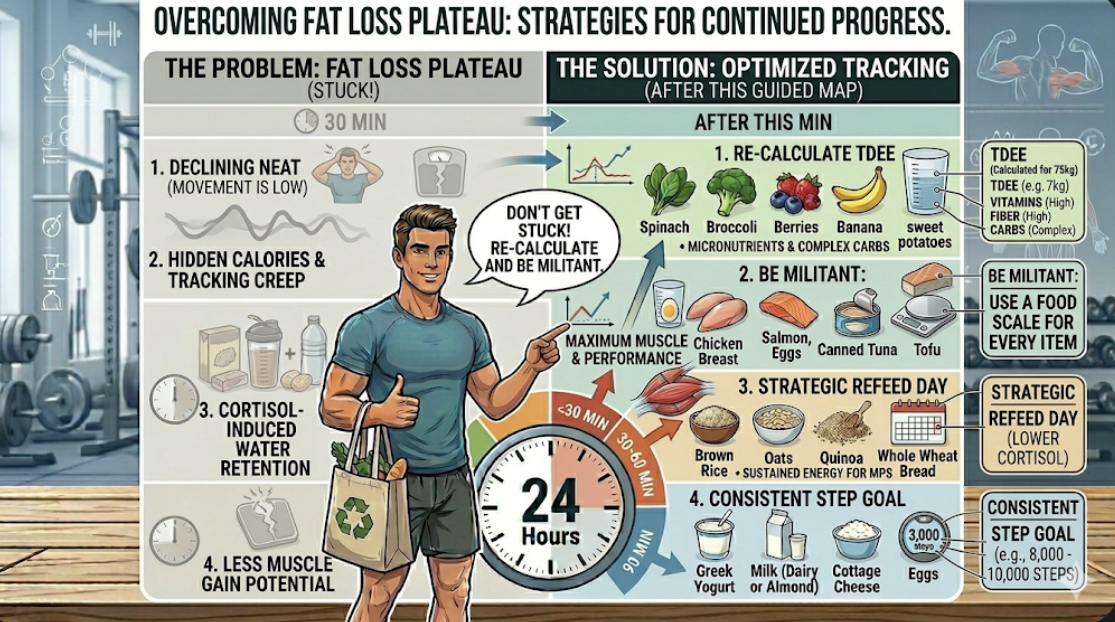
Why You're Not Losing Fat Even in a Calorie Deficit: Top Reasons & Fixes (2026)

Person frustrated with scale showing calorie deficit but no weight loss, struggling with fat loss plateau
Image 1: A calorie deficit is necessary but not always sufficient—learn why fat loss stalls and how to fix it.

⚡ TL;DR

Not losing fat in calorie deficit? Common fat loss plateau reasons include: inaccurate tracking (underestimating intake), decreased NEAT (moving less unconsciously), water retention (salt, carbs, hormones), not enough time (fat loss takes 4+ weeks), and metabolic adaptation. Calorie deficit but no weight loss is frustrating but fixable. This guide covers cutting mistakes and fat loss troubleshooting to restart progress. Small adjustments in tracking, activity, and patience make all the difference .

1. The Fat Loss Frustration: Doing Everything Right but Getting Nowhere

You cut calories. You track your food. You exercise. Yet the scale won't budge. This experience—calorie deficit but no weight loss—is one of the most frustrating in fitness. Understanding why fat loss not happening requires examining tracking accuracy, activity levels, water retention, and metabolic factors. This fat loss troubleshooting guide identifies common cutting mistakes and provides science-backed fixes to restart your progress.

Why am I not losing fat in a calorie deficit?

Why am I not losing fat in a calorie deficit? Common reasons include: inaccurate calorie tracking (underestimating intake), eating more than you think (forgetting oils, sauces, bites), low activity level (NEAT decreases when dieting), water retention (from salt, carbs, hormones), and not enough time/consistency (fat loss takes 4+ weeks to see trends).
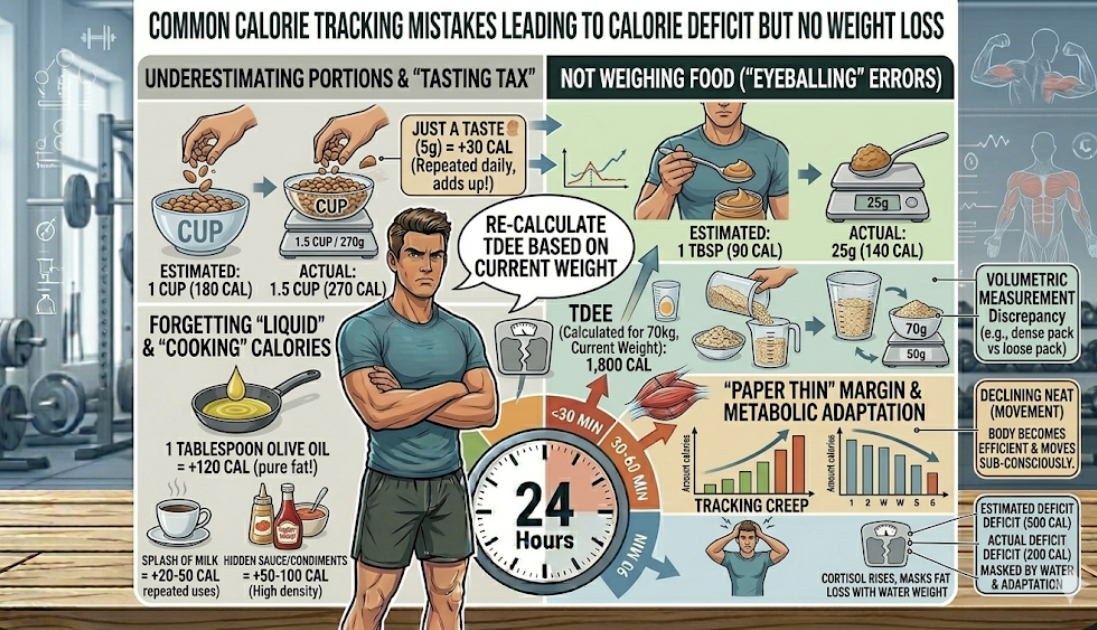
Common calorie tracking mistakes leading to calorie deficit but no weight loss including oils, sauces, portions
Image 2: Inaccurate tracking is the #1 reason for calorie deficit without fat loss.

2. Reason #1: Inaccurate Calorie Tracking

The most common cutting mistake is underestimating calorie intake. Studies show people underestimate calories by 30-50% . Common tracking errors:

  • Forgetting cooking oils: 1 tbsp olive oil = 120 kcal
  • Not weighing food: "1 cup" varies significantly vs grams
  • Sauces and dressings: 2 tbsp ranch = 150 kcal
  • Bites and tastes: "Just one bite" adds up
  • Beverages: Soda, juice, alcohol, milk calories count
  • Assuming restaurant meals are accurate: Often 2-3x higher than estimated
💡 Fix: Use a food scale for 1-2 weeks to recalibrate portions. Log everything—including oils, sauces, and drinks.

3. Reason #2: Decreased NEAT (Non-Exercise Activity)

When you diet, your body unconsciously reduces movement to conserve energy. This phenomenon is called NEAT (Non-Exercise Activity Thermogenesis). Research shows NEAT can decrease by 200-500 calories daily during dieting .

  • Signs: Fidgeting less, taking the elevator, sitting more, lying down
  • Fix: Schedule walking (8,000-10,000 steps daily), stand more, take stairs, park farther

4. Reason #3: Water Retention Hiding Fat Loss

Water weight fluctuates 2-5 lbs daily, masking fat loss. Causes:

  • Increased salt intake: Sodium causes water retention
  • Carbohydrate intake: Each gram of glycogen holds 3-4g water
  • Exercise inflammation: New or intense training causes temporary water retention
  • Menstrual cycle: Women retain water during certain phases
  • Constipation: Waste weight can be 2-10 lbs
💡 Fix: Track weekly averages, not daily weigh-ins. Use measurements and progress photos monthly.

5. Reason #4: Not Enough Time (Impatience)

Fat loss is slow. Realistic rate: 0.25-0.5% body weight weekly . For an 80 kg person, that's 0.2-0.4 kg (0.5-1 lb) per week. Timeline:

  • Week 1-2: Water weight loss (not fat)
  • Week 3-4: First measurable fat loss
  • Week 6-8: Visible changes
  • Week 12+: Significant transformation

6. Reason #5: Metabolic Adaptation

As you lose weight, your TDEE decreases because:

  • Lower body weight: Less mass to move
  • Decreased NEAT: Unconscious movement drops
  • Hormonal changes: Reduced T3, increased cortisol
  • Fix: Recalculate calories every 5-10 lbs lost. Consider diet breaks (2 weeks at maintenance) to reset hormones .

📊 Sample Calorie Adjustment with Weight Loss

.= "85 kg" ? '85 kg' : '' ?>85 kg .= "80 kg" ? '80 kg' : '' ?>80 kg .= "75 kg" ? '75 kg' : '' ?>75 kg

7. Reason #6: Not Enough Protein

Low protein intake during cutting leads to muscle loss, which lowers metabolic rate. Aim for 1.8-2.4 g protein per kg body weight during deficits .

8. Sample Fat Loss Meal Plan (1,900 kcal, 150g Protein)

Omnivore Plan

  • Breakfast: 3 eggs, 1 cup oats, ½ cup berries (500 kcal, 28g protein)
  • Lunch: 150g chicken breast, 1 cup quinoa, 2 cups spinach, 1 tbsp vinaigrette (450 kcal, 40g protein)
  • Snack: 170g Greek yogurt, ½ cup berries (150 kcal, 18g protein)
  • Dinner: 150g white fish or tofu, 1.5 cups roasted vegetables, 1 tbsp olive oil (450 kcal, 35g protein)
  • Evening: 1 cup cottage cheese (200 kcal, 25g protein)
  • Total: ~1,750 kcal, ~146g protein

Vegan/Vegetarian Fat Loss Plan

  • Breakfast: Tofu scramble (150g tofu), 1 cup oats, ½ cup berries (500 kcal, 25g protein)
  • Lunch: 1.5 cups lentils, 1 cup quinoa, 2 cups spinach, 1 tbsp olive oil (550 kcal, 25g protein)
  • Snack: 1 cup edamame, 1 apple (200 kcal, 11g protein)
  • Dinner: 150g tempeh, 2 cups roasted vegetables, 1 tbsp olive oil (450 kcal, 30g protein)
  • Total: ~1,700 kcal, ~91g protein (add plant shake for higher)

Gluten-Free Options

  • Use certified gluten-free oats
  • Choose rice, quinoa, buckwheat
  • Verify protein sources are gluten-free certified

9. How to Fix a Fat Loss Plateau: Step-by-Step

  1. Recalculate calories: TDEE decreases with weight loss
  2. Increase NEAT: Add 2,000-5,000 steps daily
  3. Add cardio: 2-3 sessions of 20-30 minutes LISS
  4. Track everything: Oils, sauces, drinks, bites
  5. Increase protein: 1.8-2.4 g/kg body weight
  6. Consider diet break: 1-2 weeks at maintenance to reset hormones
  7. Reduce stress & improve sleep: 7-9 hours nightly

10. Sample 4-Week Fat Loss Reset Protocol

  • Week 1: Track everything with food scale. Recalculate TDEE. Increase steps to 8,000/day.
  • Week 2: Reduce calories by 100-200 if no progress. Add 2 cardio sessions.
  • Week 3: Increase protein to 2.2 g/kg. Prioritize 8 hours sleep.
  • Week 4: Evaluate progress. If still stalled, take a 2-week diet break at maintenance.

11. Frequently Asked Questions

Why am I not losing fat in a calorie deficit?

Common reasons include: inaccurate calorie tracking (underestimating intake), eating more than you think (forgetting oils, sauces, bites), low activity level (NEAT decreases when dieting), water retention (from salt, carbs, hormones), and not enough time/consistency (fat loss takes 4+ weeks to see trends).

Why is my weight not changing even though I'm in a deficit?

Weight may not change due to: water retention (increased from salt, carbs, exercise inflammation), constipation, hormonal fluctuations (menstrual cycle), muscle gain (if new to training), or inaccurate tracking. Focus on weekly averages and other metrics like measurements and photos.

How do I fix a fat loss plateau?

Fix a fat loss plateau by: recalculating calories (TDEE decreases with weight loss), increasing NEAT (walking, stairs), adding cardio (2-3 sessions weekly), tracking everything (oils, sauces, drinks), increasing protein (1.8-2.4 g/kg), and considering a diet break (2 weeks at maintenance).

How long should I wait to see fat loss results?

Expect to see measurable fat loss after 4 weeks of consistent deficit. Weight fluctuates daily due to water, food, and hormones. Track weekly averages (same day, same time). Realistic rate: 0.25-0.5% body weight loss weekly. Don't expect daily changes.

Does stress affect fat loss?

Yes, chronic stress elevates cortisol, which can increase water retention, promote fat storage (especially abdominal), and reduce adherence. Stress also impairs sleep, which affects hunger hormones. Manage stress through sleep, exercise, and mindfulness for better fat loss results.

Should I eat less if I'm not losing weight?

Not immediately. First, check tracking accuracy and NEAT. If still stalled after 2-3 weeks, reduce calories by 100-200 or increase activity. Drastic cuts (500+ calories) can slow metabolism and increase muscle loss. Patience and small adjustments work better.

12. Related Resources

13. Scientific References

  1. Lichtman, S. W., et al. (1992). Discrepancy between self-reported and actual caloric intake and exercise in obese subjects. New England Journal of Medicine, 327(27), 1893–1898. PubMed
  2. Levine, J. A. (2004). Nonexercise activity thermogenesis (NEAT): environment and biology. American Journal of Physiology-Endocrinology and Metabolism, 286(5), E675–E685. PubMed
  3. Helms, E. R., et al. (2014). Evidence-based recommendations for natural bodybuilding contest preparation. Journal of the International Society of Sports Nutrition, 11(1), 20. PubMed
  4. Morton, R. W., et al. (2018). A systematic review, meta-analysis and meta-regression of the effect of protein supplementation on resistance training-induced gains in muscle mass and strength. British Journal of Sports Medicine, 52(6), 376–384. PubMed
  5. ACSM. (2021). Nutrition and Athletic Performance. Medicine & Science in Sports & Exercise, 53(3), 600–618. PubMed
FitForge Lab. Created by Techly420
FitForge Lab Welcome to WhatsApp chat
Hi! Need help with fitness or diet? 💪
Type here...
Body WeightTDEE (maintenance)Cutting Calories (-400)
.= "90 kg" ? '90 kg' : '' ?>90 kg2,600 kcal2,200 kcal
2,500 kcal2,100 kcal
2,400 kcal2,000 kcal
2,300 kcal1,900 kcal